Chile Modular Kitchen Market Size, Share & Growth Rate
The Chile Modular Kitchen Market was estimated at USD 990 Million in 2025 and is projected to reach USD 1439 Million by 2032, growing at a CAGR of 5.5% from 2026 to 2032. This robust growth trajectory can be attributed to an accelerating urbanization trend and a shift towards modern living spaces, which increasingly favor customizable kitchen solutions. The rising disposable incomes among Chilean consumers further enhance the demand for aesthetically appealing and functional kitchen designs.
Chile Modular Kitchen Market Year-wise Growth Rate and Key Drivers
This graph highlights how the Chile Modular Kitchen Market has steadily grown over the years, supported by major growth factors.
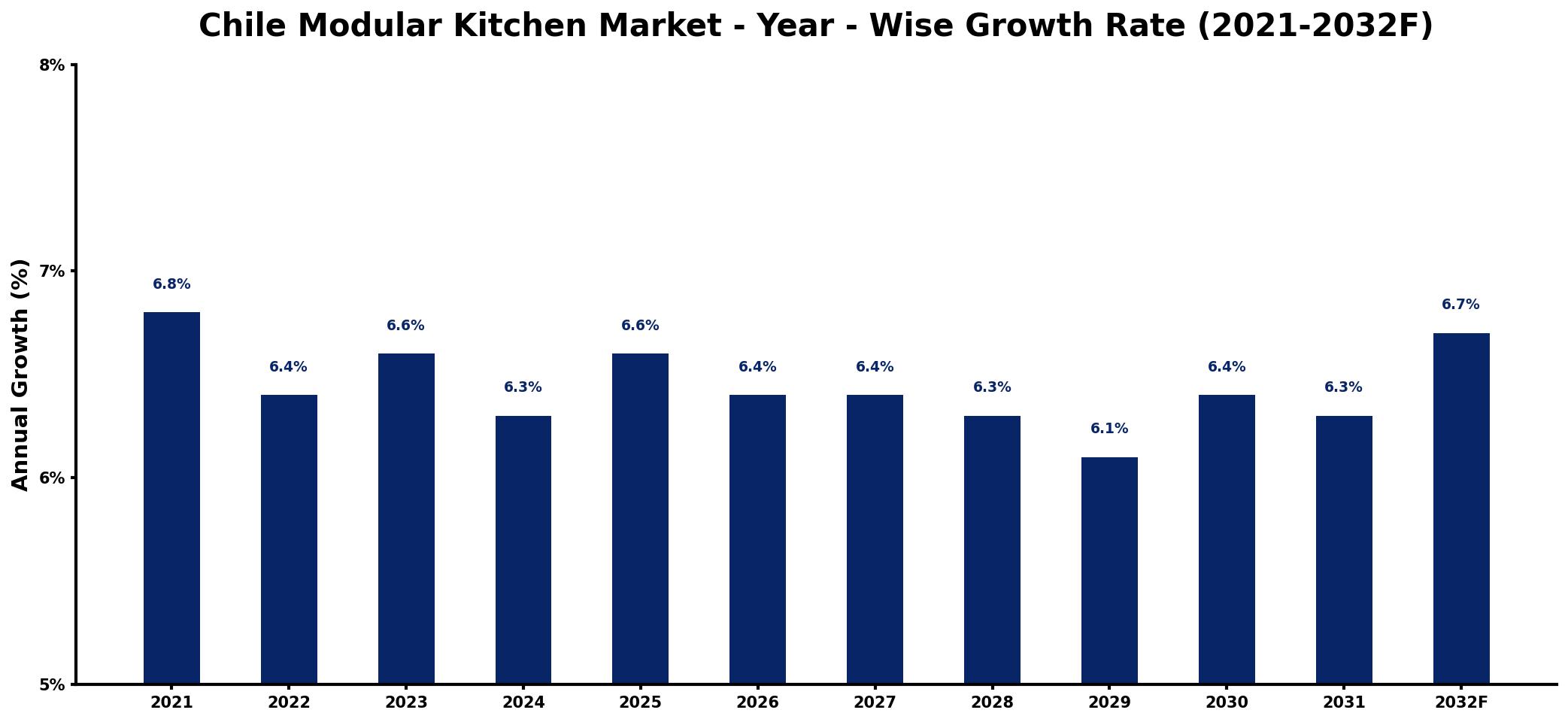
The table below presents the year‑wise growth rates along with the key drivers influencing the market
| Year | Growth Rate | Major Drivers |
| 2021 | 6.8% | Rising consumer disposable income levels |
| 2022 | 6.4% | Increased demand for home renovations |
| 2023 | 6.6% | Growth in real estate investments |
| 2024 | 6.3% | Surge in urban population density |
| 2025 | 6.6% | Expansion of e-commerce platforms |
| 2026 | 6.4% | Emerging trends in sustainable living |
| 2027 | 6.4% | Innovations in interior design solutions |
| 2028 | 6.3% | Growing interest in smart homes |
| 2029 | 6.1% | Increase in foreign investments influx |
| 2030 | 6.4% | Development of eco-friendly materials |
| 2031 | 6.3% | Shifts towards modern lifestyle preferences |
| 2032 | 6.7% | Rise in home automation technologies |
Note: Market size estimations and growth projections presented in this report are based on 6Wresearch's proprietary forecasting methodology, utilizing the latest available industry data, government publications, and primary research inputs.
Chile Modular Kitchen Market Synopsis
The strongest force currently shaping the Chile Modular Kitchen Market is the ongoing trend of urbanization. As more people move into cities, there is a growing need for space-efficient kitchen solutions that cater to limited living areas while maximizing functionality and style.
In addition to urbanization, evolving consumer lifestyles significantly influence market dynamics. With a heightened emphasis on convenience and personalized design, modern modular kitchens are increasingly appealing to both residential and commercial property owners across Chile.
Chile Modular Kitchen Market Key Takeaways
- The market is experiencing significant growth driven by urbanization and rising disposable incomes.
- Customization and space efficiency remain the primary consumer preferences influencing design and purchase decisions.
- Government policies and standards are shaping the adoption of energy-efficient and sustainable kitchen solutions.
- Consumer awareness regarding modular kitchen benefits is gradually increasing, although still a challenge.
- Local manufacturers are responding to competitive pressures by enhancing product offerings and focusing on affordability.
Evaluation of Restraints in Chile Modular Kitchen Market
Despite the promising growth potential, several restraints continue to hold back the Chile Modular Kitchen Market. Limited consumer awareness about the advantages of modular kitchens, coupled with a prevailing preference for traditional designs, can impede the acceptance of modern solutions. Cultural norms surrounding home remodeling also play a significant role in limiting consumer engagement. Additionally, supply chain disruptions and import restrictions for essential kitchen components create bottlenecks, further challenging the market's expansion. Economic factors, including fluctuations in consumer spending, present additional complexities for stakeholders in this space.
Chile Modular Kitchen Market Trends
Current trends in the Chile Modular Kitchen Market highlight a growing inclination towards eco-friendly materials and energy-efficient appliances, as sustainability becomes a core consumer focus. Additionally, technological advancements are shaping kitchen functionalities, with smart appliances gaining traction. The influence of digital platforms and social media is also noteworthy, as they foster increased awareness and drive consumer interest in modular kitchen designs. Moreover, aesthetic considerations are evolving, with a preference for modern, minimalist designs that reflect individual styles.
Chile Modular Kitchen Market Opportunities
The Chile Modular Kitchen Market is rife with opportunities, particularly in urban centers where space is at a premium. As lifestyle shifts continue to favor flexible and practical living solutions, manufacturers can tap into a growing demand for innovative kitchen designs that address space constraints while enhancing functionality. Furthermore, collaboration with real estate developers for modular kitchen installations in new housing projects presents a significant growth avenue. Investment in consumer education initiatives could also stimulate interest and broaden the customer base for modular kitchen solutions.
Government Initiatives in the Chile Modular Kitchen Market
Government policies in Chile are increasingly supportive of sustainable housing construction, which directly impacts the modular kitchen market. Building codes that promote energy efficiency and safety standards for kitchen installations are shaping industry practices. Additionally, incentives for housing development encourage the integration of modern kitchen solutions, thus fostering growth in this segment. These regulations not only ensure consumer safety but also stimulate demand for modular kitchens that comply with contemporary standards.
Future Insights of the Chile Modular Kitchen Market
Looking ahead to 2026-2032, the Chile Modular Kitchen Market is poised for sustained growth, driven by a combination of urban expansion and evolving consumer preferences. As the trend toward modern living spaces continues to gain momentum, opportunities for product innovation and customization will emerge. Furthermore, the increasing integration of smart technology within kitchen solutions will likely play a pivotal role in shaping future offerings. The markets adaptability to changing consumer lifestyles and regulatory frameworks will be crucial for long-term success.
Chile Modular Kitchen Market Latest Developments (2025 - 2026)
Recent developments in the Chile Modular Kitchen Market indicate a growing emphasis on incorporating smart technology into kitchen designs. Manufacturers are exploring collaborations to enhance product offerings and meet the increasing demand for energy-efficient appliances. Concurrently, various stakeholders are adapting to consumer feedback by introducing more customizable options, which is expected to further drive market engagement. Initiatives promoting sustainable practices within the industry are also gaining traction as regulatory frameworks evolve.
Chile Modular Kitchen Market - Key Attractiveness of the Report
- 10 Years of Market Numbers
- Historical Data Starting from 2022 to 2025
- Base Year: 2025
- Forecast Data until 2032
- Key Performance Indicators Impacting the Market
- Major Upcoming Developments and Projects
Key Highlights of the Report:
- Chile Modular Kitchen Market Outlook
- Market Size of Chile Modular Kitchen Market, 2025
- Forecast of Chile Modular Kitchen Market, 2032
- Historical Data and Forecast of Chile Modular Kitchen Revenues & Volume for the Period 2022-2032F
- Chile Modular Kitchen Market Trend Evolution
- Chile Modular Kitchen Market Drivers and Challenges
- Chile Modular Kitchen Price Trends
- Chile Modular Kitchen Porter's Five Forces
- Chile Modular Kitchen Industry Life Cycle
- Historical Data and Forecast of Chile Modular Kitchen Market Revenues & Volume By Product for the Period 2022-2032F
- Historical Data and Forecast of Chile Modular Kitchen Market Revenues & Volume By Floor Cabinet & Wall Cabinets for the Period 2022-2032F
- Historical Data and Forecast of Chile Modular Kitchen Market Revenues & Volume By Tall Storage Cabinets for the Period 2022-2032F
- Historical Data and Forecast of Chile Modular Kitchen Market Revenues & Volume By Others for the Period 2022-2032F
- Historical Data and Forecast of Chile Modular Kitchen Market Revenues & Volume By End-User for the Period 2022-2032F
- Historical Data and Forecast of Chile Modular Kitchen Market Revenues & Volume By Residential for the Period 2022-2032F
- Historical Data and Forecast of Chile Modular Kitchen Market Revenues & Volume By Commercial for the Period 2022-2032F
- Historical Data and Forecast of Chile Modular Kitchen Market Revenues & Volume By Distribution Channel for the Period 2022-2032F
- Historical Data and Forecast of Chile Modular Kitchen Market Revenues & Volume By Offline (Contractors, Builders, and Others) for the Period 2022-2032F
- Historical Data and Forecast of Chile Modular Kitchen Market Revenues & Volume By Online for the Period 2022-2032F
- Chile Modular Kitchen Import Export Trade Statistics
- Market Opportunity Assessment By Product
- Market Opportunity Assessment By End-User
- Market Opportunity Assessment By Distribution Channel
- Chile Modular Kitchen Top Companies Market Share
- Chile Modular Kitchen Competitive Benchmarking By Technical and Operational Parameters
- Chile Modular Kitchen Company Profiles
- Chile Modular Kitchen Key Strategic Recommendations






































