China Acetaminophen Market Top 5 Importing Countries and Market Competition (HHI) Analysis
China acetaminophen import market in 2024 was dominated by shipments from Norway, India, Italy, Switzerland, and China itself. The Herfindahl-Hirschman Index (HHI) indicated a very high level of market concentration. Despite a negative Compound Annual Growth Rate (CAGR) from 2020 to 2024, there was a slight improvement in the growth rate from 2023 to 2024. This data suggests a competitive and stable market for acetaminophen imports in China, with key players maintaining their positions in the industry.
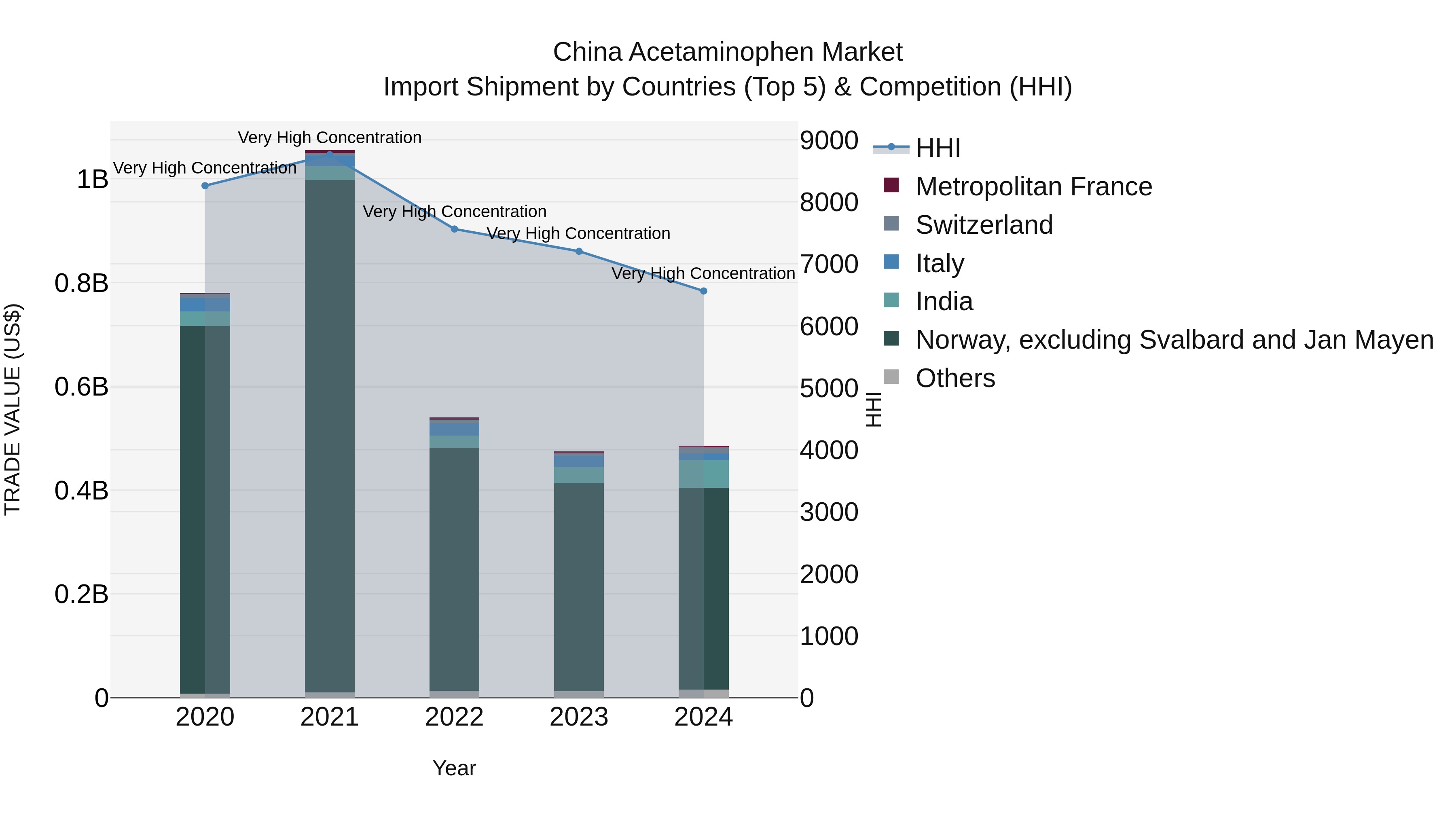
China Acetaminophen Market Overview
The acetaminophen market in China is experiencing steady growth due to factors such as increasing healthcare awareness, a growing elderly population, and rising incidences of chronic diseases. Acetaminophen, known for its pain-relieving and fever-reducing properties, is widely used in both prescription and over-the-counter medications in China. The market is highly competitive with several domestic and international pharmaceutical companies actively engaged in manufacturing and distributing acetaminophen products. The demand for acetaminophen is expected to continue to rise in China, driven by factors such as urbanization, changing lifestyles, and increasing disposable income. Regulatory reforms, quality control measures, and technological advancements in production processes are also shaping the acetaminophen market landscape in China.
China Acetaminophen Market Trends
The China acetaminophen market is witnessing several key trends. Firstly, there is a growing demand for acetaminophen due to its widespread use as a pain reliever and fever reducer. This demand is driven by factors such as an aging population, increasing healthcare awareness, and the rise in chronic diseases. Secondly, there is a shift towards the production of high-quality acetaminophen to meet stringent regulatory standards and ensure product safety. Additionally, there is a trend towards the development of innovative formulations and dosage forms of acetaminophen to cater to diverse consumer preferences. Lastly, there is a focus on sustainability and environmental responsibility in the manufacturing processes of acetaminophen, with companies increasingly adopting green practices and reducing their carbon footprint. Overall, these trends are shaping the China acetaminophen market towards growth and innovation.
China Acetaminophen Market Challenges
In the China acetaminophen market, challenges include intense competition among domestic and international manufacturers leading to price wars and margin pressures. Quality control and regulatory compliance are also key challenges, as ensuring the safety and efficacy of products is crucial in the pharmaceutical industry. Additionally, fluctuations in raw material prices, particularly for the key ingredient paracetamol, can impact production costs and profitability. Intellectual property rights and counterfeit products are significant concerns, affecting both brand reputation and revenue. Furthermore, changing consumer preferences and increasing demand for alternative pain relief options pose a threat to the traditional acetaminophen market. Overall, navigating these challenges requires companies to innovate, streamline operations, and adapt to evolving market dynamics to maintain competitiveness in the China acetaminophen sector.
China Acetaminophen Market Investment Opportunities
The China acetaminophen market presents promising investment opportunities due to the increasing demand for pain relief medications in the country. With a growing middle-class population and rising healthcare awareness, the market for acetaminophen is expected to expand further. Investors can consider opportunities in manufacturing and distribution of acetaminophen products, as well as exploring partnerships with local pharmaceutical companies to capitalize on the market potential. Additionally, investing in research and development for innovative formulations or combination products that cater to specific consumer needs could be a strategic move in this competitive market. Overall, the China acetaminophen market offers a favorable investment landscape for those looking to tap into the pharmaceutical sector`s growth in the region.
China Acetaminophen Market Government Policy
The Chinese government has implemented various policies to regulate the acetaminophen market. These include quality control measures to ensure the safety and efficacy of acetaminophen products, such as setting standards for manufacturing processes and product testing. Additionally, there are price control policies in place to prevent price gouging and ensure affordability for consumers. Environmental regulations also play a role in the acetaminophen market, with requirements for waste management and pollution control in manufacturing facilities. The government has also taken steps to promote innovation and development in the pharmaceutical industry, providing support for research and development initiatives. Overall, these policies aim to maintain a competitive and sustainable acetaminophen market in China.
China Acetaminophen Market Future Outlook
The future outlook for the China acetaminophen market appears to be positive, driven by increasing demand for the drug due to a growing aging population, rising prevalence of chronic diseases, and expanding healthcare infrastructure. Additionally, the government`s initiatives to improve access to healthcare services and the rising disposable income of the population are expected to further fuel the market growth. The market is also likely to benefit from the ongoing research and development activities aimed at introducing innovative formulations and dosage forms of acetaminophen. However, challenges such as the presence of counterfeit products, stringent regulatory requirements, and increasing competition from generic manufacturers may pose some obstacles to the market`s growth trajectory. Overall, the China acetaminophen market is projected to witness steady expansion in the coming years.
Key Highlights of the Report:
- China Acetaminophen Market Outlook
- Market Size of China Acetaminophen Market, 2024
- Forecast of China Acetaminophen Market, 2031
- Historical Data and Forecast of China Acetaminophen Revenues & Volume for the Period 2021-2031
- China Acetaminophen Market Trend Evolution
- China Acetaminophen Market Drivers and Challenges
- China Acetaminophen Price Trends
- China Acetaminophen Porter's Five Forces
- China Acetaminophen Industry Life Cycle
- Historical Data and Forecast of China Acetaminophen Market Revenues & Volume By Formulation for the Period 2021-2031
- Historical Data and Forecast of China Acetaminophen Market Revenues & Volume By Oral Tablets for the Period 2021-2031
- Historical Data and Forecast of China Acetaminophen Market Revenues & Volume By Liquid Suspensions for the Period 2021-2031
- Historical Data and Forecast of China Acetaminophen Market Revenues & Volume By Effervescent Tablets for the Period 2021-2031
- Historical Data and Forecast of China Acetaminophen Market Revenues & Volume By IV Formulations for the Period 2021-2031
- Historical Data and Forecast of China Acetaminophen Market Revenues & Volume By Application for the Period 2021-2031
- Historical Data and Forecast of China Acetaminophen Market Revenues & Volume By Pain & Fever Relief for the Period 2021-2031
- Historical Data and Forecast of China Acetaminophen Market Revenues & Volume By Pediatric Use for the Period 2021-2031
- Historical Data and Forecast of China Acetaminophen Market Revenues & Volume By Rapid Absorption for the Period 2021-2031
- Historical Data and Forecast of China Acetaminophen Market Revenues & Volume By Inpatient Care for the Period 2021-2031
- Historical Data and Forecast of China Acetaminophen Market Revenues & Volume By End User for the Period 2021-2031
- Historical Data and Forecast of China Acetaminophen Market Revenues & Volume By Pharmacies for the Period 2021-2031
- Historical Data and Forecast of China Acetaminophen Market Revenues & Volume By Hospitals/Clinics for the Period 2021-2031
- Historical Data and Forecast of China Acetaminophen Market Revenues & Volume By Retail for the Period 2021-2031
- Historical Data and Forecast of China Acetaminophen Market Revenues & Volume By Healthcare Providers for the Period 2021-2031
- China Acetaminophen Import Export Trade Statistics
- Market Opportunity Assessment By Formulation
- Market Opportunity Assessment By Application
- Market Opportunity Assessment By End User
- China Acetaminophen Top Companies Market Share
- China Acetaminophen Competitive Benchmarking By Technical and Operational Parameters
- China Acetaminophen Company Profiles
- China Acetaminophen Key Strategic Recommendations






































