China Aggregates Market Top 5 Importing Countries and Market Competition (HHI) Analysis
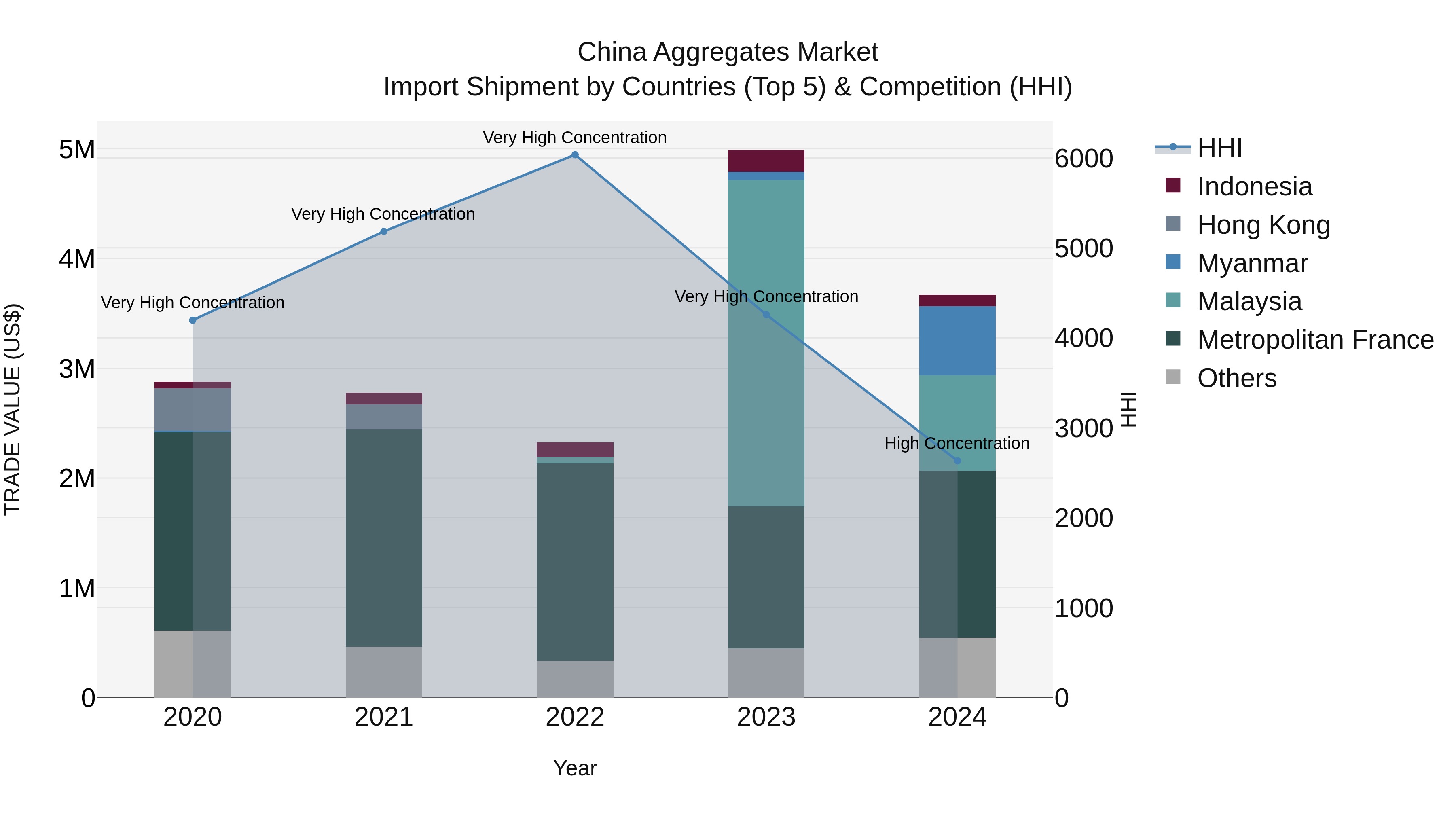
China aggregates import market in 2024 continued to see a high level of concentration, with Metropolitan France, Malaysia, Myanmar, South Africa, and Indonesia dominating the top exporting countries. Despite a decline in growth rate from 2023 to 2024, the compound annual growth rate (CAGR) over the period of 2020-2024 remained solid at 6.28%. This data suggests that while there may have been a slight slowdown in import growth in the most recent year, the overall trend for aggregates imports into China has been positive and stable over the past few years.
China Aggregates Market Overview
The China aggregates market is experiencing steady growth driven by increasing infrastructure development projects, urbanization, and construction activities in the country. With a focus on sustainable development and green construction practices, there is a growing demand for high-quality aggregates such as sand, gravel, and crushed stones. The market is highly fragmented with numerous small and large players competing based on price, quality, and distribution network. Government initiatives to promote infrastructure investments and construction projects further contribute to the market expansion. Key challenges include environmental concerns related to quarrying activities and transportation costs. Overall, the China aggregates market presents opportunities for market players to innovate and collaborate to meet the growing demand while addressing sustainability issues.
China Aggregates Market Trends
The China aggregates market is experiencing several key trends. One major trend is the increasing demand for high-quality aggregates in construction projects, driven by the country`s infrastructure development efforts. Sustainability and environmental concerns are also shaping the market, with a growing emphasis on the use of recycled aggregates and sustainable extraction practices. Digitalization and technology adoption are on the rise in the aggregates sector, leading to improved efficiency in production and logistics. Additionally, market consolidation and mergers are prevalent as companies seek to enhance their market presence and competitiveness. Overall, the China aggregates market is evolving towards a more sustainable, technology-driven, and efficient industry to meet the growing demands of the construction sector.
China Aggregates Market Challenges
In the China aggregates market, challenges include stringent environmental regulations leading to closures of quarries, increasing transportation costs due to long distances between sources and construction sites, fierce competition among a large number of domestic and international players, fluctuating prices of raw materials such as sand and gravel, and a lack of standardized quality control measures across the industry. Additionally, the market is impacted by government policies on infrastructure development and urbanization, which can create uncertainties in demand. Sustaining growth in the face of these challenges requires companies to invest in sustainable practices, innovation in production methods, efficient logistics solutions, and strategic partnerships to navigate the complex regulatory environment and remain competitive in the market.
China Aggregates Market Investment Opportunities
Investment opportunities in the China aggregates market are abundant due to the country`s ongoing infrastructure development projects. With the government`s focus on building new roads, bridges, and other construction projects, there is a high demand for aggregates such as sand, gravel, and crushed stone. Investors can consider opportunities in companies involved in aggregate production, transportation, and distribution. Additionally, there is potential for investment in technology and equipment that improve efficiency and sustainability in the aggregates industry. As the construction sector continues to grow in China, investing in the aggregates market can be a lucrative opportunity for those looking to capitalize on the country`s infrastructure development boom.
China Aggregates Market Government Policy
The Chinese government has implemented various policies to regulate the aggregates market, which includes sand, gravel, and crushed stone. Policies focus on environmental protection, resource conservation, and sustainable development. For instance, the "Ecological Protection Red Line" initiative aims to control the exploitation of natural resources, including aggregates, in ecologically sensitive areas. Additionally, the government has imposed restrictions on illegal mining activities and enforced stricter environmental standards for quarry operations to reduce pollution and land degradation. Furthermore, the promotion of green mining practices and the development of a circular economy in the aggregates sector are key focuses of government policies to ensure long-term sustainability and minimize the industry`s impact on the environment.
China Aggregates Market Future Outlook
The China aggregates market is expected to witness steady growth in the coming years, driven by the country`s ongoing infrastructure development projects, urbanization trends, and increasing demand for construction materials. The Chinese government`s focus on improving transportation networks, expanding industrial facilities, and enhancing urban living spaces will continue to drive demand for aggregates such as sand, gravel, and crushed stone. Additionally, the growing emphasis on sustainable construction practices and the adoption of advanced technologies in the mining and construction sectors are likely to further boost the market. However, challenges such as environmental regulations, resource constraints, and fluctuating raw material prices may impact the market dynamics. Overall, the China aggregates market is poised for expansion, fueled by robust construction activities and infrastructure investments.
Key Highlights of the Report:
- China Aggregates Market Outlook
- Market Size of China Aggregates Market, 2024
- Forecast of China Aggregates Market, 2031
- Historical Data and Forecast of China Aggregates Revenues & Volume for the Period 2021-2031
- China Aggregates Market Trend Evolution
- China Aggregates Market Drivers and Challenges
- China Aggregates Price Trends
- China Aggregates Porter's Five Forces
- China Aggregates Industry Life Cycle
- Historical Data and Forecast of China Aggregates Market Revenues & Volume By Product Type for the Period 2021-2031
- Historical Data and Forecast of China Aggregates Market Revenues & Volume By Crushed Stone for the Period 2021-2031
- Historical Data and Forecast of China Aggregates Market Revenues & Volume By Sand for the Period 2021-2031
- Historical Data and Forecast of China Aggregates Market Revenues & Volume By Gravel for the Period 2021-2031
- Historical Data and Forecast of China Aggregates Market Revenues & Volume By Recycled Aggregates for the Period 2021-2031
- Historical Data and Forecast of China Aggregates Market Revenues & Volume By Application for the Period 2021-2031
- Historical Data and Forecast of China Aggregates Market Revenues & Volume By Construction Materials for the Period 2021-2031
- Historical Data and Forecast of China Aggregates Market Revenues & Volume By Road Construction for the Period 2021-2031
- Historical Data and Forecast of China Aggregates Market Revenues & Volume By Concrete Production for the Period 2021-2031
- Historical Data and Forecast of China Aggregates Market Revenues & Volume By Landscaping for the Period 2021-2031
- Historical Data and Forecast of China Aggregates Market Revenues & Volume By End User for the Period 2021-2031
- Historical Data and Forecast of China Aggregates Market Revenues & Volume By Construction Industry for the Period 2021-2031
- Historical Data and Forecast of China Aggregates Market Revenues & Volume By Residential for the Period 2021-2031
- Historical Data and Forecast of China Aggregates Market Revenues & Volume By Commercial for the Period 2021-2031
- China Aggregates Import Export Trade Statistics
- Market Opportunity Assessment By Product Type
- Market Opportunity Assessment By Application
- Market Opportunity Assessment By End User
- China Aggregates Top Companies Market Share
- China Aggregates Competitive Benchmarking By Technical and Operational Parameters
- China Aggregates Company Profiles
- China Aggregates Key Strategic Recommendations






































