China Artificial Intelligence in Retail Market Size & Growth Rate (2026-2032)
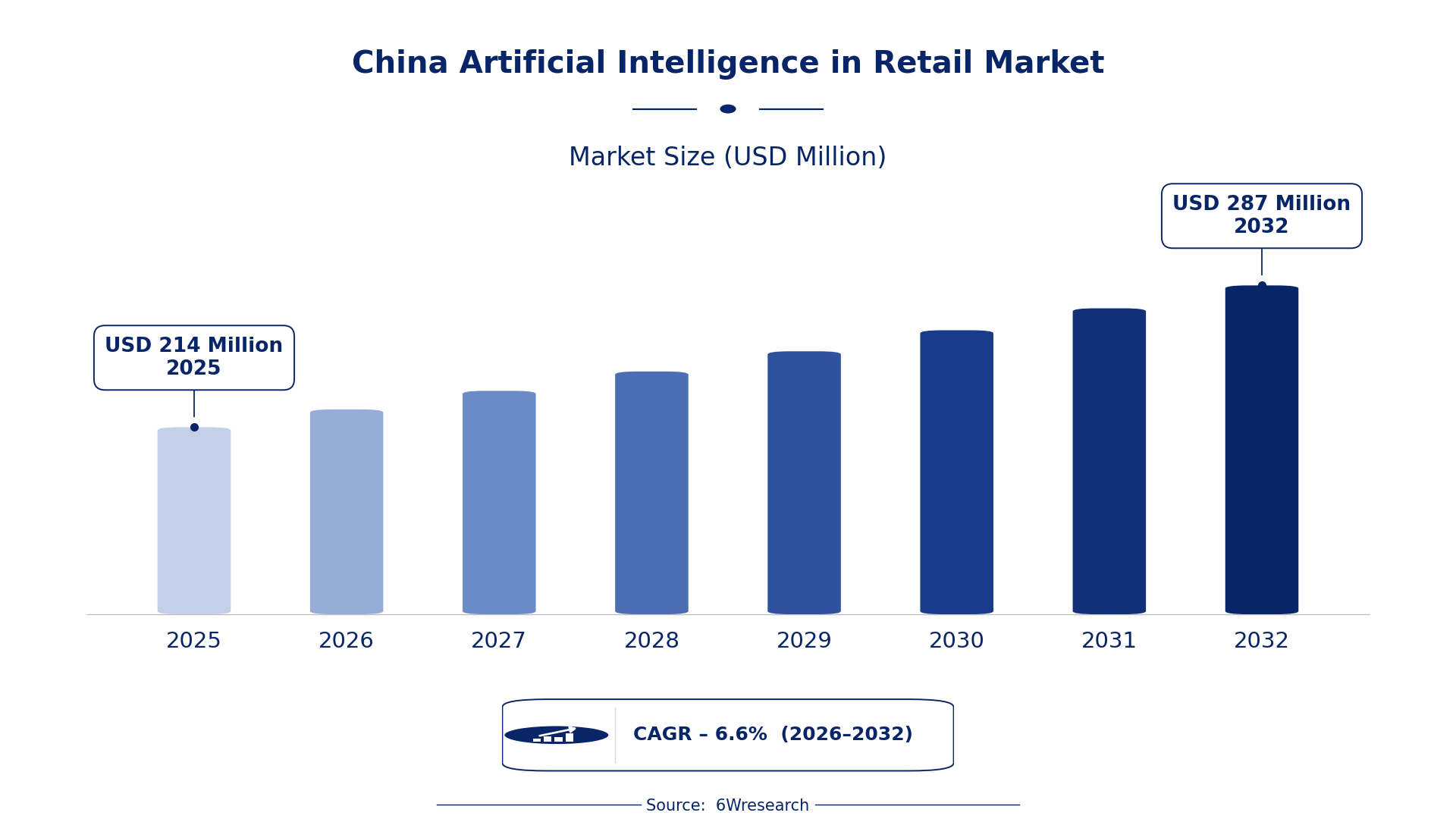
The China Artificial Intelligence in Retail Market was estimated at USD 214 Million in 2025 and is projected to reach USD 287 Million by 2032, growing at a CAGR of 6.6% from 2026 to 2032.
China Artificial Intelligence in Retail Market Synopsis
The integration of artificial intelligence into retail operations in China is no longer a futuristic concept; it's a pressing reality for many retailers. With consumer expectations evolving rapidly, businesses are leveraging AI to deliver tailored shopping experiences that resonate with their customers' preferences and behaviors.
Retailers are increasingly focused on optimizing their supply chains and inventory management through AI technologies. This shift not only enhances operational efficiency but also ensures that products are available when and where customers want them, thereby driving sales and customer satisfaction.
China Artificial Intelligence in Retail Market Year-wise Growth Rate and Key Drivers
This graph illustrates the annual growth rates of the China Artificial Intelligence in Retail Market from 2021 to 2032, highlighting a steady upward trajectory and projected expansion over the forecast period.
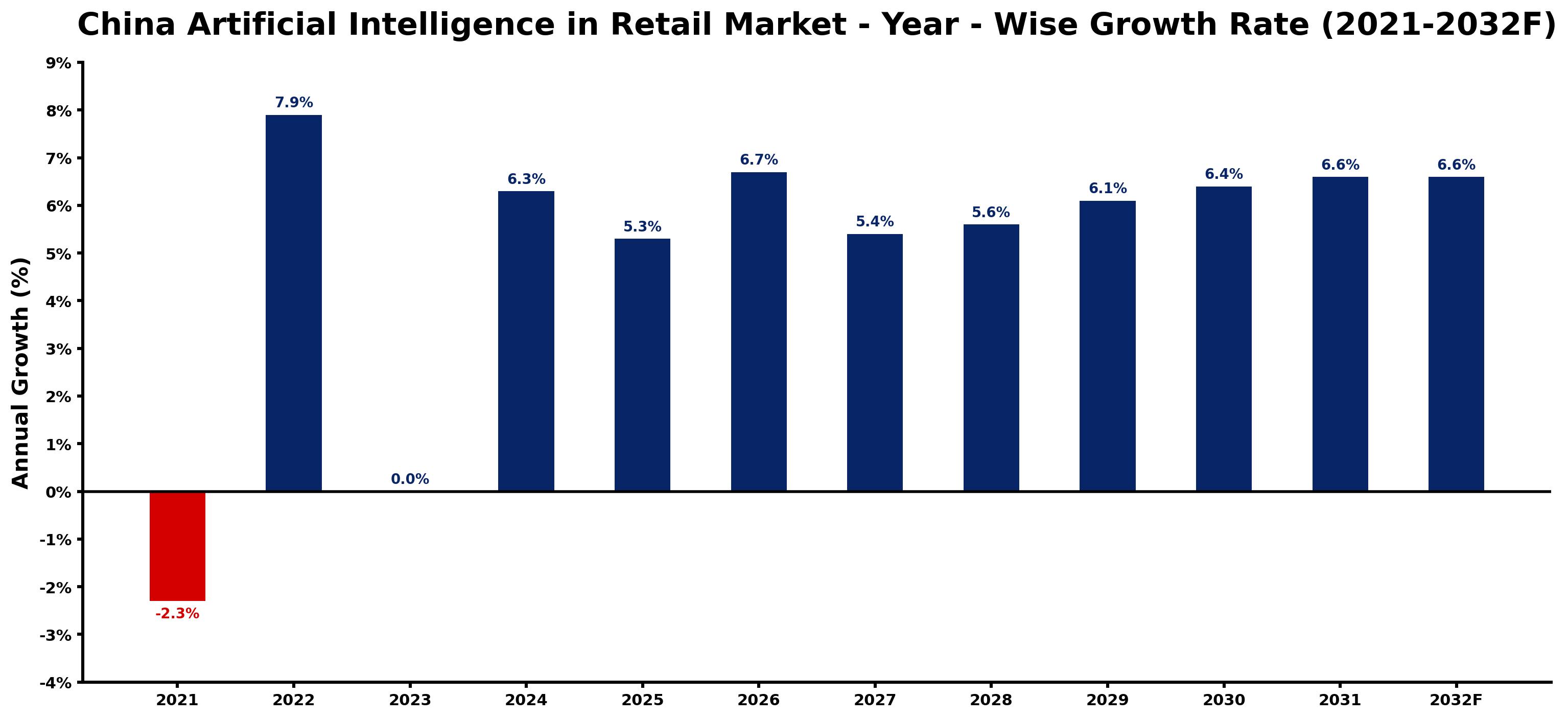
The table below presents the year‑wise growth rates along with the key drivers influencing the market
| Year | Growth Rate | Major Drivers |
| 2021 | -2.3% | Beijing's regulatory clampdown on AI technologies accelerated. |
| 2022 | 7.9% | Increased investment in AI by China's top retail brands. |
| 2023 | 0.0% | Increasing industrial infrastructure investments |
| 2024 | 6.3% | Government subsidies promoting AI integration in retail sector. |
| 2025 | 5.3% | Growing middle class driving demand for automated shopping. |
| 2026 | 6.7% | E-commerce growth spurring AI-driven logistics solutions. |
| 2027 | 5.4% | Smart retail initiatives supported by local government policies. |
| 2028 | 5.6% | Enhanced customer experience via AI-powered chatbots. |
| 2029 | 6.1% | Urbanization leading to higher tech adoption in retail. |
| 2030 | 6.4% | Regulatory framework encouraging data usage for AI technologies. |
| 2031 | 6.6% | Partnerships between tech firms and retailers boosting AI usage. |
| 2032 | 6.6% | Retailers utilizing AI for supply chain optimization strategies. |
Note: Market size estimations and growth projections presented in this report are based on 6Wresearch's proprietary forecasting methodology, utilizing the latest available industry data, government publications, and primary research inputs.
China Artificial Intelligence in Retail Market Key Takeaways
Below are some of the specific key takeaways from the market, including:
- The market is driven by the need for personalized shopping experiences and enhanced customer engagement.
- AI applications like customer service chatbots and predictive analytics are becoming essential tools for retailers.
- Data privacy concerns present ongoing challenges that retailers must navigate carefully.
- Collaboration between technology providers and retailers is expected to spur innovation in AI solutions.
- Government initiatives aimed at boosting AI development are creating a favorable environment for market growth.
Evaluation of Restraints in China Artificial Intelligence in Retail Market
The growth of the AI in retail market in China faces several notable hurdles. Data privacy remains a significant concern, as companies must balance customer insights with stringent data protection regulations. The talent shortage in AI expertise complicates matters further, as businesses struggle to find qualified professionals capable of driving AI initiatives. Additionally, integrating new AI solutions with legacy systems can be daunting, often requiring substantial investments in technology and training. These challenges could hinder the market's potential if not addressed effectively.
China Artificial Intelligence in Retail Market Trends
Several trends are shaping the future of AI in the retail sector. Retailers are increasingly adopting AI tools for personalized marketing, enabling them to target consumers more effectively based on their shopping behaviors. The rise of cashier-less stores is also a notable development, reflecting a shift toward streamlined, tech-driven shopping experiences. Additionally, the integration of AI with smart devices and IoT is facilitating innovative solutions that enhance both online and offline shopping journeys.
China Artificial Intelligence in Retail Market Opportunities
Investment prospects in the China Artificial Intelligence in Retail Market are substantial. Areas such as AI-driven customer service solutions, demand forecasting tools, and inventory management systems present lucrative opportunities for investors. The intersection of AI with emerging technologies like big data analytics and IoT is ripe for exploration, paving the way for innovative solutions that can transform retail operations.
Government Initiatives in the China Artificial Intelligence in Retail Market
Government support is instrumental in shaping the AI in retail landscape in China. Policies aimed at fostering AI innovation are encouraging investment and development within the sector. By prioritizing AI technologies, the government is creating a conducive environment for retailers to adopt these solutions, ultimately enhancing the consumer experience.
- A recently completed initiative focused on providing funding for AI startups, facilitating innovation in the retail sector.
- Currently underway is a national digital infrastructure upgrade program, enhancing connectivity and supporting AI deployment.
- A planned initiative expected to launch in 2026 aims to establish a regulatory framework for AI applications in retail, promoting data security.
- Ongoing research programs are exploring the integration of AI with traditional retail practices to enhance operational efficiency.
- Current collaborations between academic institutions and retail companies are designed to cultivate AI talent through targeted training programs.
Future Insights of the China Artificial Intelligence in Retail Market
Looking ahead to 2026-2032, the China Artificial Intelligence in Retail Market is set to experience robust growth. The increasing shift towards e-commerce and the demand for enhanced customer personalization will drive AI adoption. As retailers continue to invest in advanced technologies, the market will likely see transformative changes that redefine the shopping experience. With a focus on efficiency and customer engagement, AI will be a cornerstone of retail strategies in the coming years.
China Artificial Intelligence in Retail Market Latest Developments
Recent developments in the China Artificial Intelligence in Retail Market indicate a strong momentum towards technological adoption and innovation. Over the past year, various retailers have started implementing AI solutions to enhance customer service and streamline operations.
- A major technology vendor launched a new AI-powered inventory management system in early 2025, significantly improving supply chain efficiency.
- In Q3 2025, a leading regional operator began rolling out customer service chatbots across its platforms, enhancing customer interactions.
- A partnership established in late 2024 between a retail chain and an AI startup is currently underway, focusing on personalized marketing strategies.
- An initiative expected to begin in mid-2026 aims to introduce cashier-less store technology in urban locations, revolutionizing the shopping experience.
- Upcoming research collaborations between universities and retail firms are set to explore AI applications in consumer behavior analysis, scheduled for late 2025.
China Artificial Intelligence in Retail Market - Key Attractiveness of the Report
- 10 Years of Market Numbers
- Historical Data Starting from 2022 to 2025
- Base Year: 2025
- Forecast Data until 2032
- Key Performance Indicators Impacting the Market
- Major Upcoming Developments and Projects
Key Highlights of the Report:
- China Artificial Intelligence in Retail Market Outlook
- Market Size of China Artificial Intelligence in Retail Market, 2025
- Forecast of China Artificial Intelligence in Retail Market, 2032
- Historical Data and Forecast of China Artificial Intelligence in Retail Revenues & Volume for the Period 2022-2032F
- China Artificial Intelligence in Retail Market Trend Evolution
- China Artificial Intelligence in Retail Market Drivers and Challenges
- China Artificial Intelligence in Retail Price Trends
- China Artificial Intelligence in Retail Porter's Five Forces
- China Artificial Intelligence in Retail Industry Life Cycle
- Historical Data and Forecast of China Artificial Intelligence in Retail Market Revenues & Volume By Type for the Period 2022-2032F
- Historical Data and Forecast of China Artificial Intelligence in Retail Market Revenues & Volume By Online for the Period 2022-2032F
- Historical Data and Forecast of China Artificial Intelligence in Retail Market Revenues & Volume By Offline for the Period 2022-2032F
- Historical Data and Forecast of China Artificial Intelligence in Retail Market Revenues & Volume By Service for the Period 2022-2032F
- Historical Data and Forecast of China Artificial Intelligence in Retail Market Revenues & Volume By Professional for the Period 2022-2032F
- Historical Data and Forecast of China Artificial Intelligence in Retail Market Revenues & Volume By Managed for the Period 2022-2032F
- Historical Data and Forecast of China Artificial Intelligence in Retail Market Revenues & Volume By Technology for the Period 2022-2032F
- Historical Data and Forecast of China Artificial Intelligence in Retail Market Revenues & Volume By Machine Learning for the Period 2022-2032F
- Historical Data and Forecast of China Artificial Intelligence in Retail Market Revenues & Volume By Deep Learning for the Period 2022-2032F
- Historical Data and Forecast of China Artificial Intelligence in Retail Market Revenues & Volume By NLP for the Period 2022-2032F
- China Artificial Intelligence in Retail Import Export Trade Statistics
- Market Opportunity Assessment By Type
- Market Opportunity Assessment By Service
- Market Opportunity Assessment By Technology
- China Artificial Intelligence in Retail Top Companies Market Share
- China Artificial Intelligence in Retail Competitive Benchmarking By Technical and Operational Parameters
- China Artificial Intelligence in Retail Company Profiles
- China Artificial Intelligence in Retail Key Strategic Recommendations






































