China Automotive Tire Market Top 5 Importing Countries and Market Competition (HHI) Analysis
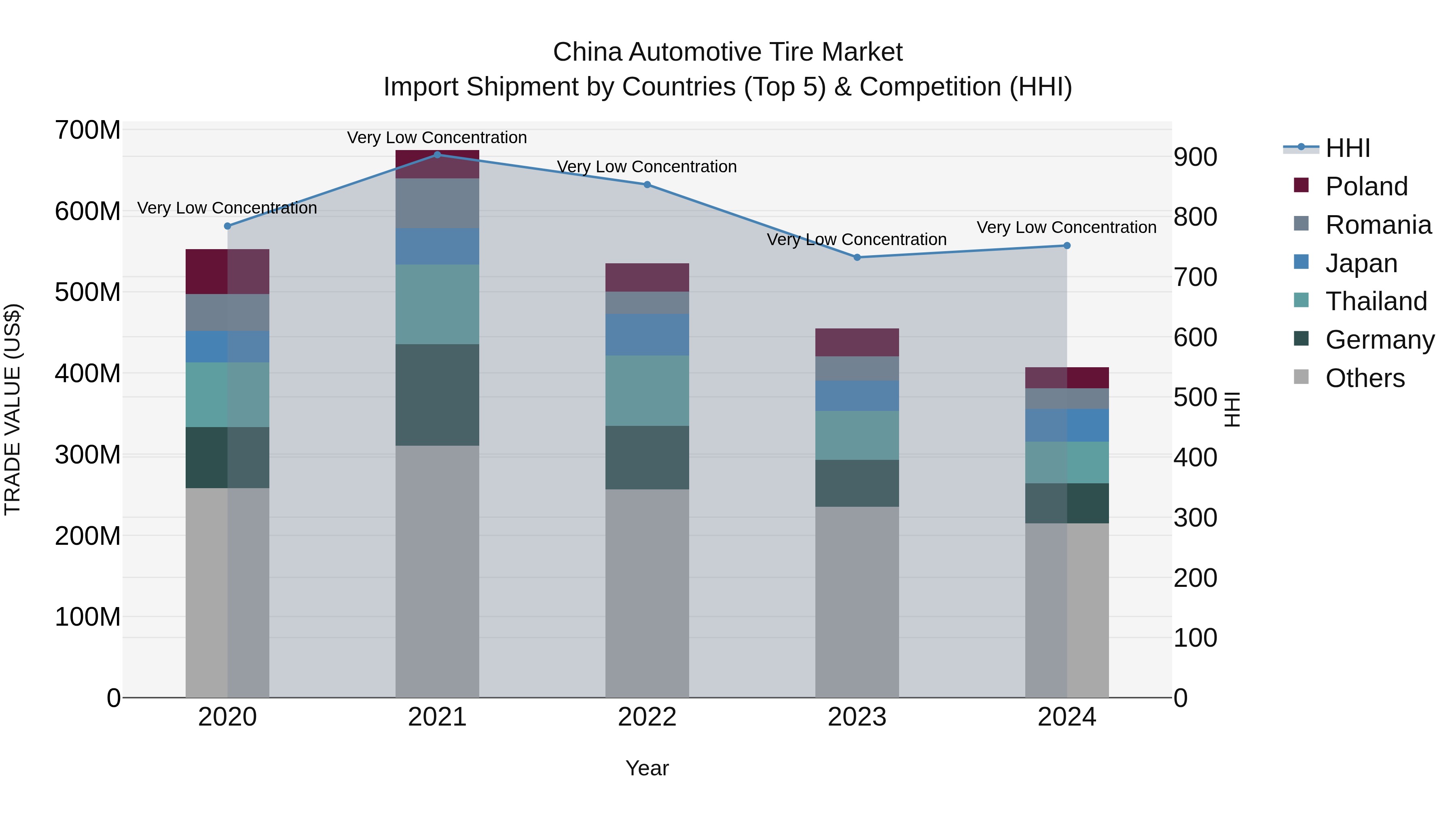
In 2024, China automotive tire import market saw a continued decline with a CAGR of -7.35% from 2020 to 2024, and a sharp decline in growth rate of -10.47% from 2023 to 2024. Despite the challenging market conditions, top exporting countries to China such as Thailand, Germany, Japan, USA, and Italy maintained their positions. The market remained highly competitive with a very low concentration as indicated by the HHI. This dynamic landscape signifies the need for industry players to adapt and innovate to meet the changing demands in the Chinese automotive tire market.
China Automotive Tire Market Overview
The China automotive tire market is one of the largest in the world, driven by the country`s booming automotive industry and increasing demand for vehicles. The market is highly competitive, with both domestic manufacturers like Linglong Tire and Triangle Group, as well as international players such as Michelin and Bridgestone, vying for market share. Factors such as technological advancements, increasing vehicle ownership, and government initiatives promoting electric vehicles are shaping the market dynamics. Additionally, the growing trend towards eco-friendly and energy-efficient tires is influencing consumer preferences. Despite challenges like raw material price fluctuations and regulatory changes, the China automotive tire market is poised for steady growth due to the country`s robust automotive sector and evolving consumer needs.
China Automotive Tire Market Trends
The China automotive tire market is witnessing several key trends, including a growing demand for eco-friendly and energy-efficient tires to align with environmental regulations and consumer preferences. There is also a shift towards the adoption of smart tires equipped with sensors for real-time monitoring of tire pressure, temperature, and tread wear, enhancing vehicle safety and performance. Additionally, the market is experiencing a rise in the popularity of all-season and specialty tires catering to different driving conditions and vehicle types. Manufacturers in China are increasingly focusing on developing innovative tire technologies to improve durability, fuel efficiency, and overall driving experience. Furthermore, the market is witnessing a steady increase in online tire sales, driven by the convenience of e-commerce platforms and digital marketing strategies adopted by tire companies.
China Automotive Tire Market Challenges
In the China automotive tire market, one of the main challenges faced is intense competition among both domestic and international tire manufacturers. This competition leads to price wars and margin pressures, making it difficult for companies to maintain profitability. Another challenge is the increasing demand for higher quality tires due to the growth of the middle-class population and their preference for premium vehicles. This requires tire manufacturers to invest in research and development to meet the evolving consumer needs while keeping costs low. Additionally, regulatory changes and environmental concerns around tire disposal and recycling pose challenges for companies operating in the market. Overall, navigating these challenges requires tire manufacturers in China to focus on innovation, cost efficiency, and sustainability to stay competitive in the market.
China Automotive Tire Market Investment Opportunities
The China automotive tire market presents several investment opportunities for both domestic and foreign investors. With the rapidly growing automotive industry in China, there is an increasing demand for high-quality tires to meet the needs of the expanding vehicle fleet. Investing in the manufacturing and distribution of tires, particularly focusing on eco-friendly and durable products, could yield significant returns. Additionally, the shift towards electric vehicles in China offers another avenue for investment, as specialized tires for electric cars are expected to be in high demand. Collaborating with local manufacturers or establishing joint ventures can provide access to the vast market and technological advancements in the automotive tire sector. Overall, the China automotive tire market offers promising opportunities for investors looking to capitalize on the country`s automotive industry growth.
China Automotive Tire Market Government Policy
The Chinese government has implemented various policies to regulate the automotive tire market in China. These policies include mandatory certification requirements for tire manufacturers to ensure quality and safety standards are met. Additionally, the government has imposed strict regulations on tire imports to protect domestic manufacturers and promote self-sufficiency in the industry. In recent years, environmental regulations have also been introduced to promote the use of eco-friendly materials in tire production and reduce pollution. Overall, the government`s policies in the China automotive tire market focus on ensuring product quality, promoting domestic production, and addressing environmental concerns to support sustainable growth in the industry.
China Automotive Tire Market Future Outlook
The future outlook for the China automotive tire market appears promising, driven by factors such as increasing vehicle production, rising disposable incomes, and growing demand for high-quality tires. The shift towards electric vehicles and the government`s focus on promoting clean energy vehicles also present opportunities for tire manufacturers to innovate and develop sustainable tire solutions. Additionally, the rapid urbanization in China is expected to boost the demand for passenger cars and commercial vehicles, further fueling the growth of the automotive tire market. With advancements in technology leading to the development of fuel-efficient and durable tires, the market is likely to witness steady growth in the coming years, making it an attractive sector for domestic and international tire companies to invest in.
Key Highlights of the Report:
- China Automotive Tire Market Outlook
- Market Size of China Automotive Tire Market, 2024
- Forecast of China Automotive Tire Market, 2031
- Historical Data and Forecast of China Automotive Tire Revenues & Volume for the Period 2021-2031
- China Automotive Tire Market Trend Evolution
- China Automotive Tire Market Drivers and Challenges
- China Automotive Tire Price Trends
- China Automotive Tire Porter's Five Forces
- China Automotive Tire Industry Life Cycle
- Historical Data and Forecast of China Automotive Tire Market Revenues & Volume By Vehicle Type for the Period 2021-2031
- Historical Data and Forecast of China Automotive Tire Market Revenues & Volume By Passenger Car for the Period 2021-2031
- Historical Data and Forecast of China Automotive Tire Market Revenues & Volume By Commercial vehicle for the Period 2021-2031
- Historical Data and Forecast of China Automotive Tire Market Revenues & Volume By Tire Type for the Period 2021-2031
- Historical Data and Forecast of China Automotive Tire Market Revenues & Volume By Radial Tires for the Period 2021-2031
- Historical Data and Forecast of China Automotive Tire Market Revenues & Volume By Bias Ply Tires for the Period 2021-2031
- Historical Data and Forecast of China Automotive Tire Market Revenues & Volume By Sales Channel for the Period 2021-2031
- Historical Data and Forecast of China Automotive Tire Market Revenues & Volume By Offline for the Period 2021-2031
- Historical Data and Forecast of China Automotive Tire Market Revenues & Volume By E-commerce for the Period 2021-2031
- Historical Data and Forecast of China Automotive Tire Market Revenues & Volume By Direct Sales for the Period 2021-2031
- Historical Data and Forecast of China Automotive Tire Market Revenues & Volume By Material Type for the Period 2021-2031
- Historical Data and Forecast of China Automotive Tire Market Revenues & Volume By Rubber for the Period 2021-2031
- Historical Data and Forecast of China Automotive Tire Market Revenues & Volume By Synthetic Materials for the Period 2021-2031
- China Automotive Tire Import Export Trade Statistics
- Market Opportunity Assessment By Vehicle Type
- Market Opportunity Assessment By Tire Type
- Market Opportunity Assessment By Sales Channel
- Market Opportunity Assessment By Material Type
- China Automotive Tire Top Companies Market Share
- China Automotive Tire Competitive Benchmarking By Technical and Operational Parameters
- China Automotive Tire Company Profiles
- China Automotive Tire Key Strategic Recommendations






































