China Bakeware Market Summary
The china bakeware market was estimated at USD 248 Million in 2025 and is projected to reach USD 288 Million by 2032, growing at a CAGR of 4.4% from 2026 to 2032.
China Bakeware Market Year-wise Growth Rate and Key Drivers
This graph highlights how the China Bakeware Market has steadily grown over the past five years, supported by major growth factors.
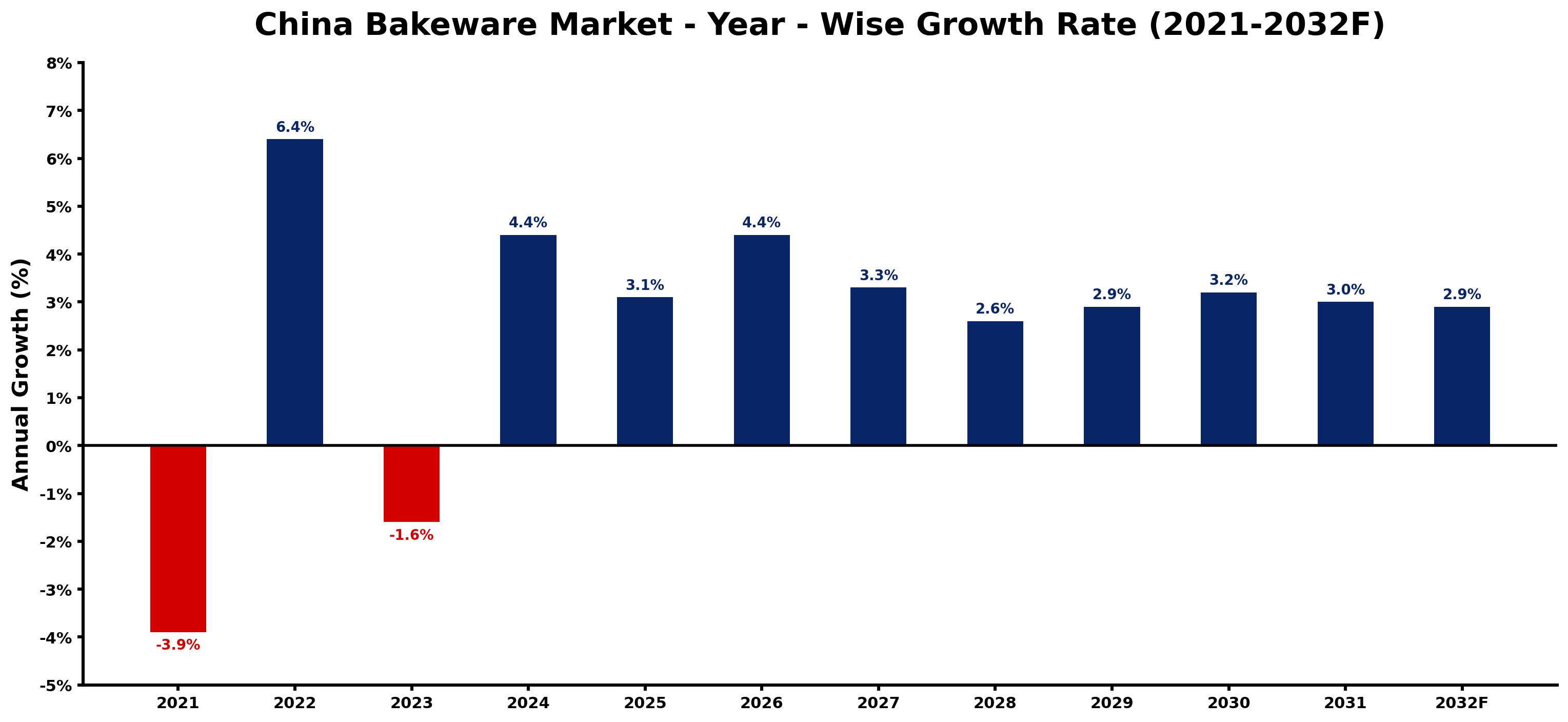
The table below presents the year wise growth rates along with the key drivers influencing the market
| Year | Growth Rate | Major Drivers |
| 2021 | -3.9% | Heightened competition from imported alternatives drastically undercut prices and eroded local manufacturers' market share. |
| 2022 | 6.4% | E-commerce platforms expanded significantly, making bakeware more accessible to consumers. |
| 2023 | -1.6% | Supply chain disruptions and higher logistical costs hindered production capabilities, leading to decreased market availability. |
| 2024 | 4.4% | Sustainable materials gained traction, encouraging eco-conscious consumers to buy bakeware. |
| 2025 | 3.1% | Health-conscious baking alternatives prompted demand for specialized bakeware products. |
| 2026 | 4.4% | Rural urbanization led to increased kitchen appliance investments in emerging cities. |
| 2027 | 3.3% | Culinary education programs flourished, fostering a new generation of passionate bakers. |
| 2028 | 2.6% | Customization options for bakeware began to appeal to a broader consumer base. |
| 2029 | 2.9% | Baking communities and clubs emerged, nurturing collaboration and shared creativity. |
| 2030 | 3.2% | Smart technology integrations in bakeware offered convenience, attracting tech-savvy consumers. |
| 2031 | 3.0% | Luxury baking experiences gained popularity, driving sales of high-end bakeware brands. |
| 2032 | 2.9% | International travel resumption fueled interest in diverse global baking practices. |
Note - Market size estimations and growth projections presented in this report are based on 6Wresearch's advanced forecasting approach, validated with industry datasets as of June 2026.
China Bakeware Market Synopsis
The China Bakeware Market is projected to reach 4.4% and witness significant growth during the forecast period (2026-2032). The market is anticipated to register a commendable compound annual growth rate (CAGR) of 4.4%, driven primarily by evolving consumer behaviors and increased demand for convenience in food preparation. With the urban population on the rise, the appetite for ready-made food items such as frozen pizzas, cakes, pastries, and an array of snacks is witnessing exponential growth. This shift in consumer preference places high demand on bakeware products, particularly lightweight and durable aluminum baking pans, which are favored for their practicality and efficiency in contemporary culinary practices.
China Bakeware Market Growth Drivers
Several key factors contribute to the growth of the China bakeware market. First, the increasing disposable income among the population has led to a greater willingness to invest in high-quality bakeware, enhancing home baking experiences. Second, health consciousness is on the rise, prompting consumers across all age groups, including children and the elderly, to seek healthier baked goods, thereby supporting the market for diverse bakeware products. Third, rapid technological advancements in manufacturing processes are enabling the production of innovative bakeware solutions, such as silicone and glass bakeware, which are growing in popularity due to their ease of cleaning and superior baking results.
- The increasing urbanization of China has transitioned consumer lifestyles, leading to higher demand for convenient cooking solutions.
- Innovative bakeware designs are attracting consumers who appreciate modern kitchen aesthetics alongside functionality.
- Health-oriented trends are prompting the development of bakeware that supports healthier baking practices.
- The availability of both organized retail outlets and online platforms has significantly eased consumer access to bakeware products.
- A rise in culinary interest, with more individuals taking up baking as a hobby, further fuels the demand for bakeware.
China Bakeware Market Trends and Opportunities
The China bakeware market is witnessing several notable trends that are reshaping its landscape. There is a marked shift towards eco-friendly products, with consumers showing a preference for bakeware made from sustainable materials. This is further influencing manufacturers to adopt green initiatives in their production processes. Additionally, smart bakeware solutions, integrated with technology for optimal performance, are emerging as intriguing prospects for tech-savvy consumers.
- Consumer demand for environmentally sustainable products is promoting innovations in recyclable bakeware materials.
- Trends in home cooking and baking are encouraging the exploration of specialty bakeware for artisanal goods.
- The rise of social media platforms is helping to popularize baking trends and recipes, thus indirectly bolstering bakeware sales.
- Collaborations with culinary influencers and chefs are opening new avenues for product visibility and consumer engagement.
- Investment in marketing strategies that focus on the multifunctionality of bakeware is becoming increasingly common.
China Bakeware Market Challenges and Restraints
Despite a positive growth trajectory, the China bakeware market is not without its challenges. Fluctuations in the prices of raw materials can significantly impact production costs and, consequently, retail prices. This could deter consumers from making purchases, particularly if cheaper alternatives appear on the market. Additionally, while the trend for eco-conscious products is on the rise, there is still a substantial market segment resistant to change, favoring traditional bakeware materials over newer, sustainable options. Furthermore, the potential for market saturation poses a risk for new entrants and current manufacturers alike.
- Price instability in raw materials could lead to increased production costs, affecting overall market profitability.
- Consumer reluctance to shift from traditional to modern bakeware options may slow down market penetration for innovative products.
- Market saturation in certain product categories can hinder the growth potential for new entrants.
- Global supply chain disruptions may affect the availability and distribution of bakeware products in the market.
- The ongoing economic fluctuations may lead consumers to prioritize essential goods over discretionary items like bakeware.
China Bakeware Market Government Investment and Initiatives
The Chinese government has recognized the potential of the bakeware industry as a vital component of the broader culinary and household goods market. Various initiatives aimed at promoting manufacturing efficiency and sustainability in production are underway. Policies encouraging local businesses to innovate and incorporate green technologies are gaining traction. Additionally, public investments in infrastructure to improve distribution channels for bakeware products are enhancing accessibility. These government initiatives provide a stable environment conducive for market expansion and could potentially lead to increased interest from both domestic and international investors looking to capitalize on the growing market.
China Bakeware Market Latest Developments (May 2025 - June 2026)
In the period from May 2025 to June 2026, the China bakeware market has seen several developments signaling a robust direction for future growth. Manufacturers have been increasingly adopting smart technologies in bakeware products, reflecting the trend towards digitization in home cooking. Additionally, there has been a noticeable surge in promotional campaigns aimed at educating consumers about the benefits of various bakeware materials, particularly eco-friendly options. This is coupled with a rise in collaborative marketing efforts with popular culinary influencers, driving both awareness and consumer engagement. The integration of health-oriented messaging in advertising has also gained momentum, appealing to a broader audience keen on healthier lifestyle choices.
China Bakeware Market - Key Attractiveness of the Report
- 10 Years of Market Numbers
- Historical Data Starting from 2022 to 2025
- Base Year: 2025
- Forecast Data until 2032
- Key Performance Indicators Impacting the Market
- Major Upcoming Developments and Projects
Key Highlights of the Report:
- China Bakeware Market Outlook
- Market Size of China Bakeware Market, 2025
- Forecast of China Bakeware Market, 2032F
- Historical Data and Forecast of China Bakeware Revenues & Volume for the Period 2022-2032F
- China Bakeware Market Trend Evolution
- China Bakeware Market Drivers and Challenges
- China Bakeware Price Trends
- China Bakeware Porter's Five Forces
- China Bakeware Industry Life Cycle
- Historical Data and Forecast of China Bakeware Market Revenues & Volume By Product Type for the Period 2022-2032F
- Historical Data and Forecast of China Bakeware Market Revenues & Volume By Ceramic for the Period 2022-2032F
- Historical Data and Forecast of China Bakeware Market Revenues & Volume By Aluminium for the Period 2022-2032F
- Historical Data and Forecast of China Bakeware Market Revenues & Volume By Cast Iron for the Period 2022-2032F
- Historical Data and Forecast of China Bakeware Market Revenues & Volume By Stainless Steel for the Period 2022-2032F
- Historical Data and Forecast of China Bakeware Market Revenues & Volume By Glass for the Period 2022-2032F
- Historical Data and Forecast of China Bakeware Market Revenues & Volume By Others for the Period 2022-2032F
- Historical Data and Forecast of China Bakeware Market Revenues & Volume By Applications for the Period 2022-2032F
- Historical Data and Forecast of China Bakeware Market Revenues & Volume By Commercial for the Period 2022-2032F
- Historical Data and Forecast of China Bakeware Market Revenues & Volume By Household for the Period 2022-2032F
- China Bakeware Import Export Trade Statistics
- Market Opportunity Assessment By Product Type
- Market Opportunity Assessment By Applications
- China Bakeware Top Companies Market Share
- China Bakeware Competitive Benchmarking By Technical and Operational Parameters
- China Bakeware Company Profiles
- China Bakeware Key Strategic Recommendations






































