China Bisphenol a Market Top 5 Importing Countries and Market Competition (HHI) Analysis
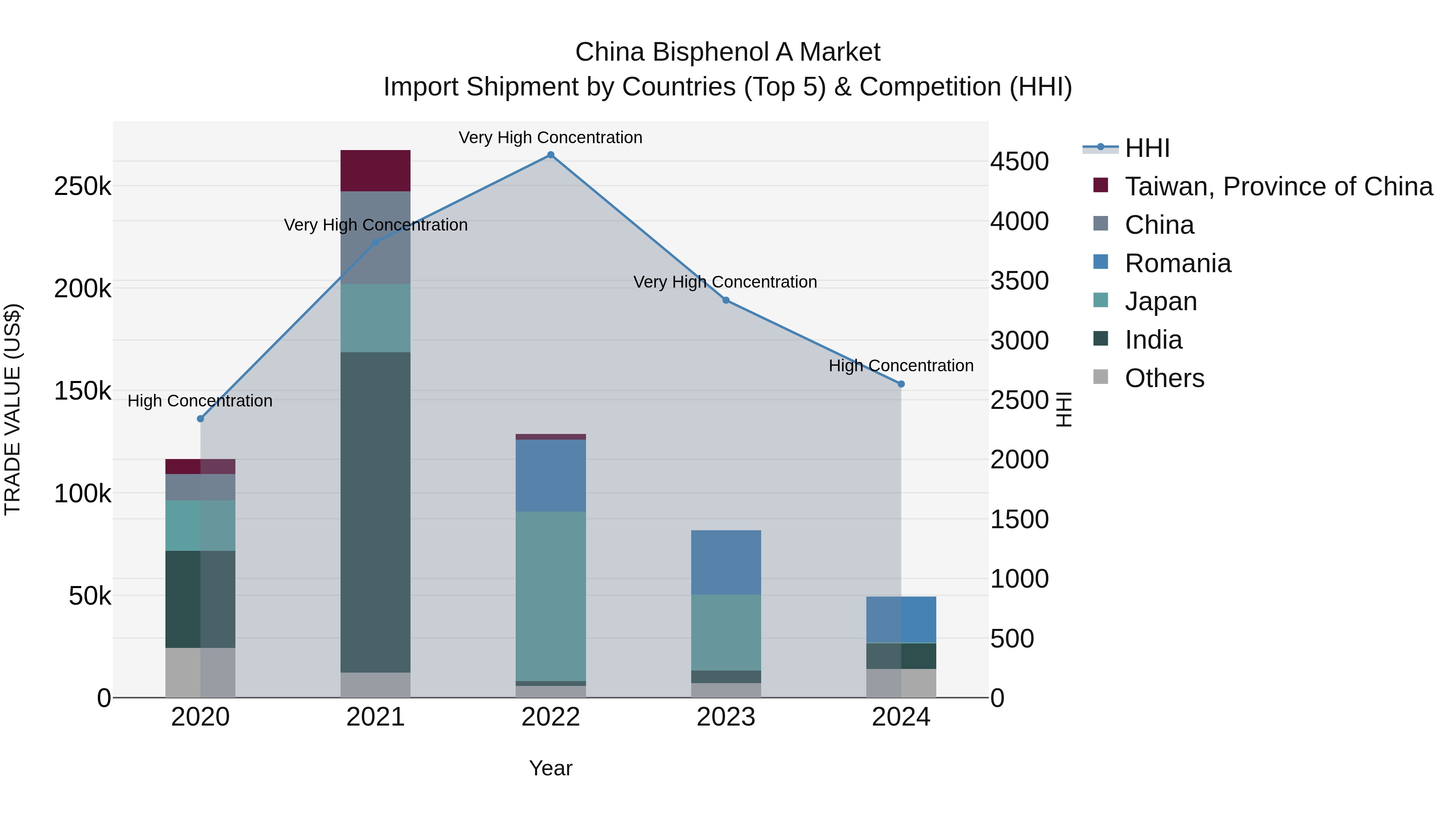
China bisphenol A import shipments in 2024 saw a shift in top exporting countries, with Romania, India, Spain, Estonia, and Metropolitan France taking the lead. The Herfindahl-Hirschman Index (HHI) indicated very high concentration in 2023, which transitioned to high concentration in 2024. The compound annual growth rate (CAGR) from 2020 to 2024 was -19.29%, with a significant decline in the growth rate from 2023 to 2024 at -39.57%. These trends suggest a dynamic landscape in bisphenol A imports to China, reflecting changing market dynamics and trade patterns.
China Bisphenol A Market Overview
The China Bisphenol A market is experiencing steady growth driven by increasing demand from various end-use industries such as automotive, electronics, and packaging. Bisphenol A is a key ingredient in the production of polycarbonate plastics and epoxy resins, which are widely used in the manufacturing sector. The market is also influenced by stringent regulations promoting the use of Bisphenol A-free products, leading to a shift towards alternative materials. China`s dominance in manufacturing and its growing consumer base are contributing to the market`s expansion. Key players in the China Bisphenol A market include Hubei Xingfa Chemicals Group, Mitsui Chemicals, and LG Chem. With the increasing focus on sustainability and eco-friendly practices, the market is expected to witness further developments in terms of product innovation and regulatory compliance.
China Bisphenol A Market Trends
The China Bisphenol A market is witnessing several key trends currently. One prominent trend is the increasing demand for Bisphenol A in the production of polycarbonate plastics and epoxy resins, driven by the growing automotive, electronics, and construction industries in China. Additionally, there is a rising focus on sustainable and eco-friendly alternatives to Bisphenol A due to environmental concerns and regulatory pressures. Companies in the market are investing in research and development to innovate and introduce bio-based or Bisphenol A-free products to cater to this demand. Moreover, the market is experiencing competition from imported Bisphenol A products, leading to pricing pressures and challenges for domestic manufacturers to maintain their market share. Overall, the China Bisphenol A market is evolving to adapt to changing consumer preferences and regulatory requirements.
China Bisphenol A Market Challenges
In the China Bisphenol A market, one of the primary challenges faced is increasing regulatory scrutiny and environmental concerns surrounding the use of this chemical in various consumer products. The Chinese government has been implementing stricter regulations and guidelines on the production and usage of Bisphenol A due to its potential health risks and environmental impact. This has led to uncertainty among manufacturers and a need for greater compliance measures, which can increase production costs and affect market competitiveness. Additionally, the market faces challenges related to fluctuating raw material prices, competition from alternative chemicals, and shifting consumer preferences towards more sustainable and eco-friendly products. Overall, navigating these regulatory, environmental, and market challenges is crucial for companies operating in the China Bisphenol A market.
China Bisphenol A Market Investment Opportunities
The China Bisphenol A market offers promising investment opportunities due to the increasing demand for this chemical compound in various industries such as automotive, electronics, and packaging. With the country`s robust manufacturing sector and growing consumer base, the market for Bisphenol A is expected to experience steady growth in the coming years. Investing in Bisphenol A production facilities or companies involved in its distribution and manufacturing could yield favorable returns. Additionally, with the Chinese government`s focus on environmental regulations and sustainability, there is potential for investments in eco-friendly or alternative Bisphenol A production methods to capitalize on the shifting market trends towards more sustainable practices. Conducting thorough market research and due diligence would be essential for identifying the most promising investment opportunities in the China Bisphenol A market.
China Bisphenol A Market Government Policy
The Chinese government has implemented various policies related to the Bisphenol A (BPA) market to regulate its usage and ensure consumer safety. In 2011, China`s Ministry of Health set limits on the amount of BPA allowed in food packaging materials. Additionally, the National Health Commission issued regulations in 2018 prohibiting the use of BPA in infant formula packaging. These policies aim to reduce exposure to BPA, which has been linked to potential health risks such as hormone disruption and developmental issues. As part of its efforts to protect public health, the Chinese government continues to monitor and enforce regulations concerning the use of BPA in various products to safeguard the well-being of its citizens.
China Bisphenol A Market Future Outlook
The future outlook for the China Bisphenol A market is positive, driven by factors such as increasing demand from end-use industries like automotive, electronics, and packaging. Bisphenol A is a key ingredient in the production of polycarbonate plastics and epoxy resins, both of which have a wide range of applications. Additionally, the growing awareness of Bisphenol A`s versatility and performance benefits will further propel market growth. However, concerns regarding the environmental and health impacts of Bisphenol A may pose challenges and lead to increased regulatory scrutiny. Overall, the China Bisphenol A market is expected to experience steady growth in the coming years, supported by robust industrial activities and technological advancements in the country.
Key Highlights of the Report:
- China Bisphenol A Market Outlook
- Market Size of China Bisphenol A Market, 2021
- Forecast of China Bisphenol A Market, 2027
- Historical Data and Forecast of China Bisphenol A Revenues & Volume for the Period 2018 - 2027
- China Bisphenol A Market Trend Evolution
- China Bisphenol A Market Drivers and Challenges
- China Bisphenol A Price Trends
- China Bisphenol A Porter's Five Forces
- China Bisphenol A Industry Life Cycle
- Historical Data and Forecast of China Bisphenol A Market Revenues & Volume By Application for the Period 2018 - 2027
- Historical Data and Forecast of China Bisphenol A Market Revenues & Volume By Polycarbonate Resin for the Period 2018 - 2027
- Historical Data and Forecast of China Bisphenol A Market Revenues & Volume By Epoxy Resin for the Period 2018 - 2027
- Historical Data and Forecast of China Bisphenol A Market Revenues & Volume By Unsaturated Polyester Resins for the Period 2018 - 2027
- Historical Data and Forecast of China Bisphenol A Market Revenues & Volume By Flame Retardants for the Period 2018 - 2027
- Historical Data and Forecast of China Bisphenol A Market Revenues & Volume By Others for the Period 2018 - 2027
- Historical Data and Forecast of China Bisphenol A Market Revenues & Volume By End-use for the Period 2018 - 2027
- Historical Data and Forecast of China Bisphenol A Market Revenues & Volume By Eye wear for the Period 2018 - 2027
- Historical Data and Forecast of China Bisphenol A Market Revenues & Volume By Automotive component for the Period 2018 - 2027
- Historical Data and Forecast of China Bisphenol A Market Revenues & Volume By Electronics for the Period 2018 - 2027
- Historical Data and Forecast of China Bisphenol A Market Revenues & Volume By Wind Energy Composites for the Period 2018 - 2027
- Historical Data and Forecast of China Bisphenol A Market Revenues & Volume By Paint and Coating for the Period 2018 - 2027
- Historical Data and Forecast of China Bisphenol A Market Revenues & Volume By Green House for the Period 2018 - 2027
- Historical Data and Forecast of China Bisphenol A Market Revenues & Volume By Others for the Period 2018 - 2027
- China Bisphenol A Import Export Trade Statistics
- Market Opportunity Assessment By Application
- Market Opportunity Assessment By End-use
- China Bisphenol A Top Companies Market Share
- China Bisphenol A Competitive Benchmarking By Technical and Operational Parameters
- China Bisphenol A Company Profiles
- China Bisphenol A Key Strategic Recommendations






































