China Breast Pump Market Top 5 Importing Countries and Market Competition (HHI) Analysis
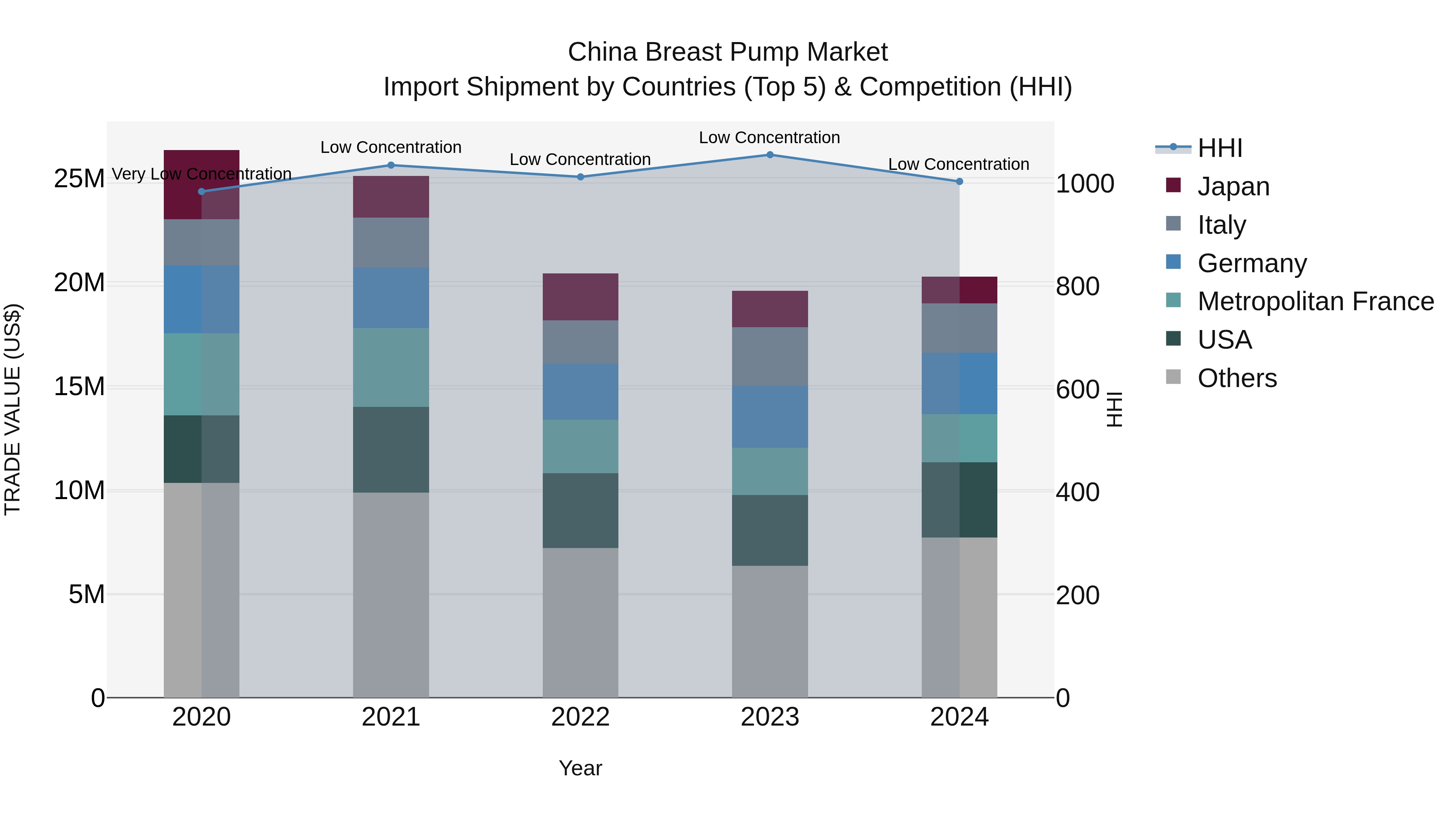
China breast pump import market in 2024 saw significant contributions from the USA, Germany, Italy, Metropolitan France, and South Korea. Despite the negative Compound Annual Growth Rate (CAGR) of -6.37% from 2020 to 2024, there was a slight growth rebound with a rate of 3.38% from 2023 to 2024. The market displayed low concentration, as indicated by the Herfindahl-Hirschman Index (HHI). This data suggests a dynamic and diversified import landscape for breast pumps in China, with potential opportunities for further market expansion and competition among the top exporting countries.
China Breast Pump Market Overview
The breast pump market in China is experiencing steady growth driven by increasing awareness about breastfeeding benefits, rising disposable income, and growing working mothers population. Key players such as Philips Avent, Medela, and Spectra are dominating the market with innovative product offerings, efficient pumping technology, and strong distribution networks. The market is witnessing a shift towards electric and double electric breast pumps due to their convenience and effectiveness. E-commerce platforms like Tmall and JD.com are playing a crucial role in expanding the reach of breast pumps to consumers in both urban and rural areas. Government initiatives promoting breastfeeding and improving healthcare infrastructure are further fueling market growth. Overall, the China breast pump market is poised for continued expansion in the coming years.
China Breast Pump Market Trends
The China breast pump market is witnessing several key trends. One significant trend is the growing popularity of smart and electric breast pumps, which offer convenience and efficiency for breastfeeding mothers. These pumps often come equipped with features such as adjustable suction levels, memory functions, and smartphone connectivity for tracking pumping sessions. Another trend is the increasing demand for portable and lightweight breast pumps that allow mothers to pump on-the-go. Additionally, there is a rising awareness and acceptance of breast pumping as a viable option for feeding infants, leading to a higher adoption rate of breast pumps among new mothers in China. The market is also seeing a surge in the availability of innovative and high-tech breast pump models catering to different needs and preferences of consumers.
China Breast Pump Market Challenges
In the China breast pump market, challenges include fierce competition among both domestic and international brands, issues related to product quality and reliability, as well as concerns regarding the safety and effectiveness of certain products. Additionally, cultural factors may influence the adoption of breast pumps in China, where breastfeeding practices and attitudes differ compared to Western countries. The market also faces regulatory challenges, with changing government regulations and standards impacting product sales and distribution. Moreover, price sensitivity among consumers and the presence of counterfeit products further complicate the landscape for companies operating in the China breast pump market. Successfully navigating these challenges requires companies to prioritize product innovation, quality control, regulatory compliance, and consumer education to build trust and establish a strong market presence.
China Breast Pump Market Investment Opportunities
The China breast pump market offers several investment opportunities due to the increasing awareness and acceptance of breastfeeding, rising disposable income levels, and growing working mothers population in the country. Key areas for investment include innovative and technologically advanced breast pump products catering to consumer preferences for convenience, portability, and efficiency. Additionally, there is a growing demand for smart breast pumps with features such as Bluetooth connectivity and app integration. Investing in marketing and distribution channels to reach a wider consumer base, as well as providing after-sales services and support, could also be lucrative. Collaborating with local manufacturers or forming strategic partnerships with e-commerce platforms can further enhance market penetration and growth prospects in the competitive China breast pump market.
China Breast Pump Market Government Policy
The Chinese government has implemented various policies related to the breast pump market to promote breastfeeding and improve maternal and child health. These policies include tax incentives for companies producing breast pumps, subsidies for breastfeeding support programs, regulations ensuring the safety and quality of breast pump products, and initiatives to encourage workplaces to provide breastfeeding-friendly environments. Additionally, the government has launched campaigns to raise awareness about the benefits of breastfeeding and the importance of using breast pumps as a tool to support lactating mothers. These policies aim to increase the prevalence of breastfeeding in China and address issues such as low breastfeeding rates, inadequate support for working mothers, and the prevalence of formula feeding in the country.
China Breast Pump Market Future Outlook
The future outlook for the China breast pump market appears promising, driven by factors such as increasing awareness about the benefits of breastfeeding, rising disposable incomes, and the growing number of working mothers. The market is expected to witness steady growth due to the rising emphasis on infant health and nutrition, coupled with advancements in technology that are making breast pumps more efficient, convenient, and user-friendly. Additionally, the Chinese government`s initiatives to promote breastfeeding and improve maternity benefits are likely to further boost the demand for breast pumps in the country. As a result, key players in the market are expected to focus on product innovation, strategic partnerships, and marketing campaigns to capitalize on the expanding opportunities in the China breast pump market.
Key Highlights of the Report:
- China Breast Pump Market Outlook
- Market Size of China Breast Pump Market,2024
- Forecast of China Breast Pump Market, 2031
- Historical Data and Forecast of China Breast Pump Revenues & Volume for the Period 2021-2031
- China Breast Pump Market Trend Evolution
- China Breast Pump Market Drivers and Challenges
- China Breast Pump Price Trends
- China Breast Pump Porter's Five Forces
- China Breast Pump Industry Life Cycle
- Historical Data and Forecast of China Breast Pump Market Revenues & Volume By Product Type for the Period 2021-2031
- Historical Data and Forecast of China Breast Pump Market Revenues & Volume By Electric Pumps for the Period 2021-2031
- Historical Data and Forecast of China Breast Pump Market Revenues & Volume By Manual Pumps for the Period 2021-2031
- Historical Data and Forecast of China Breast Pump Market Revenues & Volume By Wearable Pumps for the Period 2021-2031
- Historical Data and Forecast of China Breast Pump Market Revenues & Volume By Hospital-Grade Pumps for the Period 2021-2031
- Historical Data and Forecast of China Breast Pump Market Revenues & Volume By Mechanism for the Period 2021-2031
- Historical Data and Forecast of China Breast Pump Market Revenues & Volume By Single/Double for the Period 2021-2031
- Historical Data and Forecast of China Breast Pump Market Revenues & Volume By Hand-Operated for the Period 2021-2031
- Historical Data and Forecast of China Breast Pump Market Revenues & Volume By Smart Technology for the Period 2021-2031
- Historical Data and Forecast of China Breast Pump Market Revenues & Volume By Hospital-Strength for the Period 2021-2031
- Historical Data and Forecast of China Breast Pump Market Revenues & Volume By Application for the Period 2021-2031
- Historical Data and Forecast of China Breast Pump Market Revenues & Volume By Milk Extraction for the Period 2021-2031
- Historical Data and Forecast of China Breast Pump Market Revenues & Volume By Occasional Use for the Period 2021-2031
- Historical Data and Forecast of China Breast Pump Market Revenues & Volume By Discreet Pumping for the Period 2021-2031
- Historical Data and Forecast of China Breast Pump Market Revenues & Volume By NICU & Preterm Babies for the Period 2021-2031
- Historical Data and Forecast of China Breast Pump Market Revenues & Volume By End User for the Period 2021-2031
- Historical Data and Forecast of China Breast Pump Market Revenues & Volume By Working Mothers for the Period 2021-2031
- Historical Data and Forecast of China Breast Pump Market Revenues & Volume By Stay-at-Home Mothers for the Period 2021-2031
- Historical Data and Forecast of China Breast Pump Market Revenues & Volume By Hospitals for the Period 2021-2031
- Historical Data and Forecast of China Breast Pump Market Revenues & Volume By Maternity Clinics for the Period 2021-2031
- China Breast Pump Import Export Trade Statistics
- Market Opportunity Assessment By Product Type
- Market Opportunity Assessment By Mechanism
- Market Opportunity Assessment By Application
- Market Opportunity Assessment By End User
- China Breast Pump Top Companies Market Share
- China Breast Pump Competitive Benchmarking By Technical and Operational Parameters
- China Breast Pump Company Profiles
- China Breast Pump Key Strategic Recommendations






































