China Cat Food Market Size, Share & Growth Rate
The China Cat Food Market was estimated at USD 110 Million in 2025 and is projected to reach USD 125 Million by 2032, growing at a CAGR of 1.8% from 2026 to 2032. This growth trajectory is heavily influenced by the increasing number of households adopting cats and a concurrent rise in consumer awareness regarding the importance of proper pet nutrition. The surge in demand for premium, natural, and organic cat food is particularly noteworthy as pet owners continue to view their pets as family members, thus prioritizing quality and specialized dietary options.
China Cat Food Market Year-wise Growth Rate and Key Drivers
This graph highlights how the China Cat Food Market has steadily grown over the years, supported by major growth factors.
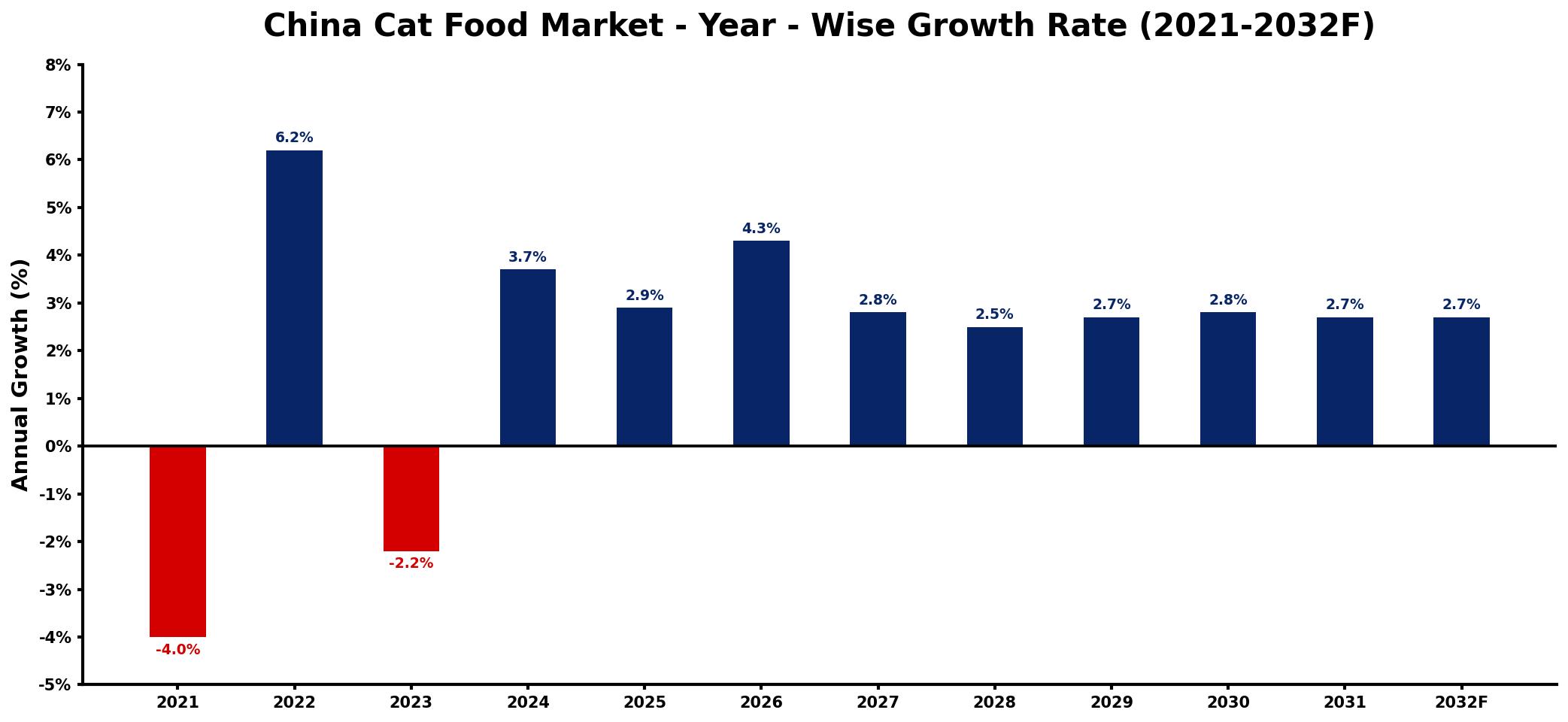
The table below presents the year‑wise growth rates along with the key drivers influencing the market
| Year | Growth Rate | Major Drivers |
| 2021 | -4.0% | decreased consumer spending on pets |
| 2022 | 6.2% | rising interest in premium options |
| 2023 | -2.2% | shift towards budget-friendly alternatives |
| 2024 | 3.7% | increased focus on sustainability practices |
| 2025 | 2.9% | growing demand for natural ingredients |
| 2026 | 4.3% | expansion of e-commerce platforms |
| 2027 | 2.8% | emerging trends in health consciousness |
| 2028 | 2.5% | rising popularity of subscription services |
| 2029 | 2.7% | increased investment in innovation |
| 2030 | 2.8% | growing awareness of nutritional benefits |
| 2031 | 2.7% | rising export shipment volumes |
| 2032 | 2.7% | strengthening underlying market demand |
Note: Market size estimations and growth projections presented in this report are based on 6Wresearch's proprietary forecasting methodology, utilizing the latest available industry data, government publications, and primary research inputs.
China Cat Food Market Synopsis
The most significant force shaping the China Cat Food Market is the growing trend of pet humanization. Pet owners increasingly regard their cats as companions deserving of the same quality of nutrition that they themselves consume. This shift is leading to a pronounced demand for high-quality, specialized food products tailored to individual health needs.
Additionally, the expansion of e-commerce platforms is reshaping the landscape, making it easier for consumers to access a broader array of products. With the rise of online shopping, convenience and variety become crucial factors driving consumer choices in the cat food market.
China Cat Food Market Key Takeaways
- Increased pet ownership is propelling market growth, with cats being particularly popular.
- Consumer preferences are shifting towards premium, natural, and organic cat food products.
- The expansion of e-commerce is facilitating easier access to diverse cat food offerings.
- Regulatory compliance challenges necessitate innovation among manufacturers.
- The trend of pet humanization is significantly impacting purchasing decisions.
Evaluation of Restraints in China Cat Food Market
Despite the promising growth prospects, the China Cat Food Market faces several restraints. Shifting consumer preferences demand constant innovation and differentiation among product offerings, compelling manufacturers to adapt quickly. Furthermore, adherence to stringent regulations regarding pet food safety and quality standards adds layers of complexity, as companies must navigate rigorous testing and certification processes. The increasing popularity of homemade and natural food alternatives poses an additional challenge to traditional cat food products, as consumers seek perceived healthier options for their pets.
China Cat Food Market Trends
Currently, there is a noticeable trend towards natural and organic cat food, reflecting broader consumer desires for health and wellness. Brands are responding by launching products that emphasize high-quality ingredients and nutritional benefits. Additionally, the rise of subscription services for pet food delivery exemplifies the shift towards convenience, catering to busy pet owners who value time and effort-saving solutions. Furthermore, the market is witnessing an uptick in specialized diets targeting specific health issues, such as obesity and allergies, further diversifying the product landscape.
China Cat Food Market Opportunities
There are considerable opportunities for growth in the China Cat Food Market, particularly in developing premium product lines that cater to health-conscious consumers. As awareness around pet health and nutrition continues to rise, brands that offer innovative, high-quality, and specialized products stand to benefit immensely. Moreover, leveraging technology to enhance the online shopping experience can attract a broader customer base. Collaborations with veterinary nutritionists to formulate products could also enhance brand credibility and capture a niche market segment focused on health-oriented solutions.
Government Initiatives in the China Cat Food Market
Government regulations play a crucial role in shaping the China Cat Food Market, focusing on ensuring pet food safety and quality standards. Policies aimed at promoting pet health and safety, along with specific import restrictions, guide market dynamics and influence product offerings. Additionally, increased public spending on pet welfare initiatives reflects a growing recognition of pets importance in society, encouraging further investment in high-quality pet food options.
Future Insights of the China Cat Food Market
Looking ahead to 2026-2032, the China Cat Food Market is expected to continue on its growth trajectory, driven by evolving consumer preferences and increased pet ownership rates. The trend of humanization will likely persist, pushing demand for more sophisticated and specialized pet food products. Furthermore, advancements in technology and online shopping may redefine consumer engagement, paving the way for innovative marketing strategies and personalized product offerings. Overall, the future looks promising for stakeholders in this dynamic market as they adapt to emerging trends and consumer demands.
China Cat Food Market Latest Developments (2025 - 2026)
In the past year, the China Cat Food Market has witnessed several noteworthy developments. There has been an increase in product launches focusing on premium and specialized diets, reflecting the consumer shift towards health-conscious choices. E-commerce platforms have expanded their offerings, and many brands have begun exploring direct-to-consumer models to enhance customer engagement. Additionally, innovative marketing campaigns emphasizing quality and transparency have become prevalent, catering to the informed consumer base increasingly concerned with pet health.
China Cat Food Market - Key Attractiveness of the Report
- 10 Years of Market Numbers
- Historical Data Starting from 2022 to 2025
- Base Year: 2025
- Forecast Data until 2032
- Key Performance Indicators Impacting the Market
- Major Upcoming Developments and Projects
Key Highlights of the Report:
- China Cat Food Market Outlook
- Market Size of China Cat Food Market, 2025
- Forecast of China Cat Food Market, 2032
- Historical Data and Forecast of China Cat Food Revenues & Volume for the Period 2022-2032F
- China Cat Food Market Trend Evolution
- China Cat Food Market Drivers and Challenges
- China Cat Food Price Trends
- China Cat Food Porter's Five Forces
- China Cat Food Industry Life Cycle
- Historical Data and Forecast of China Cat Food Market Revenues & Volume By Nature for the Period 2022-2032F
- Historical Data and Forecast of China Cat Food Market Revenues & Volume By Organic for the Period 2022-2032F
- Historical Data and Forecast of China Cat Food Market Revenues & Volume By Monoprotein for the Period 2022-2032F
- Historical Data and Forecast of China Cat Food Market Revenues & Volume By Conventional for the Period 2022-2032F
- Historical Data and Forecast of China Cat Food Market Revenues & Volume By Source for the Period 2022-2032F
- Historical Data and Forecast of China Cat Food Market Revenues & Volume By Animal Derived for the Period 2022-2032F
- Historical Data and Forecast of China Cat Food Market Revenues & Volume By Plant-derived for the Period 2022-2032F
- Historical Data and Forecast of China Cat Food Market Revenues & Volume By Insect- Derived for the Period 2022-2032F
- Historical Data and Forecast of China Cat Food Market Revenues & Volume By Product Type for the Period 2022-2032F
- Historical Data and Forecast of China Cat Food Market Revenues & Volume By Kibble/dry for the Period 2022-2032F
- Historical Data and Forecast of China Cat Food Market Revenues & Volume By Treats And Chews for the Period 2022-2032F
- Historical Data and Forecast of China Cat Food Market Revenues & Volume By Dehydrated Food for the Period 2022-2032F
- Historical Data and Forecast of China Cat Food Market Revenues & Volume By Freeze Dried Food for the Period 2022-2032F
- Historical Data and Forecast of China Cat Food Market Revenues & Volume By Freeze-dried Raw for the Period 2022-2032F
- Historical Data and Forecast of China Cat Food Market Revenues & Volume By Wet Food for the Period 2022-2032F
- Historical Data and Forecast of China Cat Food Market Revenues & Volume By Frozen for the Period 2022-2032F
- Historical Data and Forecast of China Cat Food Market Revenues & Volume By Powder for the Period 2022-2032F
- Historical Data and Forecast of China Cat Food Market Revenues & Volume By Pet Type for the Period 2022-2032F
- Historical Data and Forecast of China Cat Food Market Revenues & Volume By Kitten for the Period 2022-2032F
- Historical Data and Forecast of China Cat Food Market Revenues & Volume By Senior for the Period 2022-2032F
- Historical Data and Forecast of China Cat Food Market Revenues & Volume By Packaging Type for the Period 2022-2032F
- Historical Data and Forecast of China Cat Food Market Revenues & Volume By Pouches for the Period 2022-2032F
- Historical Data and Forecast of China Cat Food Market Revenues & Volume By Bags for the Period 2022-2032F
- Historical Data and Forecast of China Cat Food Market Revenues & Volume By Folding Cartons for the Period 2022-2032F
- Historical Data and Forecast of China Cat Food Market Revenues & Volume By Tubs & Cups for the Period 2022-2032F
- Historical Data and Forecast of China Cat Food Market Revenues & Volume By Can for the Period 2022-2032F
- Historical Data and Forecast of China Cat Food Market Revenues & Volume By Bottles & Jars for the Period 2022-2032F
- Historical Data and Forecast of China Cat Food Market Revenues & Volume By Distribution Channel for the Period 2022-2032F
- Historical Data and Forecast of China Cat Food Market Revenues & Volume By Store-based Retailing for the Period 2022-2032F
- Historical Data and Forecast of China Cat Food Market Revenues & Volume By Online Retailers for the Period 2022-2032F
- China Cat Food Import Export Trade Statistics
- Market Opportunity Assessment By Nature
- Market Opportunity Assessment By Source
- Market Opportunity Assessment By Product Type
- Market Opportunity Assessment By Pet Type
- Market Opportunity Assessment By Packaging Type
- Market Opportunity Assessment By Distribution Channel
- China Cat Food Top Companies Market Share
- China Cat Food Competitive Benchmarking By Technical and Operational Parameters
- China Cat Food Company Profiles
- China Cat Food Key Strategic Recommendations






































