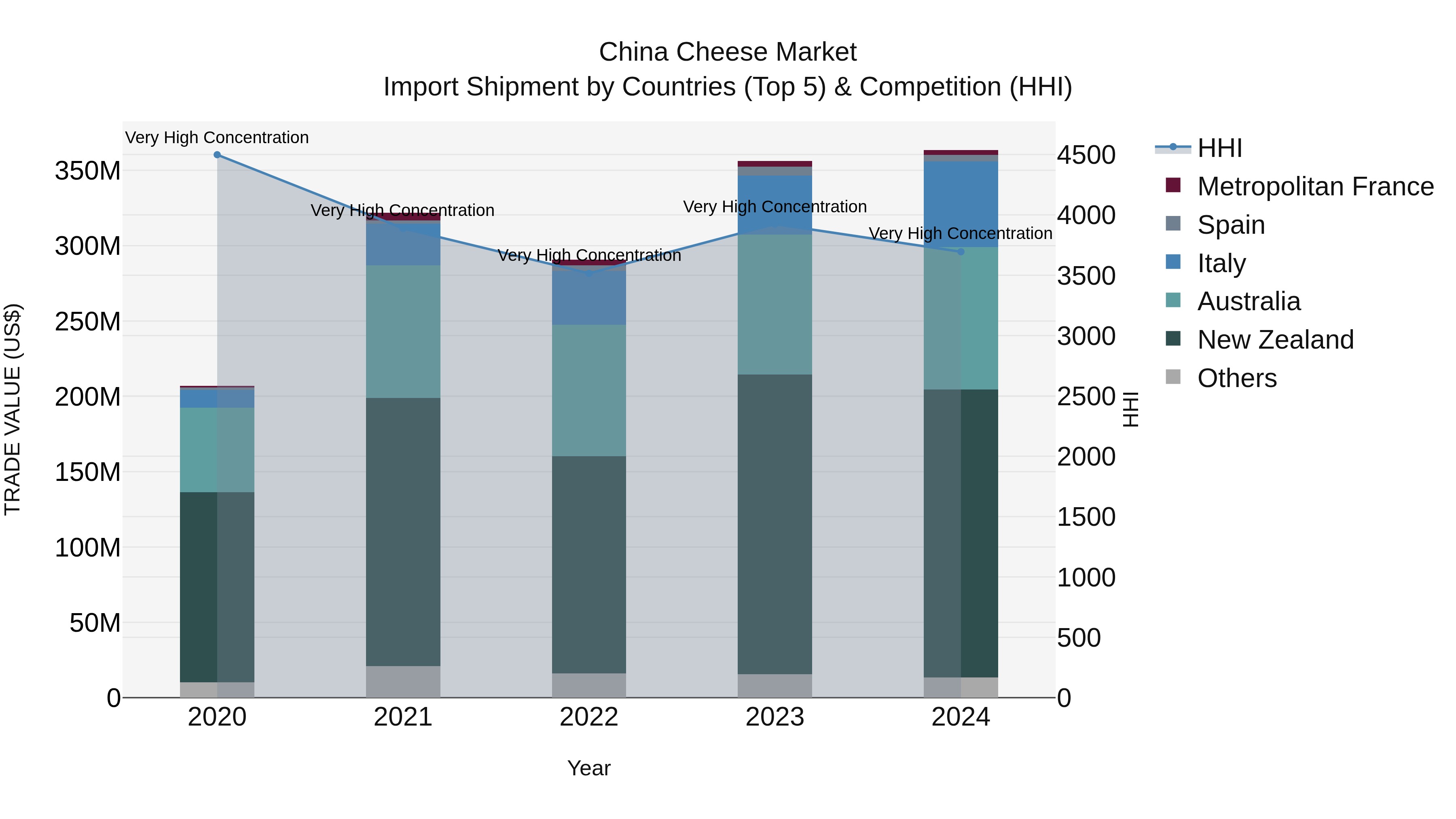
China Cheese Market Top 5 Importing Countries and Market Competition (HHI) Analysis
China cheese import market continued to witness strong growth in 2024, with top exporting countries like New Zealand, Australia, Italy, Spain, and Metropolitan France dominating the scene. The high Herfindahl-Hirschman Index (HHI) indicates a concentrated market, while the impressive compound annual growth rate (CAGR) of 15.12% from 2020 to 2024 underscores the increasing demand for cheese in China. Despite a slightly lower growth rate in 2024 at 2.01%, the market remains promising for cheese exporters looking to tap into China growing appetite for dairy products.
China Cheese Market Highlights
| Report Name | China Cheese Market |
| Forecast period | 2025-2029 |
| CAGR | 7.59% |
| Growing Sector | Processed Cheese |
Topics Covered in the China Cheese Market Report
The China Cheese Market report thoroughly covers the market by type, product, source, and distribution channels. It delivers an unbiased and comprehensive analysis of ongoing trends, investment opportunities, and market drivers. This helps stakeholders formulate strategies based on current and anticipated market dynamics, emphasizing demand patterns, supply chain challenges, and evolving consumer preferences in cheese consumption.
China Cheese Market Synopsis
China Cheese Market is expected to grow significantly owing to rising westernized diets, increased dairy consumption, and expanding foodservice sectors. Additionally, heightened awareness of cheese’s nutritional benefits along with innovations in flavor and packaging drives demand. The market gains from rising urban disposable incomes, fast retail growth, and growing cold-chain infrastructure investments, which together support the expansion of diverse cheese products through retail and institutional channels.
China Cheese Market is expected to grow at a compound annual growth rate (CAGR) of 7.59% during the forecast period of 2025-2029. Growth is fueled by the expansion of quick-service restaurants and bakery sectors incorporating cheese products. Increasing consumer experimentation with international cuisines and the growing availability of imported cheese varieties contribute significantly. Furthermore, government programs promoting modernization of the dairy sector and investments in cold storage and distribution infrastructure aid market growth in metropolitan and emerging cities.
China Cheese Market Challenges
The market confronts issues such as high import duties on foreign cheese, inconsistent local raw milk supply, and variable raw material costs. Cultural preferences for traditional dairy products and limited consumer awareness of specialty cheeses slow widespread acceptance. Also, inefficient supply chains and lacking cold-chain infrastructure, especially in rural and lower-tier cities, increase operational costs and constrain market access. These factors collectively limit the growth and reach of specialty cheese products across diverse consumer segments.
China Cheese Market Trends
Key trends in the China Cheese Industry are rising preference for artisanal and organic cheese, growing demand for lactose-free options, and expanded use of cheese in ready-to-eat snacks. Adoption of smart packaging and blockchain improves supply chain transparency. International cheese brands collaborate with local retailers to increase accessibility, while nutrition awareness efforts inform consumers about cheese benefits, supporting the expanding interest in diverse cheese products across urban markets.
Investment Opportunities in the China Cheese Industry
There are significant investment prospects in improving cold-chain logistics, setting up cheese processing units in major dairy regions, and creating flavors tailored to local tastes. Startups offering organic, low-fat, and specialty cheeses are attracting venture capital interest. Government initiatives like the National Dairy Industry Development Plan support innovation and modernization. This creates a favorable ecosystem for new entrants and tech-driven growth in both urban and emerging rural cheese markets across China.
Leading Players of the China Cheese Market
The China Cheese Market Share features key players like Mengniu Dairy, Yili Group, Arla Foods, and Fonterra. These companies focus on expanding product portfolios with premium and processed cheese options and strengthening distribution via hypermarkets and convenience stores. Local artisanal producers and international importers also compete by offering niche and gourmet cheese varieties to cater to evolving consumer preferences.
Government Regulations Introduced in the China Cheese Market
According to Chinese government data, measures such as the Dairy Industry Development Plan and enhanced food safety standards under the Food Safety Law stress traceability and quality assurance. Adjustments to dairy import tariffs aim to balance domestic production and global trade. Additionally, subsidies for cold-chain infrastructure and tech upgrades help boost product safety and reliability. These regulatory changes collectively build consumer trust while encouraging modernization and competitiveness in China’s expanding cheese industry.
Future Insights of the China Cheese Market
The future of China cheese market will be influenced by AI for analyzing consumer behavior, blockchain for supply chain transparency, and advanced dairy farming technologies. Plant-based and fortified cheese products are predicted to see growing demand. Market expansion into tier-3 and rural areas will gain pace with ongoing infrastructure development. Additionally, the growing impact of e-commerce and app-based grocery platforms will improve accessibility and drive convenient, on-demand cheese consumption across demographics.
Market Segmentation Analysis
Processed Cheese to Dominate the Market - By Type
According to Guneet Kaur, Senior Research Analyst, 6Wresearch dominates the China Cheese Market due to its longer shelf life, affordability, and versatility in cooking and foodservice applications. Consumers prefer processed cheese for sandwiches, snacks, and fast foods, contributing to its widespread adoption. Natural cheese is growing steadily but still trails processed varieties, primarily in urban areas and premium segments, driven by rising health consciousness and demand for authentic cheese flavors.
Mozzarella to Dominate the Market - By Product
Mozzarella holds the largest share within the China Cheese Market, favored by its use in pizzas, pasta, and bakery items. Cheddar follows closely due to its popularity in sandwiches and ready-to-eat meals. Specialty cheeses such as Feta and Parmesan are gradually gaining recognition, driven by western food trends and increased fine dining options in metropolitan regions, while Roquefort and other blue cheeses remain niche.
Cow Milk Cheese to Dominate the Market - By Source
Cow milk cheese dominates due to China’s extensive dairy farming and consumer familiarity. Sheep and goat milk cheeses are niche but growing in health-conscious urban consumers seeking alternative dairy sources. Buffalo milk cheese is still limited, primarily used in specialty products. Increasing investment in dairy farming techniques aims to improve milk quality and diversify cheese production, enhancing source variety in the coming years.
Hypermarkets to Dominate the Market - By Distribution Channel
Hypermarkets dominate the distribution of cheese products in China, offering wide product variety and competitive pricing. Supermarkets also hold significant share, especially in tier-1 and tier-2 cities. Food specialty stores cater to premium and imported cheeses, attracting niche consumers. Convenience stores are growing due to urban lifestyle changes, providing easy access to processed cheese snacks, while e-commerce channels continue to expand rapidly.
Key Attractiveness of the Report
- 10 Years of Market Numbers
- Historical Data Starting from 2021 to 2024
- Base Year: 2024
- Forecast Data until 2029
- Key Performance Indicators Impacting the Market
- Major Upcoming Developments and Projects
Key Highlights of the Report:
- China Cheese Market Outlook
- Market Size of China Cheese Market, 2024
- Forecast of China Cheese Market, 2029
- Historical Data and Forecast of China Cheese Revenues & Volume for the Period 2019-2029
- China Cheese Market Trend Evolution
- China Cheese Market Drivers and Challenges
- China Cheese Price Trends
- China Cheese Porter's Five Forces
- China Cheese Industry Life Cycle
- Historical Data and Forecast of China Cheese Market Revenues & Volume By Type for the Period 2019-2029
- Historical Data and Forecast of China Cheese Market Revenues & Volume By Natural for the Period 2019-2029
- Historical Data and Forecast of China Cheese Market Revenues & Volume By Processed for the Period 2019-2029
- Historical Data and Forecast of China Cheese Market Revenues & Volume By Product for the Period 2019-2029
- Historical Data and Forecast of China Cheese Market Revenues & Volume By Mozzarella for the Period 2019-2029
- Historical Data and Forecast of China Cheese Market Revenues & Volume By Cheddar for the Period 2019-2029
- Historical Data and Forecast of China Cheese Market Revenues & Volume By Feta for the Period 2019-2029
- Historical Data and Forecast of China Cheese Market Revenues & Volume By Parmesan for the Period 2019-2029
- Historical Data and Forecast of China Cheese Market Revenues & Volume By Roquefort for the Period 2019-2029
- Historical Data and Forecast of China Cheese Market Revenues & Volume By Others for the Period 2019-2029
- Historical Data and Forecast of China Cheese Market Revenues & Volume By Source for the Period 2019-2029
- Historical Data and Forecast of China Cheese Market Revenues & Volume By Cow Milk for the Period 2019-2029
- Historical Data and Forecast of China Cheese Market Revenues & Volume By Sheep Milk for the Period 2019-2029
- Historical Data and Forecast of China Cheese Market Revenues & Volume By Goat Milk for the Period 2019-2029
- Historical Data and Forecast of China Cheese Market Revenues & Volume By Buffalo for the Period 2019-2029
- Historical Data and Forecast of China Cheese Market Revenues & Volume By Distribution Channel for the Period 2019-2029
- Historical Data and Forecast of China Cheese Market Revenues & Volume By Hypermarkets for the Period 2019-2029
- Historical Data and Forecast of China Cheese Market Revenues & Volume By Supermarkets for the Period 2019-2029
- Historical Data and Forecast of China Cheese Market Revenues & Volume By Food Specialty Stores for the Period 2019-2029
- Historical Data and Forecast of China Cheese Market Revenues & Volume By Convenience Stores for the Period 2019-2029
- Historical Data and Forecast of China Cheese Market Revenues & Volume By Others for the Period 2019-2029
- China Cheese Import Export Trade Statistics
- Market Opportunity Assessment By Type
- Market Opportunity Assessment By Product
- Market Opportunity Assessment By Source
- Market Opportunity Assessment By Distribution Channel
- China Cheese Top Companies Market Share
- China Cheese Competitive Benchmarking By Technical and Operational Parameters
- China Cheese Company Profiles
- China Cheese Key Strategic Recommendations
Market Covered
The market report provides a detailed analysis of the following market segments:
By Type
- Natural
- Processed
By Product
- Mozzarella
- Cheddar
- Feta
- Parmesan
- Roquefort
- Others
By Source
- Cow Milk
- Sheep Milk
- Goat Milk
- Buffalo
By Distribution Channel
- Hypermarkets
- Supermarkets
- Food Specialty Stores
- Convenience Stores
- Others






































