China Cloud CRM Market Size & Growth Rate (2026-2032)
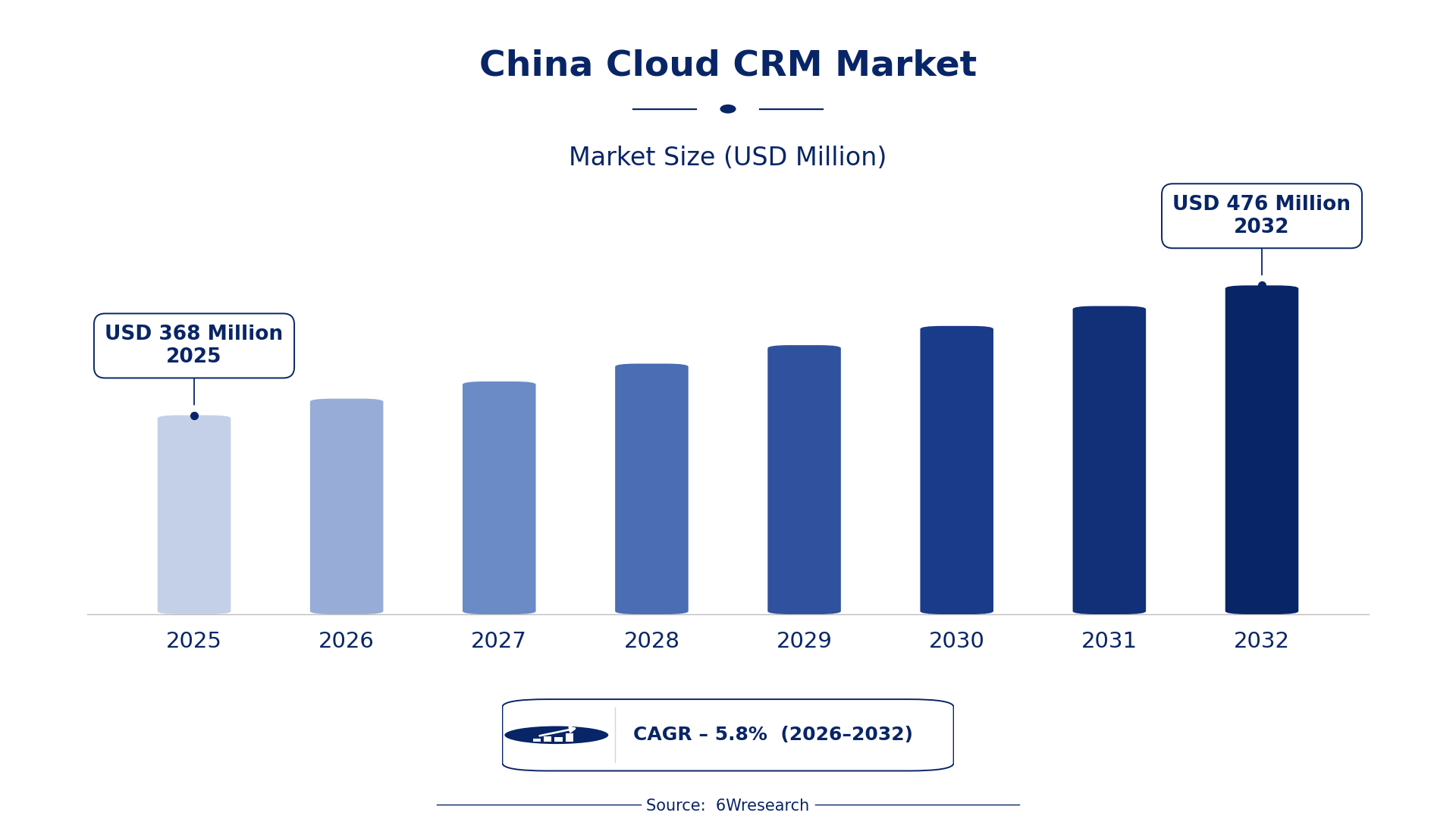
The China Cloud CRM Market was estimated at USD 368 Million in 2025 and is projected to reach USD 476 Million by 2032, growing at a CAGR of 5.8% from 2026 to 2032.
China Cloud CRM Market Synopsis
The surge in digital transformation initiatives across various sectors is the most influential force shaping the China Cloud CRM market today. Businesses increasingly recognize the importance of cloud-based customer relationship management solutions to enhance operational efficiency and customer engagement.
This growth is further fueled by the rapid expansion of the e-commerce sector and a heightened focus on personalized customer experiences. As companies strive to meet the demands of a tech-savvy customer base, the need for innovative CRM solutions tailored to local market needs is more critical than ever.
China Cloud CRM Market Year-wise Growth Rate and Key Drivers
This graph illustrates the annual growth rates of the China Cloud CRM Market from 2021 to 2032, highlighting a steady upward trajectory and projected expansion over the forecast period.
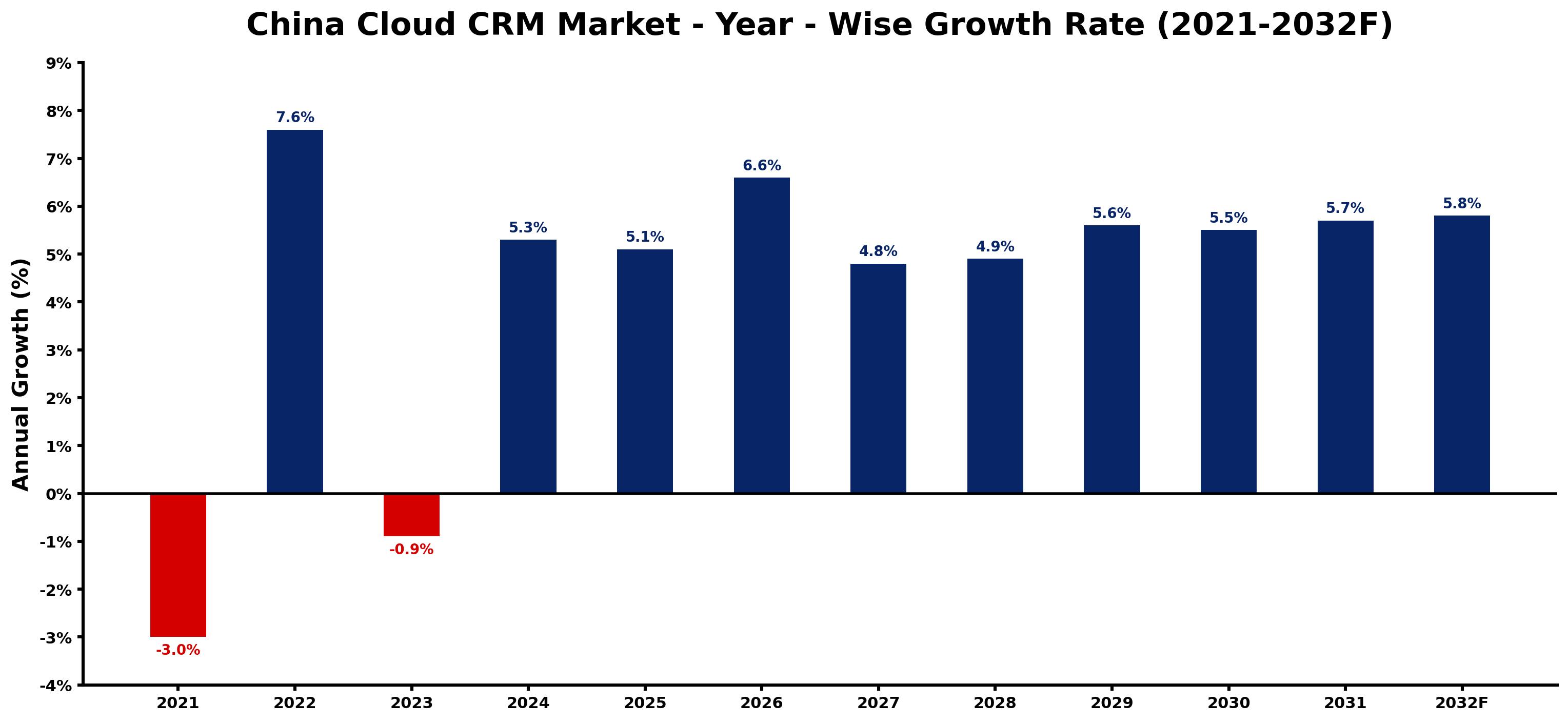
The table below presents the year‑wise growth rates along with the key drivers influencing the market
| Year | Growth Rate | Major Drivers |
| 2021 | -3.0% | Tencent's WeChat limited third-party CRM integrations significantly. |
| 2022 | 7.6% | Increased adoption of remote work enhancing CRM usage. |
| 2023 | -0.9% | Chinese data privacy laws curtailed foreign SaaS access. |
| 2024 | 5.3% | Growing small business digitalization backed by policy incentives. |
| 2025 | 5.1% | Expanding e-commerce sector requiring sophisticated customer management solutions. |
| 2026 | 6.6% | Enhanced data privacy regulations boosting secure CRM investments. |
| 2027 | 4.8% | Shift towards mobile-first solutions driving CRM demand. |
| 2028 | 4.9% | Increased competition among enterprises catalyzing CRM upgrades. |
| 2029 | 5.6% | Rising reliance on data analytics for customer retention. |
| 2030 | 5.5% | Emergence of localized cloud providers supporting market growth. |
| 2031 | 5.7% | Growing integration of social media channels into CRM systems. |
| 2032 | 5.8% | Government initiatives promoting technology adoption in businesses. |
Note: Market size estimations and growth projections presented in this report are based on 6Wresearch's proprietary forecasting methodology, utilizing the latest available industry data, government publications, and primary research inputs.
China Cloud CRM Market Key Takeaways
Below are some of the specific key takeaways from the market, including:
- The market is experiencing strong growth driven by cloud technology adoption.
- Integration of AI and machine learning in CRM systems is becoming a standard expectation.
- Mobile CRM applications are increasingly important for accommodating a mobile workforce.
- Data security and compliance with local regulations remain top priorities for businesses.
- Customization and industry-specific solutions are essential for meeting diverse client needs.
Evaluation of Restraints in China Cloud CRM Market
Despite the promising growth trajectory, several constraints hinder the full potential of the China Cloud CRM market. Stringent data security regulations create apprehension among businesses regarding compliance. on top of that, cultural nuances can complicate CRM implementation, requiring adaptations that not all vendors are prepared to make. There's also intense competition, particularly among local providers, which can lead to pricing pressures that impact service quality. Many small and medium-sized enterprises (SMEs) lack awareness of cloud CRM benefits, further limiting market penetration. Continuous innovation is necessary for providers to stay relevant in this fast-paced environment.
China Cloud CRM Market Trends
Several trends are shaping the China Cloud CRM market, primarily the infusion of artificial intelligence and big data analytics into CRM platforms. This integration enables deeper customer insights and personalized experiences, which are increasingly demanded by consumers. Another trend is the escalating importance of mobile CRM solutions, as businesses adapt to the needs of a mobile workforce. Additionally, there is a growing emphasis on data privacy and security compliance, pushing vendors to enhance their security measures while developing CRM solutions.
China Cloud CRM Market Opportunities
The China Cloud CRM market offers substantial investment opportunities, particularly for vendors who can address specific industry needs. As companies continue to undergo digital transformation, innovative CRM solutions that incorporate AI and analytics will be highly sought after. on top of that, strategic partnerships with local firms can facilitate market entry and enhance service delivery, particularly in navigating regulatory challenges. The shift towards industry-specific CRM solutions, especially in sectors like finance and healthcare, presents additional avenues for growth.
Government Initiatives in the China Cloud CRM Market
The Chinese government is actively shaping the Cloud CRM market through a series of regulations and initiatives aimed at fostering a secure and competitive environment. Emphasis on data security and privacy is paramount, with policies designed to protect consumer information while encouraging the growth of domestic CRM providers. These initiatives are critical as they set the framework within which businesses must operate, making government support essential for market stability.
- A recently completed initiative focused on enhancing data security standards for CRM providers, implemented in early 2025.
- A currently ongoing public-private partnership aimed at developing a comprehensive digital infrastructure, enhancing CRM capabilities across industries.
- A planned regulatory framework expected to be introduced in late 2026, mandating transparency in data handling practices for CRM vendors.
- An initiative to promote the adoption of cloud technologies among SMEs, aimed at increasing market penetration for CRM solutions.
- A national policy introduced in mid-2025 to streamline compliance processes for CRM service providers, aimed at reducing barriers to entry.
Future Insights of the China Cloud CRM Market
Looking ahead to 2026-2032, the China Cloud CRM market is set for substantial growth. As businesses increasingly recognize the value of customer engagement, the demand for advanced CRM solutions will continue to surge. Technological advancements, particularly in AI and machine learning, will enhance CRM functionalities, making them indispensable for customer relationship management. Additionally, government initiatives aimed at supporting digitalization will further stimulate market development, presenting lucrative opportunities for both domestic and international providers.
China Cloud CRM Market Latest Developments
In the past year, the China Cloud CRM market has witnessed notable advancements and activities that signal a vibrant industry. Companies are increasingly prioritizing technological upgrades and strategic partnerships to enhance their service offerings. The competitive landscape is evolving, with both local and international players striving to capture market share through innovation and tailored solutions.
- A major technology vendor launched a new AI-driven CRM platform in Q2 2025, aimed at enhancing customer insights and personalization.
- An initiative began in early 2025 to collaborate with local businesses for developing customized CRM solutions tailored to specific industry needs.
- A rollout of enhanced data security features is currently underway, expected to be completed by late 2025, in response to regulatory pressures.
- A planned expansion of cloud infrastructure is set to begin in early 2026, targeting underserved regions to improve CRM accessibility.
- A recent partnership between a leading regional operator and a local tech firm aims to create innovative mobile CRM applications, currently in the development phase.
China Cloud CRM Market - Key Attractiveness of the Report
- 10 Years of Market Numbers
- Historical Data Starting from 2022 to 2025
- Base Year: 2025
- Forecast Data until 2032
- Key Performance Indicators Impacting the Market
- Major Upcoming Developments and Projects
Key Highlights of the Report:
- China Cloud CRM Market Outlook
- Market Size of China Cloud CRM Market, 2025
- Forecast of China Cloud CRM Market, 2032
- Historical Data and Forecast of China Cloud CRM Revenues & Volume for the Period 2022-2032F
- China Cloud CRM Market Trend Evolution
- China Cloud CRM Market Drivers and Challenges
- China Cloud CRM Price Trends
- China Cloud CRM Porter's Five Forces
- China Cloud CRM Industry Life Cycle
- Historical Data and Forecast of China Cloud CRM Market Revenues & Volume By Vertical for the Period 2022-2032F
- Historical Data and Forecast of China Cloud CRM Market Revenues & Volume By Nonprofit for the Period 2022-2032F
- Historical Data and Forecast of China Cloud CRM Market Revenues & Volume By Higher Education for the Period 2022-2032F
- Historical Data and Forecast of China Cloud CRM Market Revenues & Volume By Nonprofit Sub Vertical for the Period 2022-2032F
- Historical Data and Forecast of China Cloud CRM Market Revenues & Volume By Education for the Period 2022-2032F
- Historical Data and Forecast of China Cloud CRM Market Revenues & Volume By Research and Innovation for the Period 2022-2032F
- Historical Data and Forecast of China Cloud CRM Market Revenues & Volume By Social Affairs for the Period 2022-2032F
- Historical Data and Forecast of China Cloud CRM Market Revenues & Volume By Children and Youth for the Period 2022-2032F
- Historical Data and Forecast of China Cloud CRM Market Revenues & Volume By Art and Culture for the Period 2022-2032F
- Historical Data and Forecast of China Cloud CRM Market Revenues & Volume By Others for the Period 2022-2032F
- China Cloud CRM Import Export Trade Statistics
- Market Opportunity Assessment By Vertical
- Market Opportunity Assessment By Nonprofit Sub Vertical
- China Cloud CRM Top Companies Market Share
- China Cloud CRM Competitive Benchmarking By Technical and Operational Parameters
- China Cloud CRM Company Profiles
- China Cloud CRM Key Strategic Recommendations






































