China Coffee Capsules Market Top 5 Importing Countries and Market Competition (HHI) Analysis
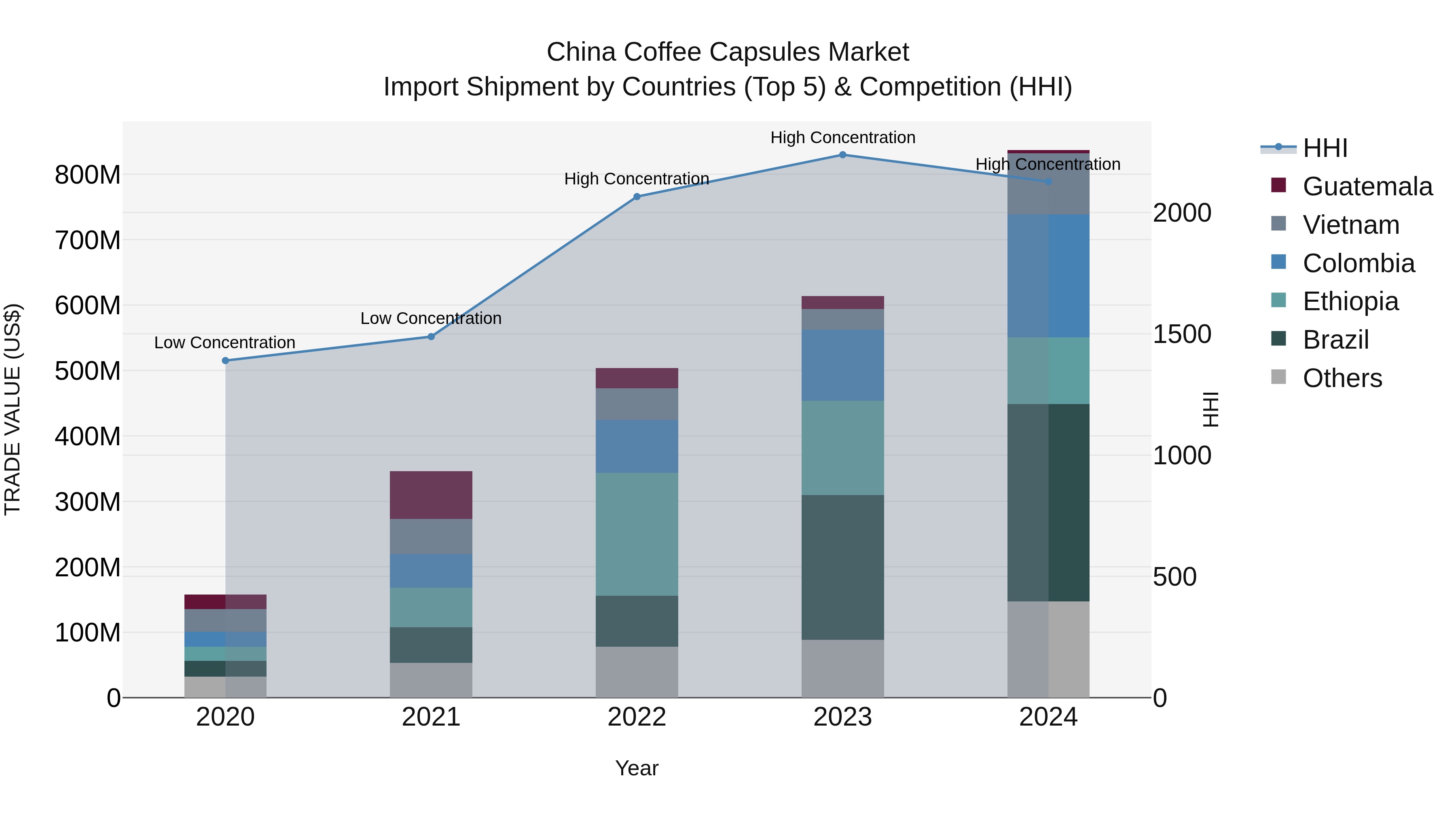
China coffee capsule import market in 2024 continued to show strong growth, with notable contributions from top exporting countries such as Brazil, Colombia, Ethiopia, Vietnam, and Indonesia. The high Herfindahl-Hirschman Index (HHI) indicates a concentrated market, while the impressive Compound Annual Growth Rate (CAGR) of 51.79% from 2020 to 2024 underscores the increasing demand for coffee capsules in China. Furthermore, the growth rate of 36.28% from 2023 to 2024 suggests sustained momentum in the market, promising opportunities for both domestic and international coffee capsule suppliers.
China Coffee Capsules Market Overview
The China coffee capsules market has experienced significant growth in recent years, driven by increasing coffee consumption among the country`s growing middle-class population. Consumers are increasingly seeking convenience and quality in their coffee choices, leading to a rising demand for coffee capsules. Key players in the market are introducing a variety of flavors and blends to cater to diverse consumer preferences. The market is also witnessing a shift towards sustainable and eco-friendly options, with more environmentally conscious consumers opting for biodegradable coffee capsules. E-commerce platforms are playing a crucial role in the distribution of coffee capsules, offering a convenient purchasing experience for consumers. Overall, the China coffee capsules market is poised for further expansion as coffee culture continues to evolve in the country.
China Coffee Capsules Market Trends
The China coffee capsules market is experiencing significant growth driven by increasing consumer demand for convenience, premium coffee experiences, and a growing coffee culture. Key trends in the market include the rising popularity of single-serve coffee options, especially among urban consumers looking for quick and easy ways to enjoy high-quality coffee at home or on-the-go. Additionally, there is a growing interest in sustainable and eco-friendly coffee capsule options, leading to the introduction of compostable and biodegradable capsules. The market is also seeing increased competition among both domestic and international coffee capsule brands, leading to innovations in flavors, packaging, and marketing strategies to attract and retain customers in this competitive landscape. Overall, the China coffee capsules market is evolving rapidly to meet the changing preferences and lifestyles of Chinese consumers.
China Coffee Capsules Market Challenges
The China coffee capsules market faces several challenges, including intense competition from established local and international brands, price sensitivity among Chinese consumers, and the dominance of traditional tea culture over coffee consumption. Additionally, logistical challenges related to distribution and supply chain management in a vast and diverse market like China can hinder the growth of coffee capsule brands. Furthermore, increasing environmental concerns regarding the disposal of single-use plastic capsules have led to calls for more sustainable packaging solutions, posing a challenge for companies operating in this market. Overall, navigating these challenges requires innovative marketing strategies, investment in sustainability initiatives, and a deep understanding of the evolving preferences and behaviors of Chinese coffee consumers.
China Coffee Capsules Market Investment Opportunities
The China coffee capsules market presents lucrative investment opportunities due to the growing adoption of coffee culture and changing consumer preferences towards convenience. With a rising middle-class population and increasing urbanization, there is a growing demand for premium coffee products, including coffee capsules. Investing in this market offers the potential for significant growth as major coffee companies expand their presence in China and local players enter the market. Additionally, the shift towards at-home consumption of coffee due to the COVID-19 pandemic has further boosted the demand for coffee capsules. Investors can consider opportunities in manufacturing and distribution of coffee capsules, partnering with established brands for market entry, or investing in innovative technologies for sustainable and eco-friendly capsule solutions to capitalize on the expanding China coffee capsules market.
China Coffee Capsules Market Government Policy
Government policies in China related to the coffee capsules market primarily focus on environmental sustainability and waste management. In 2019, China implemented regulations to reduce single-use plastic waste, including restrictions on the production, sale, and use of disposable plastic products such as coffee capsules. The government aims to promote the use of biodegradable and eco-friendly alternatives to reduce environmental pollution. Additionally, China has also introduced policies to support domestic coffee production and promote local coffee brands, encouraging the growth of the coffee industry within the country. These policies aim to create a more sustainable and environmentally friendly coffee market in China while also supporting the development of local businesses and industries.
China Coffee Capsules Market Future Outlook
The China coffee capsules market is poised for significant growth in the coming years, driven by the increasing adoption of coffee culture among Chinese consumers, particularly the younger demographic. The convenience and quality offered by coffee capsules are attracting more consumers looking for a quick and easy way to enjoy their favorite brew at home or in the office. The market is also benefiting from the rising disposable incomes and changing lifestyles in China, which are fueling the demand for premium coffee products. As more international coffee brands enter the market and domestic players expand their offerings, competition is expected to intensify, leading to innovation and product diversification. Overall, the China coffee capsules market is forecasted to experience robust growth in the foreseeable future, presenting opportunities for both established players and new entrants to capitalize on this expanding market segment.
Key Highlights of the Report:
- China Coffee Capsules Market Outlook
- Market Size of China Coffee Capsules Market, 2024
- Forecast of China Coffee Capsules Market, 2031
- Historical Data and Forecast of China Coffee Capsules Revenues & Volume for the Period 2021-2031
- China Coffee Capsules Market Trend Evolution
- China Coffee Capsules Market Drivers and Challenges
- China Coffee Capsules Price Trends
- China Coffee Capsules Porter's Five Forces
- China Coffee Capsules Industry Life Cycle
- Historical Data and Forecast of China Coffee Capsules Market Revenues & Volume By Material Type for the Period 2021-2031
- Historical Data and Forecast of China Coffee Capsules Market Revenues & Volume By Aluminium for the Period 2021-2031
- Historical Data and Forecast of China Coffee Capsules Market Revenues & Volume By Compostable for the Period 2021-2031
- Historical Data and Forecast of China Coffee Capsules Market Revenues & Volume By PBT Plastic for the Period 2021-2031
- Historical Data and Forecast of China Coffee Capsules Market Revenues & Volume By End user for the Period 2021-2031
- Historical Data and Forecast of China Coffee Capsules Market Revenues & Volume By Commercial for the Period 2021-2031
- Historical Data and Forecast of China Coffee Capsules Market Revenues & Volume By Residential for the Period 2021-2031
- Historical Data and Forecast of China Coffee Capsules Market Revenues & Volume By Distribution Channel for the Period 2021-2031
- Historical Data and Forecast of China Coffee Capsules Market Revenues & Volume By Supermarkets and Hypermarkets for the Period 2021-2031
- Historical Data and Forecast of China Coffee Capsules Market Revenues & Volume By Convenience Stores for the Period 2021-2031
- Historical Data and Forecast of China Coffee Capsules Market Revenues & Volume By Online Stores for the Period 2021-2031
- Historical Data and Forecast of China Coffee Capsules Market Revenues & Volume By Specialty Stores for the Period 2021-2031
- Historical Data and Forecast of China Coffee Capsules Market Revenues & Volume By Others for the Period 2021 - 2031
- China Coffee Capsules Import Export Trade Statistics
- Market Opportunity Assessment By Material Type
- Market Opportunity Assessment By End user
- Market Opportunity Assessment By Distribution Channel
- China Coffee Capsules Top Companies Market Share
- China Coffee Capsules Competitive Benchmarking By Technical and Operational Parameters
- China Coffee Capsules Company Profiles
- China Coffee Capsules Key Strategic Recommendations






































