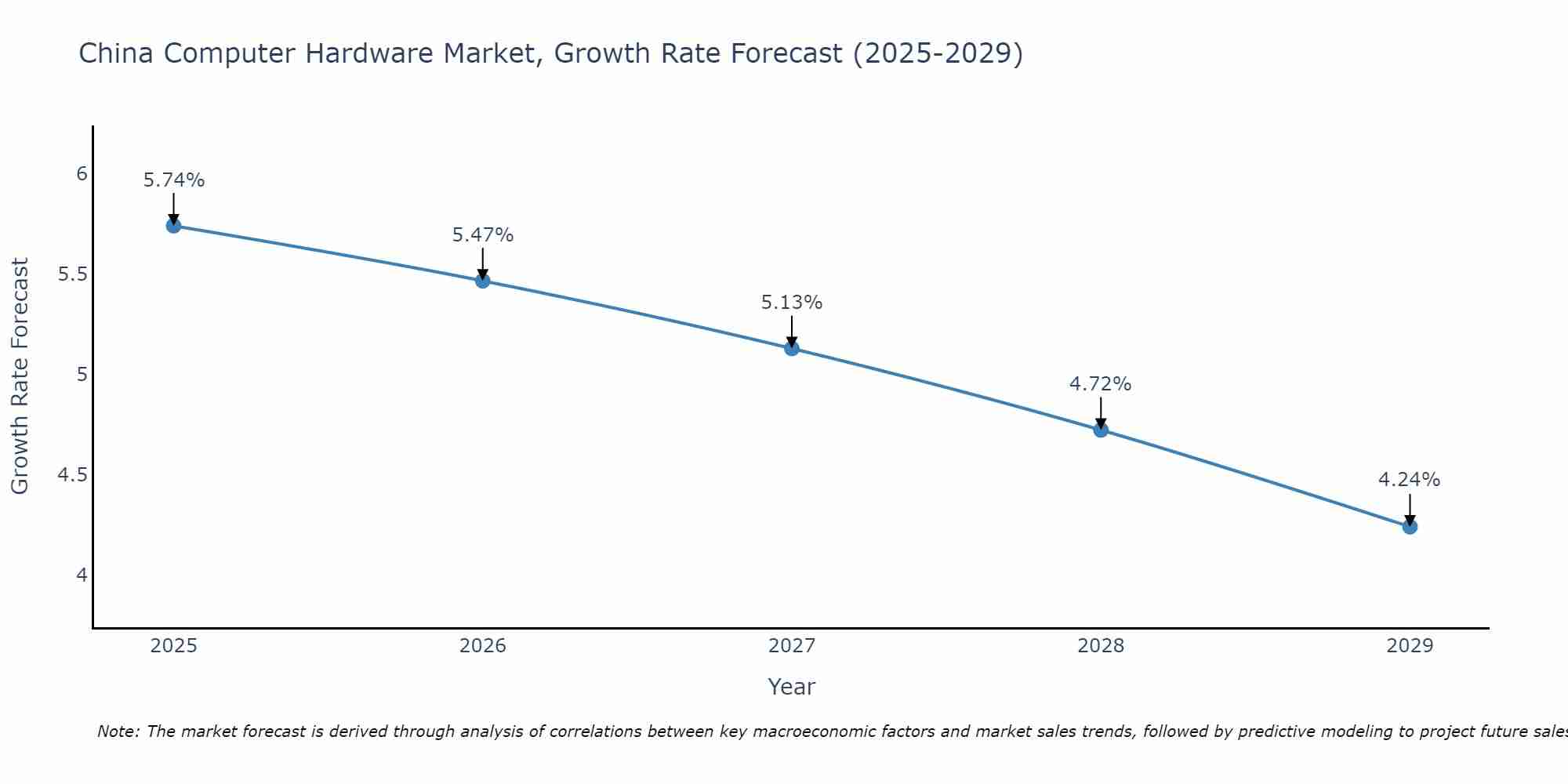
China Computer Hardware Market Size Growth Rate
The China Computer Hardware Market could see a tapering of growth rates over 2025 to 2029. Although the growth rate starts strong at 5.74% in 2025, it steadily loses momentum, ending at 4.24% by 2029.
China Computer Hardware Market Highlights
| Report Name | China Computer Hardware Market |
| Forecast Period | 2025-2029 |
| CAGR | 4.24% |
| Growing Sector | AI and High-Performance Computing |
Topics Covered in the China Computer Hardware Market Report
The China Computer Hardware Market report offers a comprehensive analysis by type, end-user, and distribution channel segments. The report presents an unbiased and comprehensive view of the latest market trends, opportunities, and drivers. It enables stakeholders to formulate robust strategies according to evolving consumer demands and regulatory frameworks, offering insights into emerging segments and competitive landscape dynamics to maximize revenue potential.
China Computer Hardware Market Synopsis
China Computer Hardware Market is set for major growth as technology uptake speeds up in consumer and commercial sectors alike. Rising investments in smart manufacturing, AI adoption, and cloud infrastructure drive the market demand. Strengthened local manufacturing alongside growing domestic consumption support this rise.
Moreover, government policies propelling digital infrastructure and semiconductor innovation boost hardware use nationwide. This trend not only increases the competitiveness of local businesses but also attracts foreign investments, further making China position in the global tech market.
Evaluation of Growth Drivers in the China Computer Hardware Market
Below mentioned are some prominent drivers and their influence to the market dynamics:
| Driver | Primary Segments Affected | Why it matters (evidence) |
| Government Procurement & Tech Self‑Reliance Policies | Servers; Computers; Storage Devices; Commercial End‑User | Policies such as the “ITAI (Information Technology Application Innovation)” procurement guideline prioritize domestic brands and domestic processors/OS in government & education sectors. |
| Growth of Data Centers & AI Applications | Servers; High‑Performance Computers; Storage Devices; Commercial End‑User | Programs like “East Data, West Compute” expanding cloud and compute infrastructure; rising demand for AI‑accelerators & efficient data center processors. |
| Rising Household and Consumer Demand for Laptops & Hybrid Devices | Computers; Peripherals; Household End‑User | Personal computer market in China projected to grow from USD 24.8 billion in 2024 to USD 38.9 billion by 2030; laptops are the largest type, hybrid devices growing fastest. |
| Expansion of Online Distribution Channels & E‑Commerce Platforms | All types; Online Distribution Channel | Increasing penetration of online retail; digital marketplaces and live‑stream sales; reduction in cost & wider reach. |
The China Computer Hardware Market is projected to grow rapidly, growing at a compound annual growth rate of (CAGR) of 4.24% during the forecast period 2025-2029. Increasing demand for gaming hardware, cloud computing expansion, and growing e-commerce platforms are key growth drivers. Rising disposable incomes and urbanization, together with strong government support for the semiconductor industry, improve market prospects.
Moreover, increasing enterprise investments in server infrastructure and data storage play a significant role. Innovations in peripheral device technologies that meet changing consumer demands also contribute importantly in driving growth and expanding opportunities within semiconductor and gaming hardware sectors.
Evaluation of Restraints in the China Computer Hardware Market
Below mentioned are some major restraints and their influence to the market dynamics:
| Restraint | Primary Segments Affected | What this means (evidence) |
| Supply Chain Constraints & Import Restrictions | Servers, Storage Devices; High‑performance Components | Export controls and trade tensions restrict supply of advanced foreign CPUs/GPUs; increases cost for hardware dependent on imported components. |
| Price Sensitivity in Household Segment | Laptops, Desktops, Peripherals; Household End‑User | For many consumers, budget constraints slow down upgrades; premium hardware adoption is slower outside tier‑1 cities. |
| Power & Energy Efficiency Regulations | Data Center Servers; Computers | Energy consumption, cooling costs, and regulations demanding lower PUE (Power Usage Effectiveness) influence design; inefficiencies penalized. |
| Competition from Alternative Compute Paradigms | Servers; Computers; Commercial Users | Shift to cloud or thin clients, virtualization, edge/cloud compute reduce need for on‑site heavy hardware for some users. |
China Computer Hardware Market Challenges
Despite of upward trajectory, the China Computer Hardware Market encounters several barriers to sustained growth. Component shortages caused by supply chain disruptions remain a core issue, while intense price competition squeezes margins. The swift pace of technological evolution shortens product life cycles, demanding continuous innovation.
Trade tensions and intellectual property enforcement challenges further complicate international operations. High input costs and substantial innovation funding needs restrict smaller firms from scaling. On top of these, mounting cybersecurity requirements place an additional strain on manufacturers and distributors.
China Computer Hardware Market Trends
Several prominent trends reshaping the China Computer Hardware Industry include:
- AI Capable PCs and Workstations: Increasing inclusion of on device AI accelerators and high-performance GPUs in PCs and workstations, especially for commercial, creative, and research use.
- Hybrid / Convertible Devices: Growth in devices that combine portability and performance, such as 2 in 1 laptop, hybrids, detachable tablets with keyboard, favored by households and education.
- Localized Hardware Ecosystems: Growth in indigenous processors, domestic operating systems, and increased OEM/ODM production inside China to reduce reliance on foreign supply.
- Edge and Cloud Integration: Hardware designed for edge computing, high throughput, low latency; and improved storage & server tech to support cloud services, AI analytics, and big data processing.
Investment Opportunities in the China Computer Hardware Industry
Some prominent investment opportunities in the market are:
- Domestic Processor & AI Accelerator Innovation – Investing in development of CPUs, GPUs, ASICs designed domestically, benefiting from procurement preferences.
- High Performance Storage & SSD Technologies – As data demands grow, there is opportunity in SSDs, NVMe, high density storage, and efficient cooling/storage architectures.
- Hybrid Device & Portable/Thin Form Factor Hardware – Devices integrating with portability and compute power for households, education, remote work, and commercial mobility.
- Data Center & Server Infrastructure Deployments – Large scale server farms, edge computing facilities, AI training & inference clusters, particularly in less saturated western provinces.
Top 5 Leading Players in the China Computer Hardware Market
Some leading players contributing to the China Computer Hardware Growth include:
Lenovo Group Limited
| Company Name | Lenovo Group Limited |
| Established Year | 1984 |
| Headquarters | Beijing, China |
| Official Website | Click Here |
Lenovo provides computers, servers, and storage devices widely used in China’s household, commercial, and government sectors with a focus on innovation and performance.
Huawei Technologies Co., Ltd.
| Company Name | Huawei Technologies Co., Ltd. |
| Established Year | 1987 |
| Headquarters | Shenzhen, China |
| Official Website | Click Here |
Huawei provides computer hardware, including laptops and servers, widely used in China’s commercial and government sectors with a focus on technological self-reliance and AI integration.
Xiaomi Corporation
| Company Name | Xiaomi Corporation |
| Established Year | 2010 |
| Headquarters | Beijing, China |
| Official Website | Click Here |
Xiaomi provides laptops and computer peripherals widely used in China’s household and commercial sectors with a focus on affordability and digital lifestyle integration.
Hasee Computer Co., Ltd.
| Company Name | Hasee Computer Co., Ltd. |
| Established Year | 1995 |
| Headquarters | Shenzhen, China |
| Official Website | Click Here |
Hasee provides desktops and laptops widely used in China’s consumer and education sectors with a focus on cost-efficiency and localized production.
Tongfang Co., Ltd.
| Company Name | Tongfang Co., Ltd. |
| Established Year | 1997 |
| Headquarters | Beijing, China |
| Official Website | Click Here |
Tongfang provides computers and servers widely used in China’s government and institutional sectors with a focus on domestic innovation and national procurement standards.
Government Regulations Introduced in the China Computer Hardware Market
According to Chinese Government Data, there are several policies and regulations being implemented to increase semiconductor self-sufficiency and digital infrastructure growth. Prioritizing local chip production and innovation, the “Made in China 2025” strategy guides efforts.
The Ministry of Industry and Information Technology (MIIT) upholds quality and cybersecurity standards for hardware devices. Concurrently, tax incentives and R&D subsidies encourage modernization, while regulations focus on environmental standards to minimize electronic waste throughout the supply chain.
Future Insights of the China Computer Hardware Market
China Computer Hardware Industry is anticipated to have consistent growth, fueled by innovation in quantum computing and AI chips. Expansion of cloud data centers and 5G technology will boost hardware demand. Blockchain adoption for supply chain transparency and AI-enabled predictive maintenance will raise operational efficiency.
Additionally, rising consumer demand for eco-friendly and modular devices will shape product development. Continued government backing and infrastructure growth will broaden market access in rural and semi-urban regions.
Market Segmentation Analysis
The report offers a comprehensive study of the subsequent market segments and their leading categories.
Computer Peripheral Equipment to Dominate the Market- By Type
According to Sachin, Senior Research Analyst, 6Wresearch, the computer peripheral equipment segment dominates due to rising consumer demand for keyboards, mice, monitors, and gaming accessories. Increasing home office adoption and gaming trends significantly drive this category.
Commercial Segment to Dominate the Market- By End-User
The commercial segment leads due to the escalating investments in enterprise IT infrastructure, data centers, and cloud computing facilities. Growing digital transformation initiatives across finance, healthcare, and manufacturing sectors amplify demand.
Online Distribution Channels to Dominate the Market- By Distribution Channel
Online distribution channels are projected to dominate the China Computer Hardware Market Share in the coming years as consumers increasingly prefer the convenience of e-commerce platforms with extensive product variety and competitive pricing. Major players optimize app-based sales, integrated payment systems, and AI-powered recommendation engines. Offline channels remain vital for enterprise clients requiring customized hardware and technical support.
Key Attractiveness of the Report
- 10 Years of Market Numbers.
- Historical Data Starting from 2021 to 2024.
- Base Year: 2024.
- Forecast Data until 2029
- Key Performance Indicators Impacting the Market.
- Major Upcoming Developments and Projects.
Key Highlights of the Report:
- China Computer Hardware Market Outlook
- Market Size of China Computer Hardware Market, 2024
- Forecast of China Computer Hardware Market, 2029
- Historical Data and Forecast of China Computer Hardware Revenues & Volume for the Period 2019 - 2029F
- China Computer Hardware Market Trend Evolution
- China Computer Hardware Market Drivers and Challenges
- China Computer Hardware Price Trends
- China Computer Hardware Porter's Five Forces
- China Computer Hardware Industry Life Cycle
- Historical Data and Forecast of China Computer Hardware Market Revenues & Volume By Type for the Period 2019 - 2029F
- Historical Data and Forecast of China Computer Hardware Market Revenues & Volume By Computer Peripheral Equipment for the Period 2019 - 2029F
- Historical Data and Forecast of China Computer Hardware Market Revenues & Volume By Computer Storage Devices and Servers for the Period 2019 - 2029F
- Historical Data and Forecast of China Computer Hardware Market Revenues & Volume By Computers for the Period 2019 - 2029F
- Historical Data and Forecast of China Computer Hardware Market Revenues & Volume By End-User for the Period 2019 - 2029F
- Historical Data and Forecast of China Computer Hardware Market Revenues & Volume By Household for the Period 2019 - 2029F
- Historical Data and Forecast of China Computer Hardware Market Revenues & Volume By Commercial for the Period 2019 - 2029F
- Historical Data and Forecast of China Computer Hardware Market Revenues & Volume By Distribution Channel for the Period 2019 - 2029F
- Historical Data and Forecast of China Computer Hardware Market Revenues & Volume By Online for the Period 2019 - 2029F
- Historical Data and Forecast of China Computer Hardware Market Revenues & Volume By Offline for the Period 2019 - 2029F
- China Computer Hardware Import Export Trade Statistics
- Market Opportunity Assessment By Type
- Market Opportunity Assessment By End-User
- Market Opportunity Assessment By Distribution Channel
- China Computer Hardware Top Companies Market Share
- China Computer Hardware Competitive Benchmarking By Technical and Operational Parameters
- China Computer Hardware Company Profiles
- China Computer Hardware Key Strategic Recommendations
Markets Covered
The report subsequently covers the market by following segmentations.
By Type
- Computer Peripheral Equipment
- Computer Storage Devices and Servers
- Computers
By End-User
- Household
- Commercial
By Distribution Channel
- Online
- Offline






































