China Construction Lubricants Market Top 5 Importing Countries and Market Competition (HHI) Analysis
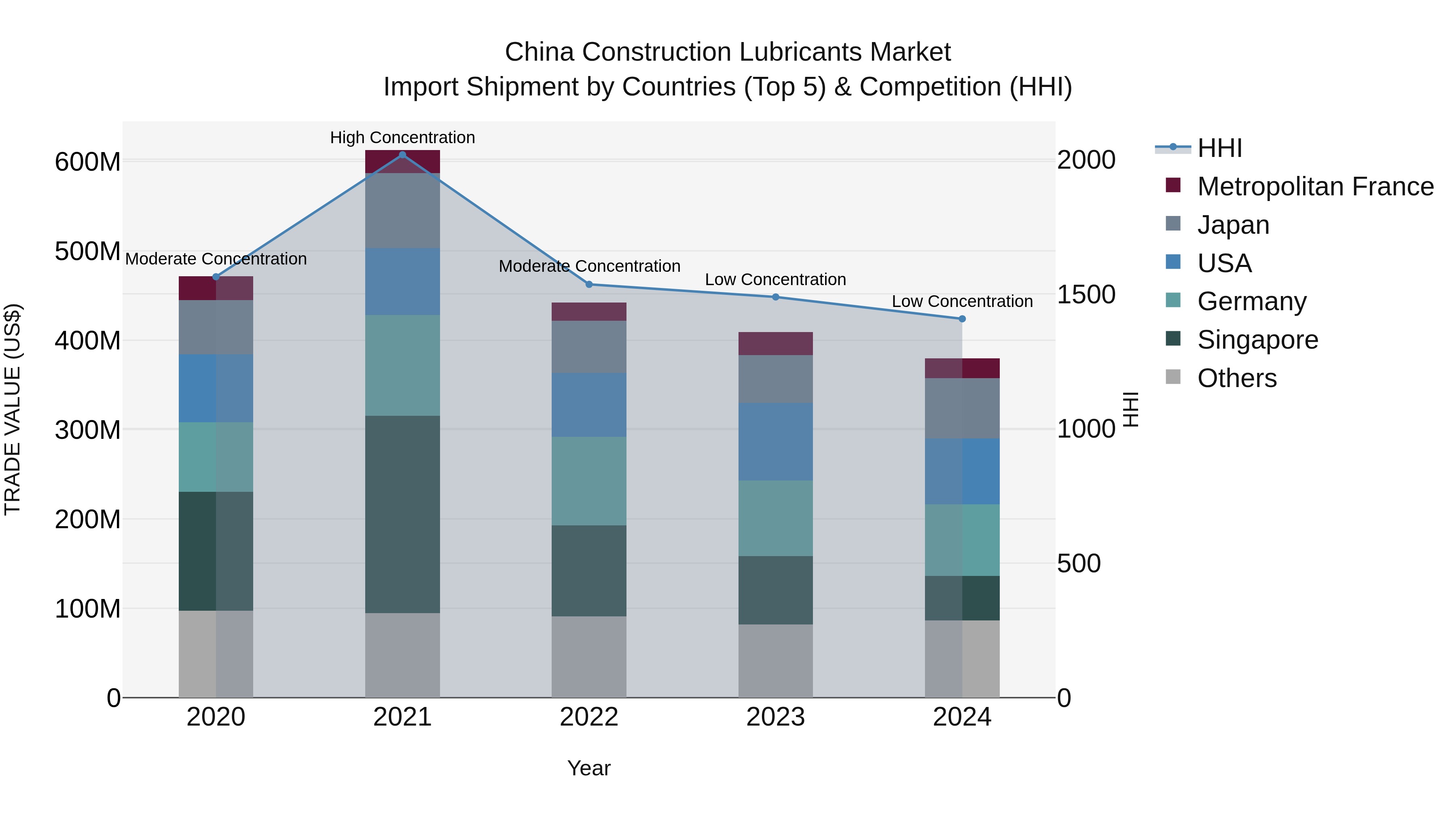
Despite a negative CAGR and declining growth rate in 2024, China construction lubricants import market continues to see diverse sources of supply with top exporting countries including Germany, USA, Japan, Singapore, and Metropolitan France. The low concentration of the Herfindahl-Hirschman Index (HHI) indicates a competitive landscape, ensuring a variety of options for Chinese buyers in the construction lubricants sector. Monitoring trends in these key exporting countries and understanding their market dynamics can provide valuable insights for stakeholders in the industry.
China Construction Lubricants Market Overview
The China construction lubricants market is growing, fueled by the extensive construction activities and the need for efficient machinery operation. Lubricants are critical for minimizing friction, reducing wear and tear, and extending the lifespan of construction equipment. The market is characterized by the increasing use of high-performance synthetic lubricants, which offer better protection and longer intervals between maintenance. Environmental regulations are also pushing for lubricants that are more biodegradable and have a lower environmental impact.
Drivers of the market
The China construction lubricants market is driven by the expansion of the construction and mining sectors, which require a high volume of lubricants to maintain machinery and equipment. The increasing adoption of high-performance lubricants, which enhance equipment efficiency and reduce maintenance costs, further propels market growth. The trend towards mechanization and automation in construction activities also boosts the demand for construction lubricants.
Challenges of the market
The market for construction lubricants in China is challenged by fluctuating oil prices, which directly impact production costs. Environmental regulations and the shift towards sustainable and biodegradable lubricants also require companies to invest heavily in R&D. Moreover, intense competition and price wars among manufacturers affect profitability.
Government Policy of the market
The government regulates the construction lubricants market to ensure the availability of high-quality, environmentally friendly products that enhance equipment performance and longevity. Policies encourage the development and use of biodegradable lubricants and support technological advancements in lubricant formulations. The government also provides tax incentives and subsidies to local manufacturers to increase domestic production capacity and reduce reliance on imports.
Key Highlights of the Report:
- China Construction Lubricants Market Outlook
- Market Size of China Construction Lubricants Market, 2024
- Forecast of China Construction Lubricants Market, 2031
- Historical Data and Forecast of China Construction Lubricants Revenues & Volume for the Period 2021-2031
- China Construction Lubricants Market Trend Evolution
- China Construction Lubricants Market Drivers and Challenges
- China Construction Lubricants Price Trends
- China Construction Lubricants Porter's Five Forces
- China Construction Lubricants Industry Life Cycle
- Historical Data and Forecast of China Construction Lubricants Market Revenues & Volume By Base Oil for the Period 2021-2031
- Historical Data and Forecast of China Construction Lubricants Market Revenues & Volume By Mineral Oil for the Period 2021-2031
- Historical Data and Forecast of China Construction Lubricants Market Revenues & Volume By Synthetic Oil for the Period 2021-2031
- Historical Data and Forecast of China Construction Lubricants Market Revenues & Volume By PAO for the Period 2021-2031
- Historical Data and Forecast of China Construction Lubricants Market Revenues & Volume By PAG for the Period 2021-2031
- Historical Data and Forecast of China Construction Lubricants Market Revenues & Volume By Esters for the Period 2021-2031
- Historical Data and Forecast of China Construction Lubricants Market Revenues & Volume By Group III (Hydrocracking) for the Period 2021-2031
- Historical Data and Forecast of China Construction Lubricants Market Revenues & Volume By Type for the Period 2021-2031
- Historical Data and Forecast of China Construction Lubricants Market Revenues & Volume By Hydraulic Fluid for the Period 2021-2031
- Historical Data and Forecast of China Construction Lubricants Market Revenues & Volume By Engine Oil for the Period 2021-2031
- Historical Data and Forecast of China Construction Lubricants Market Revenues & Volume By Gear Oil for the Period 2021-2031
- Historical Data and Forecast of China Construction Lubricants Market Revenues & Volume By Automatic Transmission Fluid for the Period 2021-2031
- Historical Data and Forecast of China Construction Lubricants Market Revenues & Volume By Grease for the Period 2021-2031
- Historical Data and Forecast of China Construction Lubricants Market Revenues & Volume By Compressor Oil for the Period 2021-2031
- Historical Data and Forecast of China Construction Lubricants Market Revenues & Volume By Others for the Period 2021-2031
- Historical Data and Forecast of China Construction Lubricants Market Revenues & Volume By Equipment Type for the Period 2021-2031
- Historical Data and Forecast of China Construction Lubricants Market Revenues & Volume By Earthmoving for the Period 2021-2031
- Historical Data and Forecast of China Construction Lubricants Market Revenues & Volume By Material Handling for the Period 2021-2031
- Historical Data and Forecast of China Construction Lubricants Market Revenues & Volume By Heavy Construction Vehicle for the Period 2021-2031
- China Construction Lubricants Import Export Trade Statistics
- Market Opportunity Assessment By Base Oil
- Market Opportunity Assessment By Type
- Market Opportunity Assessment By Equipment Type
- China Construction Lubricants Top Companies Market Share
- China Construction Lubricants Competitive Benchmarking By Technical and Operational Parameters
- China Construction Lubricants Company Profiles
- China Construction Lubricants Key Strategic Recommendations






































