China Construction Plastics Market Size, Share & Growth Rate
The China Construction Plastics Market was estimated at USD 114 Million in 2025 and is projected to reach USD 134 Million by 2032, growing at a CAGR of 2.3% from 2026 to 2032. This growth trajectory is underpinned by an ever-increasing demand for lightweight, durable materials across various construction applications. Factors such as rapid urbanization, significant government investment in infrastructure, and a pronounced shift towards energy-efficient building practices are key contributors to this upward trend.
China Construction Plastics Market Year-wise Growth Rate and Key Drivers
This graph highlights how the China Construction Plastics Market has steadily grown over the years, supported by major growth factors.
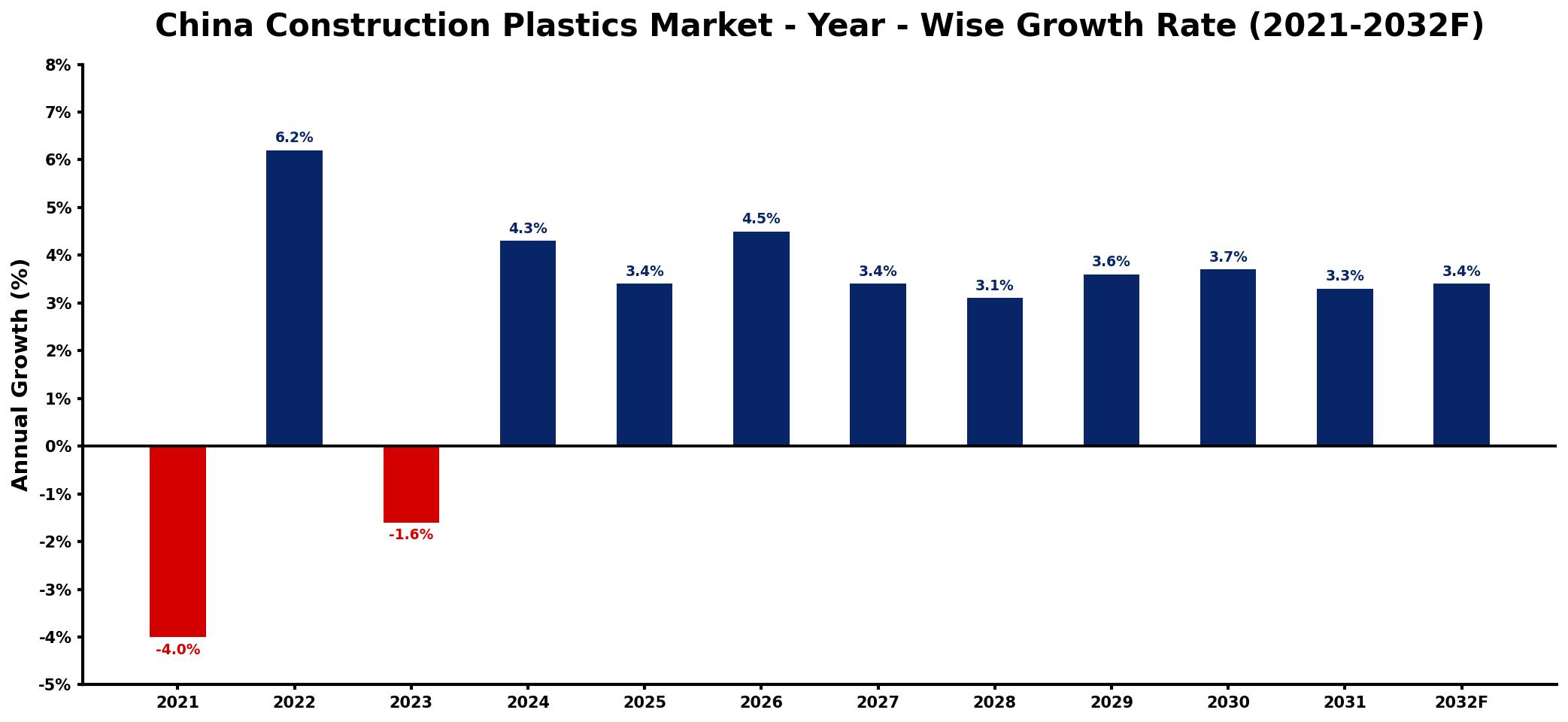
The table below presents the year‑wise growth rates along with the key drivers influencing the market
| Year | Growth Rate | Major Drivers |
| 2021 | -4.0% | decreased infrastructure investment activity |
| 2022 | 6.2% | increased residential building projects |
| 2023 | -1.6% | lower consumer spending trends |
| 2024 | 4.3% | expanding renewable energy initiatives |
| 2025 | 3.4% | growing automotive manufacturing demand |
| 2026 | 4.5% | rising urbanization rates observed |
| 2027 | 3.4% | increased public transportation investments |
| 2028 | 3.1% | growing e-commerce logistics expansion |
| 2029 | 3.6% | enhanced waste management solutions |
| 2030 | 3.7% | expanding green building certifications |
| 2031 | 3.3% | increased overall sector activity |
| 2032 | 3.4% | growing demand for sustainable materials |
Note: Market size estimations and growth projections presented in this report are based on 6Wresearch's proprietary forecasting methodology, utilizing the latest available industry data, government publications, and primary research inputs.
China Construction Plastics Market Synopsis
While the China construction plastics market has shown impressive momentum, the future presents both challenges and opportunities. The integration of innovative plastic solutions is expected to enhance performance while addressing environmental concerns, highlighting a pivotal shift toward sustainability.
Moving forward, the market is increasingly being influenced by stringent regulations aimed at reducing plastic waste. Companies are now compelled to adopt greener practices, which will shape the landscape of construction materials and technology.
China Construction Plastics Market Key Takeaways
- The market is driven by the demand for lightweight and cost-effective construction materials.
- Urbanization and infrastructure investments are propelling market growth.
- Government policies are shifting towards sustainable and recyclable materials.
- Innovations in plastic technology are enhancing performance and energy efficiency.
- Environmental concerns continue to challenge traditional plastic usage in construction.
Evaluation of Restraints in China Construction Plastics Market
Despite significant growth, the China construction plastics market faces notable restraints. Environmental concerns have led to increasing regulatory pressures, compelling the industry to reevaluate its practices. The competition from alternative materials perceived as more environmentally friendly has put further strain on the traditional plastics segment. Additionally, fluctuating raw material prices and supply chain disruptions pose ongoing challenges for stakeholders in the market, affecting production capabilities and profit margins.
China Construction Plastics Market Trends
Current trends indicate a pronounced shift towards green building practices. Companies are innovating with materials that not only meet performance standards but also minimize environmental impact. Furthermore, the integration of advanced manufacturing technologies is enhancing the efficiency and functionality of construction plastics, driving demand in piping, insulation, and roofing applications. There is a growing focus on materials that offer improved insulation properties, which aligns with the broader industry movement toward energy efficiency.
China Construction Plastics Market Opportunities
The market is ripe with opportunities for growth and investment, particularly in the development of new, sustainable products. The growing emphasis on recycling and biodegradable plastics in construction applications presents avenues for innovation and differentiation. Additionally, as urban centers expand, there will be an ongoing need for durable, lightweight materials, making it a lucrative segment for investment. Collaboration with governmental initiatives aimed at promoting sustainability will also create further opportunities for companies willing to adapt.
Government Initiatives in the China Construction Plastics Market
The Chinese government is actively promoting sustainability within the construction sector through various initiatives. Policies are focused on reducing environmental impact and encouraging the use of recyclable materials. Incentives are in place for companies that implement green manufacturing processes, thereby aligning economic growth with ecological responsibility. Regulations emphasizing waste management and recycling play a crucial role in shaping the future of the construction plastics landscape, urging manufacturers to adopt innovative approaches.
Future Insights of the China Construction Plastics Market
Looking ahead to 2026-2032, the China construction plastics market is expected to evolve significantly. With continuing urbanization and a focus on sustainable practices, the demand for innovative materials will likely increase. The push for energy-efficient buildings will drive advancements in insulation and performance characteristics of plastics. As regulations tighten, companies that adapt swiftly to changing market conditions and invest in sustainable solutions will be well-positioned to thrive in this dynamic landscape.
China Construction Plastics Market Latest Developments (2025 - 2026)
Recent developments indicate a robust trajectory for the construction plastics sector as manufacturers are responding to market demands with innovative products. Initiatives to enhance recycling processes are gaining traction, as firms prioritize sustainable practices. Industry conferences have been highlighting breakthroughs in material technology, showcasing advancements that promise enhanced efficiency and reduced environmental footprints. Collaborative efforts between public and private sectors are fostering a forward-looking environment geared toward sustainability.
China Construction Plastics Market - Key Attractiveness of the Report
- 10 Years of Market Numbers
- Historical Data Starting from 2022 to 2025
- Base Year: 2025
- Forecast Data until 2032
- Key Performance Indicators Impacting the Market
- Major Upcoming Developments and Projects
Key Highlights of the Report:
- China Construction Plastics Market Outlook
- Market Size of China Construction Plastics Market, 2025
- Forecast of China Construction Plastics Market, 2032
- Historical Data and Forecast of China Construction Plastics Revenues & Volume for the Period 2022-2032F
- China Construction Plastics Market Trend Evolution
- China Construction Plastics Market Drivers and Challenges
- China Construction Plastics Price Trends
- China Construction Plastics Porter's Five Forces
- China Construction Plastics Industry Life Cycle
- Historical Data and Forecast of China Construction Plastics Market Revenues & Volume By Type for the Period 2022-2032F
- Historical Data and Forecast of China Construction Plastics Market Revenues & Volume By Pvc for the Period 2022-2032F
- Historical Data and Forecast of China Construction Plastics Market Revenues & Volume By Polyurethane for the Period 2022-2032F
- Historical Data and Forecast of China Construction Plastics Market Revenues & Volume By Polypropylene for the Period 2022-2032F
- Historical Data and Forecast of China Construction Plastics Market Revenues & Volume By Polyethylene for the Period 2022-2032F
- Historical Data and Forecast of China Construction Plastics Market Revenues & Volume By Application for the Period 2022-2032F
- Historical Data and Forecast of China Construction Plastics Market Revenues & Volume By Window for the Period 2022-2032F
- Historical Data and Forecast of China Construction Plastics Market Revenues & Volume By Roofing for the Period 2022-2032F
- Historical Data and Forecast of China Construction Plastics Market Revenues & Volume By Flooring for the Period 2022-2032F
- Historical Data and Forecast of China Construction Plastics Market Revenues & Volume By Insulation for the Period 2022-2032F
- Historical Data and Forecast of China Construction Plastics Market Revenues & Volume By Piping for the Period 2022-2032F
- China Construction Plastics Import Export Trade Statistics
- Market Opportunity Assessment By Type
- Market Opportunity Assessment By Application
- China Construction Plastics Top Companies Market Share
- China Construction Plastics Competitive Benchmarking By Technical and Operational Parameters
- China Construction Plastics Company Profiles
- China Construction Plastics Key Strategic Recommendations






































