China Contactless Payment Market Size & Growth Rate (2026-2032)
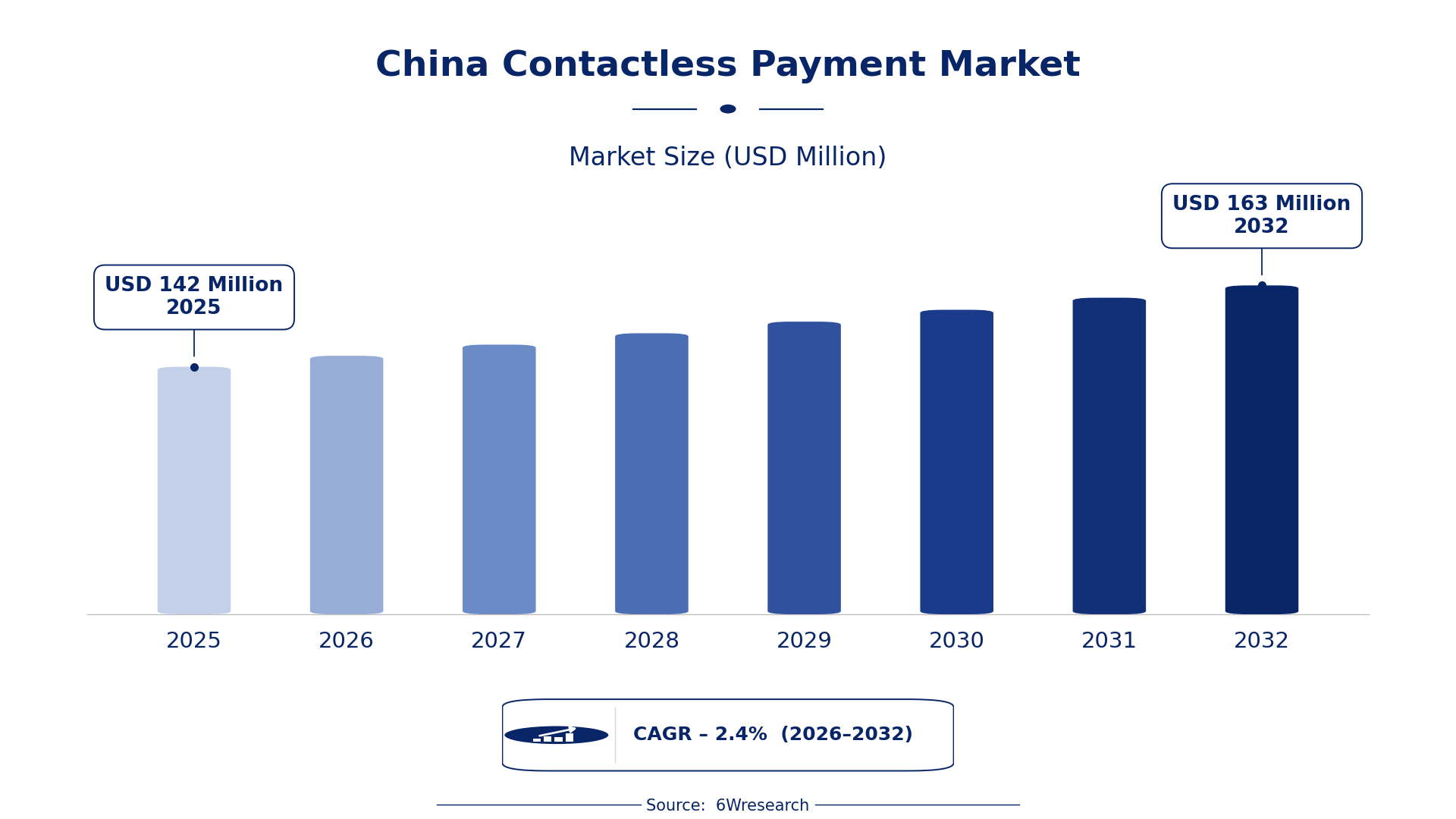
The China Contactless Payment Market was estimated at USD 142 Million in 2025 and is projected to reach USD 163 Million by 2032, growing at a CAGR of 2.4% from 2026 to 2032.
China Contactless Payment Market Synopsis
The momentum in the China contactless payment market has accelerated significantly in recent years, fueled by a cultural shift towards digital transactions. As consumers embrace the convenience of contactless methods, the market is set to evolve further, with an emphasis on security and enhanced user experience.
Looking ahead, the market is expected to expand as both consumers and merchants increasingly recognize the benefits of contactless payments. The interplay between technology advancements and government initiatives will continue to shape the future of payment systems in China.
China Contactless Payment Market Year-wise Growth Rate and Key Drivers
This graph illustrates the annual growth rates of the China Contactless Payment Market from 2021 to 2032, highlighting a steady upward trajectory and projected expansion over the forecast period.
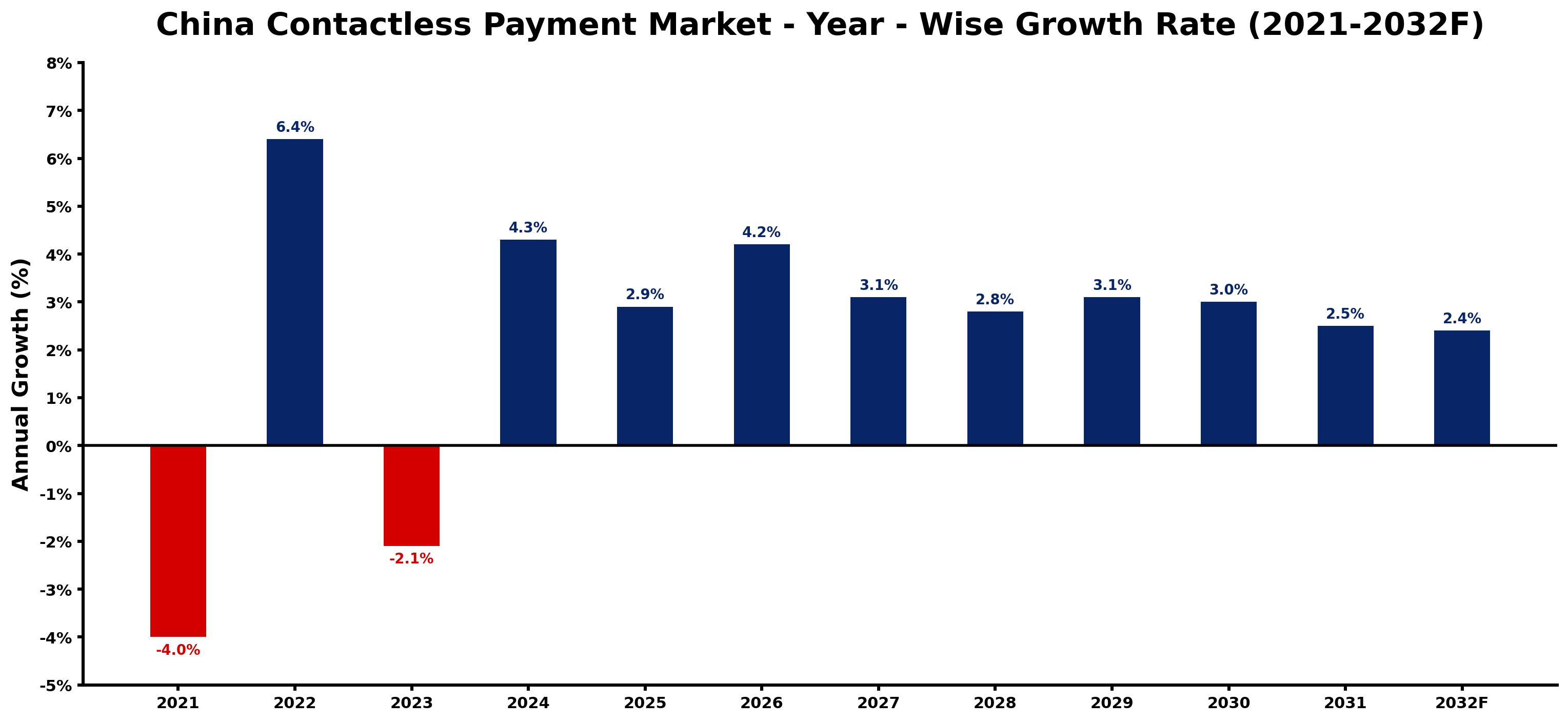
The table below presents the year‑wise growth rates along with the key drivers influencing the market
| Year | Growth Rate | Major Drivers |
| 2021 | -4.0% | Alipay and WeChat Pay dominant market presence stifled growth |
| 2022 | 6.4% | Surge in e-commerce driven by digital lifestyle trends. |
| 2023 | -2.1% | Government regulations limiting new fintech service entrants |
| 2024 | 4.3% | Growth in government-supported digital currency initiatives. |
| 2025 | 2.9% | Increased smartphone adoption among urban consumers. |
| 2026 | 4.2% | Rise in contactless transactions due to health concerns. |
| 2027 | 3.1% | Integration of contactless payment with public transport systems. |
| 2028 | 2.8% | Enhanced user experience through QR code payment systems. |
| 2029 | 3.1% | Corporate partnerships promoting mobile wallet usage. |
| 2030 | 3.0% | Growing involvement of fintech startups innovating payment solutions. |
| 2031 | 2.5% | Strengthened cybersecurity measures fostering market confidence. |
| 2032 | 2.4% | Increasing digital literacy among older demographics. |
Note: Market size estimations and growth projections presented in this report are based on 6Wresearch's proprietary forecasting methodology, utilizing the latest available industry data, government publications, and primary research inputs.
China Contactless Payment Market Key Takeaways
Below are some of the specific key takeaways from the market, including:
- The market is driven by a notable rise in mobile wallet adoption among consumers.
- Technological advancements such as NFC and QR code integration are crucial for market growth.
- Government initiatives are actively promoting a cashless economy, bolstering the adoption of contactless payments.
- Consumer concerns regarding security and fraud prevention remain a critical focus for market players.
- Intense competition among established payment systems presents both challenges and opportunities for new entrants.
Evaluation of Restraints in China Contactless Payment Market
Consumer trust is a vital component for the contactless payment market's success in China. Security concerns related to fraud and data breaches pose significant barriers. Additionally, the constantly evolving regulatory framework requires market players to stay agile, as compliance is essential for building consumer confidence. The competitive environment also complicates market entry for new firms, as established players dominate the landscape.
China Contactless Payment Market Trends
A prominent trend is the increasing integration of AI and machine learning into payment systems, enhancing security and personalizing user experiences. Adoption of biometric authentication methods is on the rise, as consumers seek more secure ways to transact. on top of that, partnerships between fintech and traditional financial institutions are becoming more common, driving innovation in payment solutions.
China Contactless Payment Market Opportunities
Significant growth opportunities exist in expanding contactless payment systems in rural areas, where digital financial literacy is improving. The e-commerce sector continues to thrive, creating demand for efficient payment solutions. Additionally, businesses can tap into emerging technologies like blockchain to enhance transaction security and reduce costs.
Government Initiatives in the China Contactless Payment Market
The Chinese government has adopted a proactive stance in promoting contactless payment technologies, viewing them as essential to achieving a cashless society. Through various regulatory frameworks and initiatives, the government aims to ensure secure and reliable payment infrastructures while incentivizing fintech innovation.
- A national digital infrastructure upgrade programme was recently completed, enhancing payment processing capabilities across urban and rural areas.
- Current regulatory measures are underway to enforce compliance with national cybersecurity standards, ensuring consumer data protection.
- A public-private initiative is planned to foster collaboration between fintech companies and traditional banks, expected to launch by mid-2026.
- The government is implementing educational campaigns to boost digital financial literacy among consumers, which is ongoing through 2025.
- Future policies will focus on encouraging the adoption of contactless payments in small and medium enterprises, with a detailed framework expected by 2027.
Future Insights of the China Contactless Payment Market
Between 2026 and 2032, the China contactless payment market is set to flourish. As technological advancements continue to emerge, payment methods will become increasingly sophisticated, with a focus on enhancing user security. The interplay between consumer expectations and regulatory requirements will be critical in shaping market dynamics. Companies that adapt quickly to these changes and innovate accordingly will likely capture significant market share.
China Contactless Payment Market Latest Developments
Recent industry activity in the China contactless payment market reflects a surge in innovation and collaboration among key stakeholders. Companies are prioritizing security enhancements and user experience, aligning with broader government initiatives for a cashless economy.
- A leading regional operator launched a new mobile wallet app in early 2025, featuring advanced biometric authentication.
- In Q3 2025, a major technology vendor announced an ongoing initiative to integrate blockchain technology into existing payment systems.
- A partnership between a fintech company and a traditional bank was established in late 2025 to enhance cross-platform payment options.
- Currently, a pilot program is underway to test contactless payment solutions in rural markets, aimed at completion by mid-2026.
- By early 2026, a new regulatory framework will be introduced to improve billing transparency and consumer protection.
China Contactless Payment Market - Key Attractiveness of the Report
- 10 Years of Market Numbers
- Historical Data Starting from 2022 to 2025
- Base Year: 2025
- Forecast Data until 2032
- Key Performance Indicators Impacting the Market
- Major Upcoming Developments and Projects
Key Highlights of the Report:
- China Contactless Payment Market Outlook
- Market Size of China Contactless Payment Market, 2025
- Forecast of China Contactless Payment Market, 2032
- Historical Data and Forecast of China Contactless Payment Revenues & Volume for the Period 2022-2032F
- China Contactless Payment Market Trend Evolution
- China Contactless Payment Market Drivers and Challenges
- China Contactless Payment Price Trends
- China Contactless Payment Porter's Five Forces
- China Contactless Payment Industry Life Cycle
- Historical Data and Forecast of China Contactless Payment Market Revenues & Volume By Component for the Period 2022-2032F
- Historical Data and Forecast of China Contactless Payment Market Revenues & Volume By Hardware for the Period 2022-2032F
- Historical Data and Forecast of China Contactless Payment Market Revenues & Volume By Solutions for the Period 2022-2032F
- Historical Data and Forecast of China Contactless Payment Market Revenues & Volume By Services for the Period 2022-2032F
- Historical Data and Forecast of China Contactless Payment Market Revenues & Volume By Vertical for the Period 2022-2032F
- Historical Data and Forecast of China Contactless Payment Market Revenues & Volume By Retail for the Period 2022-2032F
- Historical Data and Forecast of China Contactless Payment Market Revenues & Volume By Hospitality for the Period 2022-2032F
- Historical Data and Forecast of China Contactless Payment Market Revenues & Volume By Healthcare for the Period 2022-2032F
- Historical Data and Forecast of China Contactless Payment Market Revenues & Volume By Energy and Utilities for the Period 2022-2032F
- Historical Data and Forecast of China Contactless Payment Market Revenues & Volume By Transportation and Logistics for the Period 2022-2032F
- Historical Data and Forecast of China Contactless Payment Market Revenues & Volume By BFSI for the Period 2022-2032F
- Historical Data and Forecast of China Contactless Payment Market Revenues & Volume By Others (Government, telecommunications, and education) for the Period 2022-2032F
- China Contactless Payment Import Export Trade Statistics
- Market Opportunity Assessment By Component
- Market Opportunity Assessment By Vertical
- China Contactless Payment Top Companies Market Share
- China Contactless Payment Competitive Benchmarking By Technical and Operational Parameters
- China Contactless Payment Company Profiles
- China Contactless Payment Key Strategic Recommendations






































