China Corn Syrup Market Top 5 Importing Countries and Market Competition (HHI) Analysis
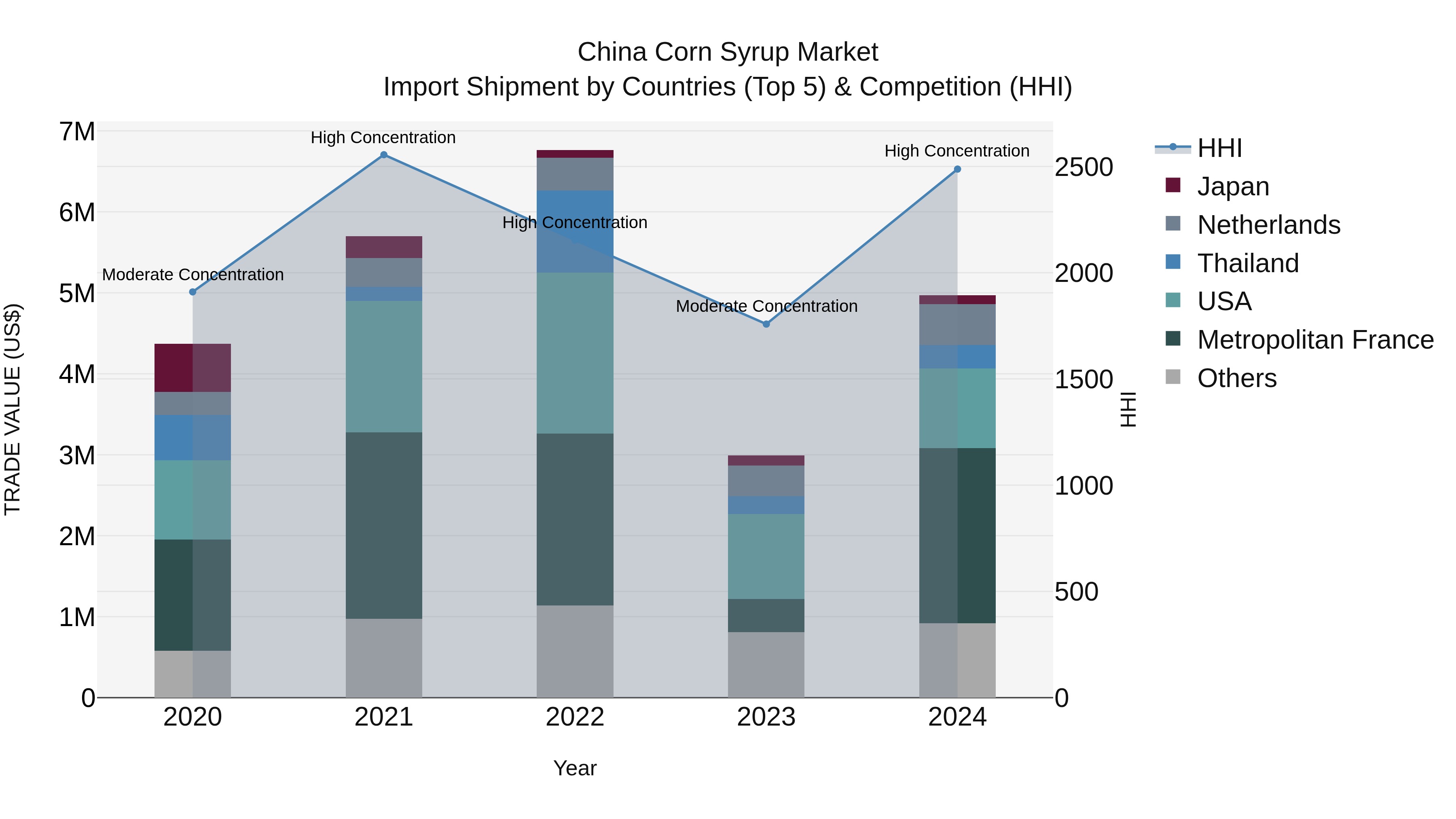
China corn syrup import market saw significant growth in 2024, with Metropolitan France, USA, Netherlands, Thailand, and South Korea emerging as the top exporters to China. The market experienced a shift from moderate to high concentration, indicating increased competition among suppliers. The compound annual growth rate (CAGR) from 2020 to 2024 stood at a steady 3.27%, while the impressive growth rate of 65.99% from 2023 to 2024 suggests a surge in demand for corn syrup in China. This data highlights a dynamic and evolving market landscape for corn syrup imports in China.
China Corn Syrup Market Overview
The China corn syrup market is experiencing steady growth driven by increasing demand from various industries such as food and beverage, pharmaceuticals, and personal care. Corn syrup is widely used as a sweetener and functional ingredient in a variety of products, including baked goods, confectionery, and beverages. The market is also benefiting from the rising consumer preference for natural sweeteners over artificial ones. Key players in the China corn syrup market are focusing on product innovation, expanding their product portfolios to cater to changing consumer preferences. Government initiatives to promote the use of corn syrup in various industries are also expected to fuel market growth. Overall, the China corn syrup market is poised for further expansion in the coming years.
China Corn Syrup Market Trends
In the China corn syrup market, there is a growing demand for high fructose corn syrup (HFCS) due to its wide applications in the food and beverage industry, particularly in the production of soft drinks, baked goods, and processed foods. Health concerns related to the consumption of traditional sugar have prompted a shift towards HFCS, which is seen as a more cost-effective sweetening alternative. Additionally, the increasing disposable income of Chinese consumers has led to a rise in the consumption of convenience foods and beverages, further driving the demand for corn syrup products. Market players are also focusing on product innovation and development of organic and non-GMO corn syrup varieties to cater to the evolving consumer preferences towards healthier and more natural ingredients.
China Corn Syrup Market Challenges
In the China corn syrup market, some challenges include fluctuating raw material prices, increasing competition from alternative sweeteners like high fructose corn syrup and artificial sweeteners, and changing consumer preferences towards healthier and natural ingredients. Additionally, regulatory scrutiny over the use of corn syrup in food and beverage products due to health concerns such as obesity and diabetes poses a challenge for manufacturers in the market. Economic factors such as trade tensions and political uncertainties can also impact the stability and growth of the corn syrup market in China. To navigate these challenges, companies in the industry may need to focus on innovation, product diversification, and marketing strategies to differentiate themselves and adapt to evolving market conditions.
China Corn Syrup Market Investment Opportunities
In the China corn syrup market, there are several investment opportunities worth considering. With the growing demand for sweeteners in various industries such as food and beverage, pharmaceuticals, and cosmetics, investing in corn syrup production and distribution companies could be lucrative. Additionally, China`s expanding processed food industry and increasing consumer preference for convenience foods provide a promising market for corn syrup as a key ingredient. Investing in research and development of innovative corn syrup products tailored to meet specific industry needs could also yield high returns. Furthermore, with the government`s push towards renewable and sustainable energy sources, investing in corn syrup as a potential biofuel feedstock could present long-term growth opportunities in the market.
China Corn Syrup Market Government Policy
The Chinese government has implemented various policies related to the corn syrup market in China. One key policy is the imposition of tariffs on imported corn syrup to protect domestic producers. Additionally, the government has set production quotas for domestic corn syrup manufacturers to control supply and stabilize prices. In recent years, there has been a push towards promoting the consumption of domestically produced corn syrup to support local producers and reduce reliance on imports. The government has also introduced quality control measures to ensure that corn syrup products meet regulatory standards for safety and purity. Overall, these policies aim to balance the interests of domestic producers with the need to ensure a stable supply of corn syrup in the Chinese market.
China Corn Syrup Market Future Outlook
The future outlook for the China corn syrup market appears promising due to several factors. Increasing consumer demand for sweeteners in various food and beverage products, coupled with the growth of the food processing industry in the region, is expected to drive market expansion. Additionally, the rising awareness of health-conscious consumers regarding natural sweeteners and the versatility of corn syrup in food applications are likely to further boost market growth. However, challenges such as fluctuating corn prices, regulatory changes, and competition from alternative sweeteners may impact market dynamics. Overall, with strategic product innovation, marketing efforts, and a focus on quality, the China corn syrup market is anticipated to experience steady growth in the coming years.
Key Highlights of the Report:
- China Corn Syrup Market Outlook
- Market Size of China Corn Syrup Market,2024
- Forecast of China Corn Syrup Market, 2031
- Historical Data and Forecast of China Corn Syrup Revenues & Volume for the Period 2021-2031
- China Corn Syrup Market Trend Evolution
- China Corn Syrup Market Drivers and Challenges
- China Corn Syrup Price Trends
- China Corn Syrup Porter's Five Forces
- China Corn Syrup Industry Life Cycle
- Historical Data and Forecast of China Corn Syrup Market Revenues & Volume By Type for the Period 2021-2031
- Historical Data and Forecast of China Corn Syrup Market Revenues & Volume By High Fructose Corn Syrup for the Period 2021-2031
- Historical Data and Forecast of China Corn Syrup Market Revenues & Volume By Glucose Syrup for the Period 2021-2031
- Historical Data and Forecast of China Corn Syrup Market Revenues & Volume By Others for the Period 2021-2031
- Historical Data and Forecast of China Corn Syrup Market Revenues & Volume By Application for the Period 2021-2031
- Historical Data and Forecast of China Corn Syrup Market Revenues & Volume By Sweeteners for the Period 2021-2031
- Historical Data and Forecast of China Corn Syrup Market Revenues & Volume By Beverage Industry for the Period 2021-2031
- Historical Data and Forecast of China Corn Syrup Market Revenues & Volume By Others for the Period 2021-2031
- Historical Data and Forecast of China Corn Syrup Market Revenues & Volume By Processing Method for the Period 2021-2031
- Historical Data and Forecast of China Corn Syrup Market Revenues & Volume By Enzymatic Hydrolysis for the Period 2021-2031
- Historical Data and Forecast of China Corn Syrup Market Revenues & Volume By Wet Milling for the Period 2021-2031
- Historical Data and Forecast of China Corn Syrup Market Revenues & Volume By Others for the Period 2021-2031
- Historical Data and Forecast of China Corn Syrup Market Revenues & Volume By End User for the Period 2021-2031
- Historical Data and Forecast of China Corn Syrup Market Revenues & Volume By Food Industry for the Period 2021-2031
- Historical Data and Forecast of China Corn Syrup Market Revenues & Volume By Beverage Manufacturers for the Period 2021-2031
- Historical Data and Forecast of China Corn Syrup Market Revenues & Volume By Others for the Period 2021-2031
- Historical Data and Forecast of China Corn Syrup Market Revenues & Volume By Distribution Channel for the Period 2021-2031
- Historical Data and Forecast of China Corn Syrup Market Revenues & Volume By Retail for the Period 2021-2031
- Historical Data and Forecast of China Corn Syrup Market Revenues & Volume By Direct Sales for the Period 2021-2031
- Historical Data and Forecast of China Corn Syrup Market Revenues & Volume By Others for the Period 2021-2031
- China Corn Syrup Import Export Trade Statistics
- Market Opportunity Assessment By Type
- Market Opportunity Assessment By Application
- Market Opportunity Assessment By Processing Method
- Market Opportunity Assessment By End User
- Market Opportunity Assessment By Distribution Channel
- China Corn Syrup Top Companies Market Share
- China Corn Syrup Competitive Benchmarking By Technical and Operational Parameters
- China Corn Syrup Company Profiles
- China Corn Syrup Key Strategic Recommendations






































