China Corrugated Boxes Market Top 5 Importing Countries and Market Competition (HHI) Analysis
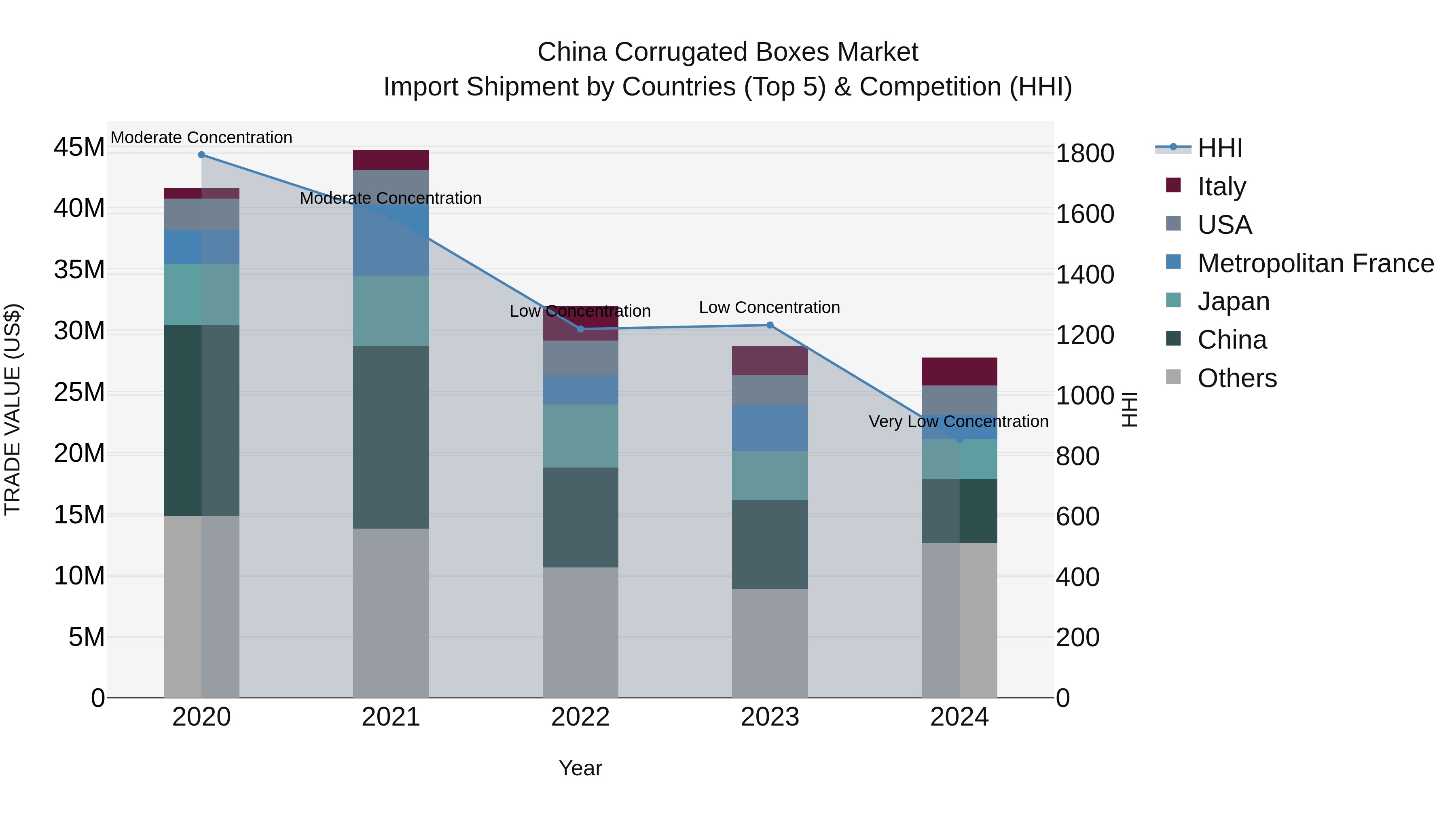
The China corrugated boxes import market experienced a decline in 2024, with a negative CAGR of -9.62% from 2020 to 2024. Despite a slight improvement from the previous year, the growth rate in 2024 remained negative at -3.2%. The top countries exporting to China in 2024 were China, Japan, USA, Italy, and Metropolitan France. The market concentration, as measured by the HHI, decreased from low to very low concentration from 2023 to 2024, indicating a more diversified import market for corrugated boxes in China.
China Corrugated Boxes Market Overview
The China Corrugated Boxes market is an essential part of the logistics and packaging industries, providing cost-effective and versatile packaging solutions. The market is expanding due to the rise in online shopping, increasing exports, and growing demand for protective packaging in various sectors.
Drivers of the market
The China Corrugated Boxes market is primarily driven by the booming e-commerce and retail sectors. The demand for corrugated boxes has surged with the growth of online shopping and the need for safe and efficient packaging solutions. Additionally, the increasing trend towards sustainable packaging and the recyclability of corrugated boxes make them an attractive option for businesses aiming to reduce their environmental footprint.
Challenges of the market
The Corrugated Boxes market in China encounters challenges including the volatility of raw material prices and supply chain issues affecting production costs. The market is also impacted by competition from alternative packaging solutions and the need to comply with environmental regulations. Additionally, fluctuations in demand from key end-use industries such as retail and e-commerce can influence market stability.
Government Policy of the market
Chinas policies on corrugated boxes focus on ensuring quality and sustainability in packaging. The government regulates the production processes, materials used, and recycling of corrugated boxes to minimize environmental impact. Support is provided for the development of new technologies and practices that enhance the performance and sustainability of corrugated boxes.
Key Highlights of the Report:
- China Corrugated Boxes Market Outlook
- Market Size of China Corrugated Boxes Market, 2024
- Forecast of China Corrugated Boxes Market, 2031
- Historical Data and Forecast of China Corrugated Boxes Revenues & Volume for the Period 2021-2031
- China Corrugated Boxes Market Trend Evolution
- China Corrugated Boxes Market Drivers and Challenges
- China Corrugated Boxes Price Trends
- China Corrugated Boxes Porter's Five Forces
- China Corrugated Boxes Industry Life Cycle
- Historical Data and Forecast of China Corrugated Boxes Market Revenues & Volume By Material for the Period 2021-2031
- Historical Data and Forecast of China Corrugated Boxes Market Revenues & Volume By Linerboard for the Period 2021-2031
- Historical Data and Forecast of China Corrugated Boxes Market Revenues & Volume By Medium for the Period 2021-2031
- Historical Data and Forecast of China Corrugated Boxes Market Revenues & Volume By Printing Ink for the Period 2021-2031
- Historical Data and Forecast of China Corrugated Boxes Market Revenues & Volume By Water-based for the Period 2021-2031
- Historical Data and Forecast of China Corrugated Boxes Market Revenues & Volume By UV-curable for the Period 2021-2031
- Historical Data and Forecast of China Corrugated Boxes Market Revenues & Volume By Hot melt-based for the Period 2021-2031
- Historical Data and Forecast of China Corrugated Boxes Market Revenues & Volume By Solvent-based for the Period 2021-2031
- Historical Data and Forecast of China Corrugated Boxes Market Revenues & Volume By Printing Technology for the Period 2021-2031
- Historical Data and Forecast of China Corrugated Boxes Market Revenues & Volume By Digital for the Period 2021-2031
- Historical Data and Forecast of China Corrugated Boxes Market Revenues & Volume By Flexography for the Period 2021-2031
- Historical Data and Forecast of China Corrugated Boxes Market Revenues & Volume By Lithography for the Period 2021-2031
- China Corrugated Boxes Import Export Trade Statistics
- Market Opportunity Assessment By Material
- Market Opportunity Assessment By Printing Ink
- Market Opportunity Assessment By Printing Technology
- China Corrugated Boxes Top Companies Market Share
- China Corrugated Boxes Competitive Benchmarking By Technical and Operational Parameters
- China Corrugated Boxes Company Profiles
- China Corrugated Boxes Key Strategic Recommendations






































