China Dairy Cream Market Top 5 Importing Countries and Market Competition (HHI) Analysis
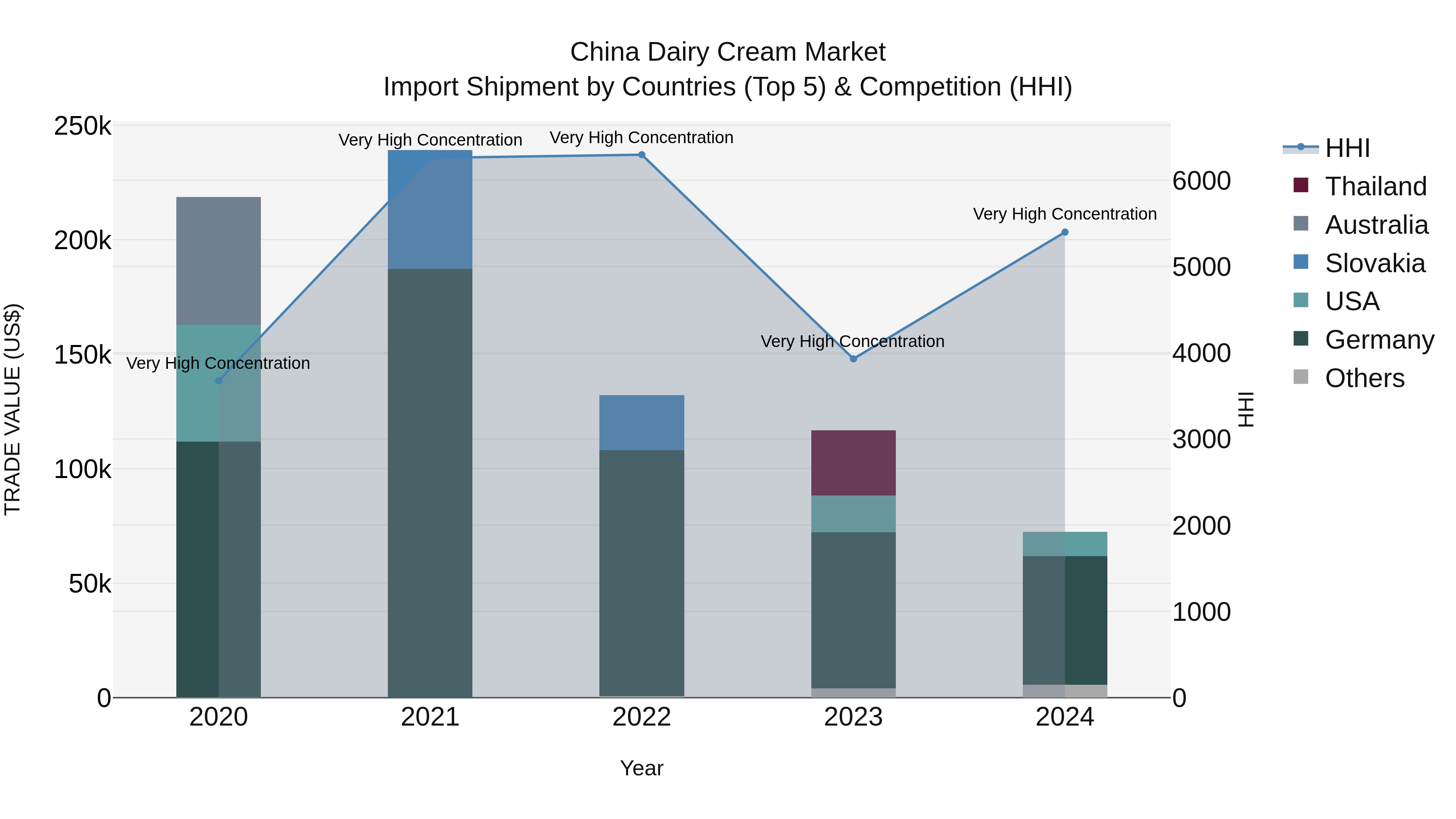
China dairy cream import market in 2024 continued to be dominated by key exporting countries such as Germany, USA, Russia, UK, and Metropolitan France, indicating a high level of concentration with a high Herfindahl-Hirschman Index (HHI). However, the market experienced a significant decline with a negative compound annual growth rate (CAGR) of -24.14% from 2020 to 2024. The growth rate in 2024 dropped even further by -37.99% compared to the previous year, reflecting a challenging environment for dairy cream imports into China.
China Dairy Cream Market Overview
The China Dairy Cream market is experiencing rapid growth driven by factors such as changing consumer preferences, increasing disposable income, and a rising demand for premium dairy products. The market is characterized by a wide variety of dairy cream products including whipping cream, heavy cream, and light cream, catering to diverse culinary needs. Key players in the market are focusing on product innovation, packaging enhancements, and marketing strategies to attract consumers. The growing trend of health-consciousness among Chinese consumers has also led to an increased demand for low-fat and organic dairy cream options. Additionally, the expanding foodservice sector in China is further boosting the demand for dairy cream products for use in various applications such as bakery, confectionery, and culinary purposes.
China Dairy Cream Market Trends
The China Dairy Cream Market is experiencing steady growth driven by increasing consumer preference for dairy-based products, rising disposable incomes, and changing dietary habits. Health-conscious consumers are seeking out low-fat and organic dairy cream options, leading to a rise in demand for healthier alternatives. Additionally, the popularity of coffee culture in China is driving the consumption of dairy cream as a key ingredient in various coffee beverages. Manufacturers are focusing on product innovation, such as flavored and plant-based dairy cream varieties, to cater to evolving consumer preferences. E-commerce platforms are also playing a significant role in expanding the market reach of dairy cream products, providing consumers with convenient access to a wide range of options. Overall, the China Dairy Cream Market is poised for continued growth and innovation in the coming years.
China Dairy Cream Market Challenges
In the China Dairy Cream Market, some of the key challenges include increasing consumer demand for healthier and more natural products, which is driving the need for dairy cream products with clean labels and fewer additives. Additionally, competition from alternative plant-based cream products is growing, putting pressure on traditional dairy cream producers to innovate and differentiate their offerings. Supply chain disruptions and fluctuating raw material prices also present challenges for market players in terms of cost management and product consistency. Furthermore, navigating complex regulations and quality standards in the Chinese market can pose obstacles for both domestic and international dairy cream manufacturers looking to enter or expand their presence in the region.
China Dairy Cream Market Investment Opportunities
The China Dairy Cream Market presents various investment opportunities due to the growing demand for dairy products in the country. With an increasing number of consumers adopting Western eating habits and a rising focus on health and wellness, there is a strong demand for premium dairy cream products in China. Investing in dairy cream production facilities, distribution networks, and marketing strategies can be lucrative. Additionally, there is potential for innovation and product development to cater to the evolving preferences of Chinese consumers, such as low-fat or flavored dairy cream options. Partnering with local dairy farmers or suppliers to ensure a stable and high-quality source of raw materials can also be a strategic investment in the China Dairy Cream Market.
China Dairy Cream Market Government Policy
The Chinese government has implemented several policies related to the dairy cream market to ensure food safety, quality control, and market stability. These policies include regulations on dairy product labeling, certification requirements for dairy producers, and monitoring of milk sources to prevent contamination. Additionally, the government has introduced subsidies and support programs to promote the development of the dairy industry, including financial assistance for small and medium-sized dairy farms and incentives for technological innovation. Furthermore, there are strict import regulations in place to protect domestic dairy producers and promote self-sufficiency in the dairy sector. Overall, these policies aim to maintain high standards in the dairy cream market, support local producers, and ensure consumer confidence in dairy products.
China Dairy Cream Market Future Outlook
The China Dairy Cream Market is expected to witness steady growth in the coming years, driven by increasing consumer demand for dairy-based products, changing dietary habits, and growing awareness of the health benefits of dairy cream. The market is also likely to benefit from the rising popularity of premium and indulgent food products among Chinese consumers. Additionally, the expanding foodservice industry and the increasing adoption of Western-style desserts and beverages are anticipated to further boost the demand for dairy cream in China. With ongoing urbanization, rising disposable incomes, and a growing middle-class population, the China Dairy Cream Market is poised for continued expansion, presenting opportunities for both domestic and international dairy cream manufacturers to capitalize on this evolving market landscape.
Key Highlights of the Report:
- China Dairy Cream Market Outlook
- Market Size of China Dairy Cream Market, 2021
- Forecast of China Dairy Cream Market, 2031
- Historical Data and Forecast of China Dairy Cream Revenues & Volume for the Period 2018 - 2031
- China Dairy Cream Market Trend Evolution
- China Dairy Cream Market Drivers and Challenges
- China Dairy Cream Price Trends
- China Dairy Cream Porter's Five Forces
- China Dairy Cream Industry Life Cycle
- Historical Data and Forecast of China Dairy Cream Market Revenues & Volume By Type for the Period 2018 - 2031
- Historical Data and Forecast of China Dairy Cream Market Revenues & Volume By Fresh Cream for the Period 2018 - 2031
- Historical Data and Forecast of China Dairy Cream Market Revenues & Volume By Thickened Cream/Heavy Cream for the Period 2018 - 2031
- Historical Data and Forecast of China Dairy Cream Market Revenues & Volume By Whipping Cream for the Period 2018 - 2031
- Historical Data and Forecast of China Dairy Cream Market Revenues & Volume By Sour Cream for the Period 2018 - 2031
- Historical Data and Forecast of China Dairy Cream Market Revenues & Volume By Other Types for the Period 2018 - 2031
- Historical Data and Forecast of China Dairy Cream Market Revenues & Volume By Distribution Channel for the Period 2018 - 2031
- Historical Data and Forecast of China Dairy Cream Market Revenues & Volume By Supermarkets/ Hypermarkets for the Period 2018 - 2031
- Historical Data and Forecast of China Dairy Cream Market Revenues & Volume By Convenince Stores for the Period 2018 - 2031
- Historical Data and Forecast of China Dairy Cream Market Revenues & Volume By Online Retail Stores for the Period 2018 - 2031
- Historical Data and Forecast of China Dairy Cream Market Revenues & Volume By Other Distribution Channels for the Period 2018 - 2031
- China Dairy Cream Import Export Trade Statistics
- Market Opportunity Assessment By Type
- Market Opportunity Assessment By Distribution Channel
- China Dairy Cream Top Companies Market Share
- China Dairy Cream Competitive Benchmarking By Technical and Operational Parameters
- China Dairy Cream Company Profiles
- China Dairy Cream Key Strategic Recommendations






































