China Data Masking Market Size & Growth Rate (2026-2032)
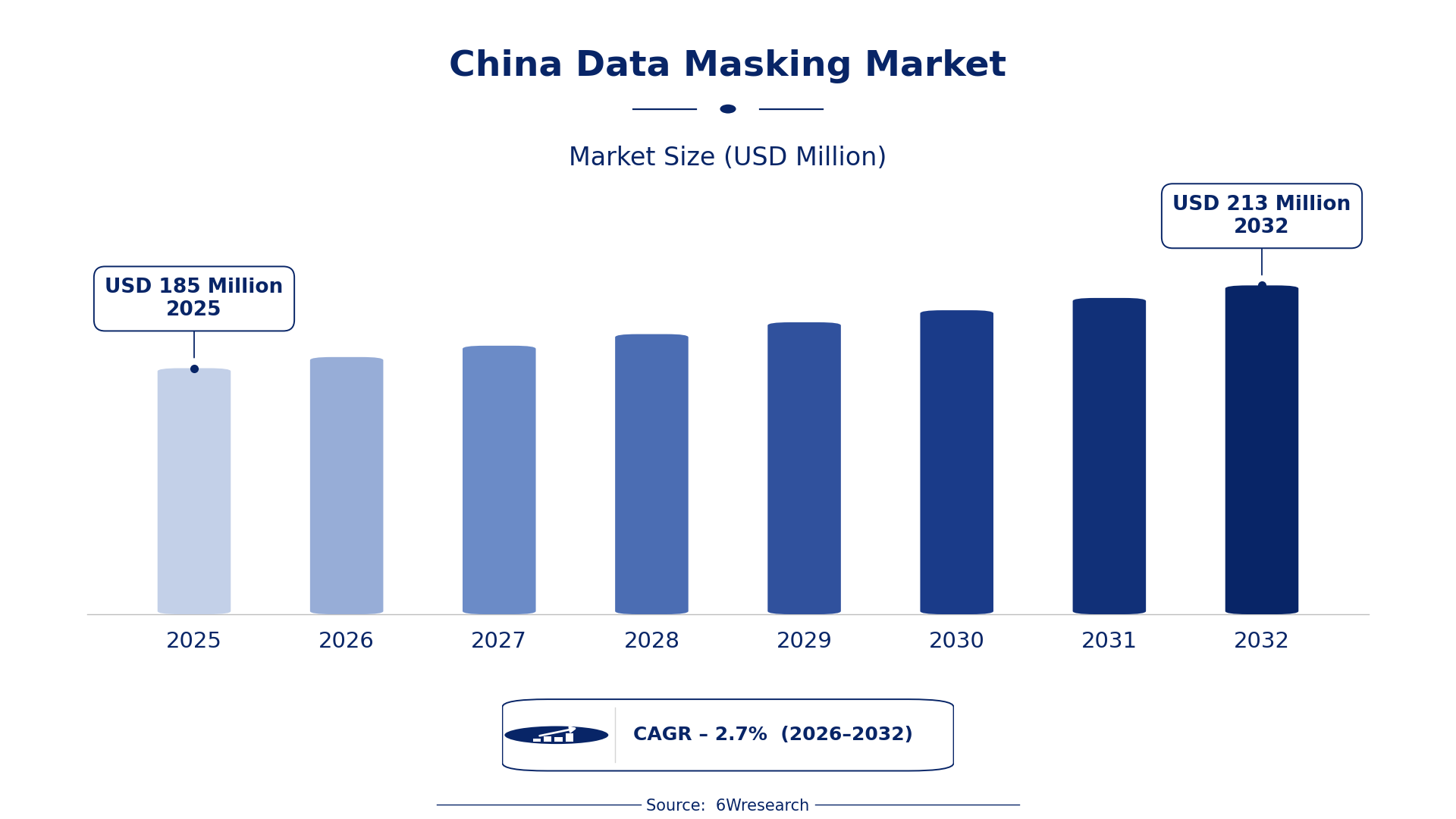
The China Data Masking Market was estimated at USD 185 Million in 2025 and is projected to reach USD 213 Million by 2032, growing at a CAGR of 2.7% from 2026 to 2032.
China Data Masking Market Synopsis
The surge in digital transformation initiatives across various industries in China is propelling the demand for data masking solutions. Businesses are increasingly realizing the importance of protecting sensitive information during testing and development, making data masking technologies indispensable.
With the strict enforcement of data privacy regulations, organizations face mounting pressure to adopt effective data masking practices. This is especially pertinent for sectors like finance and healthcare, where compliance is not just beneficial but mandatory for operational continuity.
China Data Masking Market Year-wise Growth Rate and Key Drivers
This graph illustrates the annual growth rates of the China Data Masking Market from 2021 to 2032, highlighting a steady upward trajectory and projected expansion over the forecast period.
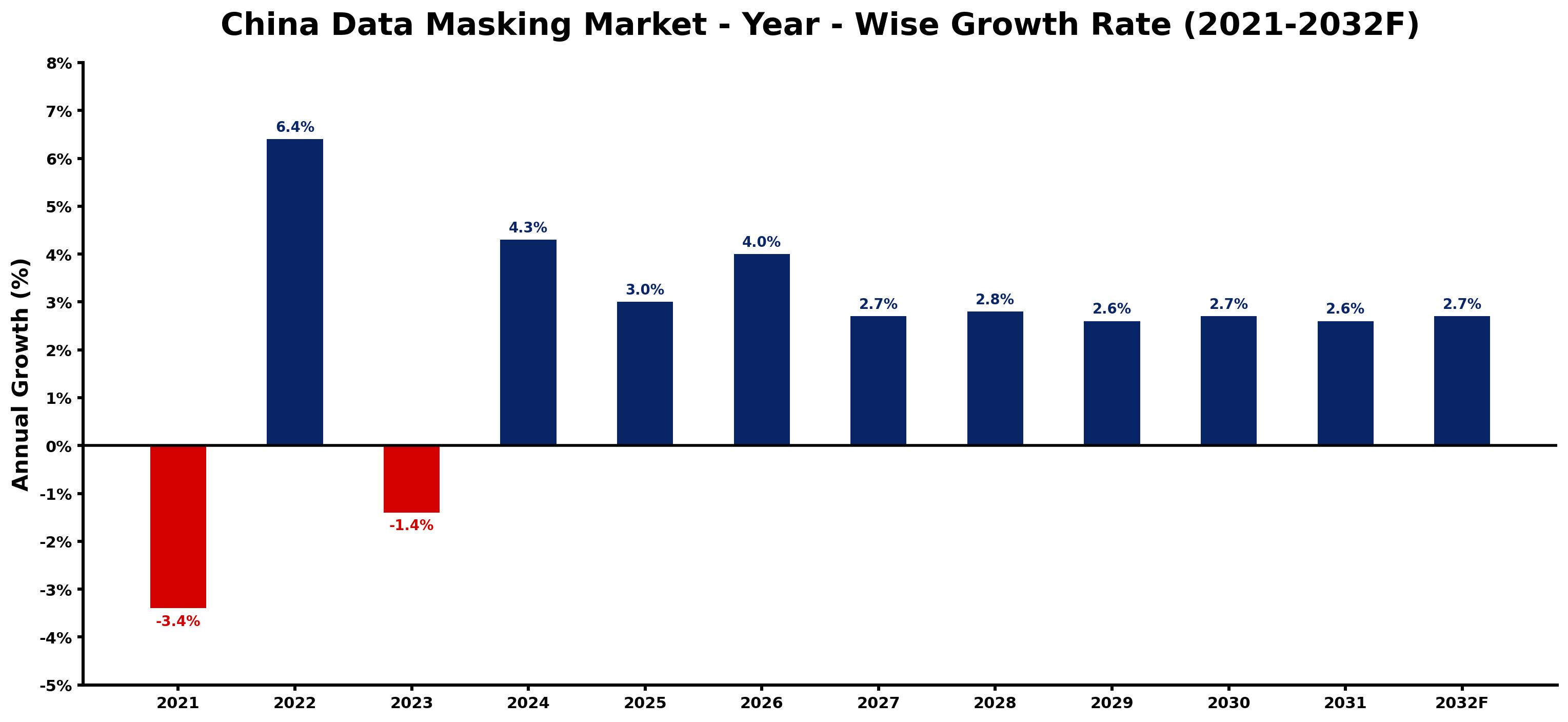
The table below presents the year‑wise growth rates along with the key drivers influencing the market
| Year | Growth Rate | Major Drivers |
| 2021 | -3.4% | China's Cybersecurity Law tightened data management compliance requirements. |
| 2022 | 6.4% | New personal data protection regulations by PIPL enforcement. |
| 2023 | -1.4% | Decreased demand for data masking in local tech startups. |
| 2024 | 4.3% | Increasing awareness of data privacy among Chinese consumers. |
| 2025 | 3.0% | Adoption of advanced bookkeeping software requiring data protection. |
| 2026 | 4.0% | Rise in data breaches drives corporate security investments. |
| 2027 | 2.7% | Digital transformation initiatives prioritize data security measures. |
| 2028 | 2.8% | Increased SaaS adoption enhancing data masking necessity. |
| 2029 | 2.6% | Growth in e-commerce spurs demand for customer data safety. |
| 2030 | 2.7% | Government push for cybersecurity practices in all industries. |
| 2031 | 2.6% | Healthcare sector’s compliance with patient privacy regulations. |
| 2032 | 2.7% | Mobile app development increasing need for data privacy solutions. |
Note: Market size estimations and growth projections presented in this report are based on 6Wresearch's proprietary forecasting methodology, utilizing the latest available industry data, government publications, and primary research inputs.
China Data Masking Market Key Takeaways
Below are some of the specific key takeaways from the market, including:
- The market is driven by the increasing need for compliance with data protection regulations.
- Technological advancements in data masking methods are fostering innovation within the industry.
- Organizations are prioritizing data privacy, reflecting a cultural shift in data governance.
- Challenges persist in balancing operational efficiency with stringent data protection measures.
- The healthcare and financial sectors represent the largest demand for masking solutions.
Evaluation of Restraints in China Data Masking Market
Several key factors inhibit the growth of the data masking market in China. First, the complexity of implementing data masking solutions often leads to resistance among organizations, primarily due to concerns over operational disruption. Companies need to ensure data utility while effectively obfuscating sensitive information, which complicates deployment. Second, the rapidly evolving technology landscape necessitates constant updates to masking techniques, which can strain resources. Finally, the varying levels of data maturity across industries hinder uniform adoption of data masking practices, leaving many organizations vulnerable to compliance risks.
China Data Masking Market Trends
Several trends are shaping the China Data Masking Market. The integration of artificial intelligence into data masking solutions is enhancing the efficiency of data obfuscation processes, allowing for smarter, automated workflows. Organizations are also gravitating towards cloud-based masking solutions as they seek flexibility and scalability. on top of that, as data breaches continue to make headlines, there is a growing focus on implementing more sophisticated security protocols, pushing data masking further into the spotlight. Privacy-by-design is becoming the new norm, with data masking embedded in the development of new applications and services.
China Data Masking Market Opportunities
The future of the China Data Masking Market presents several investment opportunities. As regulations tighten, businesses will increasingly seek to ensure compliance, creating a sustained demand for data masking solutions. Additionally, the rise of big data analytics offers opportunities to develop advanced masking techniques that maintain data utility while ensuring privacy. Collaboration between technology providers and industry stakeholders can foster innovation, leading to the creation of tailored solutions that address specific sector challenges. Investing in training and awareness programs for data privacy can also enhance market penetration.
Government Initiatives in the China Data Masking Market
Government policies play a crucial role in shaping the data masking market in China, primarily through the establishment of regulations aimed at enhancing data security and privacy. The enforcement of the Personal Information Protection Law (PIPL) has significant implications for organizations handling sensitive data, pushing them to adopt data masking practices. The ongoing regulatory focus demonstrates the government’s commitment to safeguarding personal information, thus driving demand for effective data masking solutions across industries.
- A recently completed regulation established under the PIPL mandates that organizations must implement data masking practices to protect sensitive information.
- A current initiative focuses on increasing public awareness regarding data privacy, encouraging organizations to adopt data masking technologies.
- Planned enhancements to regulatory frameworks are expected to include stricter penalties for data breaches, further incentivizing companies to invest in masking solutions.
- A public-sector initiative promoting cybersecurity education is currently underway, emphasizing the importance of data masking in safeguarding information.
- The government has launched a national strategy to bolster data security across critical sectors, reinforcing the need for robust data masking techniques.
Future Insights of the China Data Masking Market
Looking ahead to 2026-2032, the China Data Masking Market is expected to experience gradual yet steady growth. As regulatory frameworks evolve, organizations will be compelled to enhance their data protection strategies, firmly integrating masking solutions into their data management practices. The convergence of data privacy concerns and technological advancements will likely lead to the development of more sophisticated and user-friendly masking tools. on top of that, industries facing the highest regulatory scrutiny will drive innovation and adoption, fostering a more secure data ecosystem.
China Data Masking Market Latest Developments
Recent developments in the China Data Masking Market indicate a surge in activity as companies seek advanced solutions to comply with new regulations. The rising public emphasis on data privacy has also pushed many organizations to reevaluate their data protection strategies, leading to increased investments in data masking technologies.
- A major technology vendor announced a new suite of data masking tools designed to simplify compliance with the PIPL, launched in early 2025.
- An initiative that began in mid-2025 focuses on developing partnerships between tech firms and enterprises to promote data privacy education, which remains underway.
- A rollout expected to begin in the second half of 2026 will introduce a national certification program for data masking solution providers, aimed at establishing industry standards.
- A recent collaboration between a government agency and private sector leaders aims to enhance data protection frameworks, with activities starting in early 2025 and ongoing.
- A planned upgrade to existing data protection regulations is set for 2027, specifically targeting the healthcare sector and necessitating enhanced data masking practices.
China Data Masking Market - Key Attractiveness of the Report
- 10 Years of Market Numbers
- Historical Data Starting from 2022 to 2025
- Base Year: 2025
- Forecast Data until 2032
- Key Performance Indicators Impacting the Market
- Major Upcoming Developments and Projects
Key Highlights of the Report:
- China Data Masking Market Outlook
- Market Size of China Data Masking Market, 2025
- Forecast of China Data Masking Market, 2032
- Historical Data and Forecast of China Data Masking Revenues & Volume for the Period 2022-2032F
- China Data Masking Market Trend Evolution
- China Data Masking Market Drivers and Challenges
- China Data Masking Price Trends
- China Data Masking Porter's Five Forces
- China Data Masking Industry Life Cycle
- Historical Data and Forecast of China Data Masking Market Revenues & Volume By Data Masking Type for the Period 2022-2032F
- Historical Data and Forecast of China Data Masking Market Revenues & Volume By Static for the Period 2022-2032F
- Historical Data and Forecast of China Data Masking Market Revenues & Volume By Dynamic for the Period 2022-2032F
- Historical Data and Forecast of China Data Masking Market Revenues & Volume By Component for the Period 2022-2032F
- Historical Data and Forecast of China Data Masking Market Revenues & Volume By Software for the Period 2022-2032F
- Historical Data and Forecast of China Data Masking Market Revenues & Volume By Services for the Period 2022-2032F
- Historical Data and Forecast of China Data Masking Market Revenues & Volume By Business Function for the Period 2022-2032F
- Historical Data and Forecast of China Data Masking Market Revenues & Volume By Finance for the Period 2022-2032F
- Historical Data and Forecast of China Data Masking Market Revenues & Volume By Marketing & Sales for the Period 2022-2032F
- Historical Data and Forecast of China Data Masking Market Revenues & Volume By Operations for the Period 2022-2032F
- Historical Data and Forecast of China Data Masking Market Revenues & Volume By Legal for the Period 2022-2032F
- Historical Data and Forecast of China Data Masking Market Revenues & Volume By Organization Size for the Period 2022-2032F
- Historical Data and Forecast of China Data Masking Market Revenues & Volume By Small and Medium-sized Enterprises (SMEs) for the Period 2022-2032F
- Historical Data and Forecast of China Data Masking Market Revenues & Volume By Large enterprises for the Period 2022-2032F
- Historical Data and Forecast of China Data Masking Market Revenues & Volume By Deployment Type for the Period 2022-2032F
- Historical Data and Forecast of China Data Masking Market Revenues & Volume By On-premises for the Period 2022-2032F
- Historical Data and Forecast of China Data Masking Market Revenues & Volume By Cloud for the Period 2022-2032F
- Historical Data and Forecast of China Data Masking Market Revenues & Volume By Vertical for the Period 2022-2032F
- Historical Data and Forecast of China Data Masking Market Revenues & Volume By BFSI for the Period 2022-2032F
- Historical Data and Forecast of China Data Masking Market Revenues & Volume By Healthcare and life sciences for the Period 2022-2032F
- Historical Data and Forecast of China Data Masking Market Revenues & Volume By Retail and eCommerce for the Period 2022-2032F
- Historical Data and Forecast of China Data Masking Market Revenues & Volume By Telecommunications and IT for the Period 2022-2032F
- Historical Data and Forecast of China Data Masking Market Revenues & Volume By Government and defense for the Period 2022-2032F
- Historical Data and Forecast of China Data Masking Market Revenues & Volume By Media and entertainment for the Period 2022-2032F
- Historical Data and Forecast of China Data Masking Market Revenues & Volume By Manufacturing for the Period 2022-2032F
- China Data Masking Import Export Trade Statistics
- Market Opportunity Assessment By Data Masking Type
- Market Opportunity Assessment By Component
- Market Opportunity Assessment By Business Function
- Market Opportunity Assessment By Organization Size
- Market Opportunity Assessment By Deployment Type
- Market Opportunity Assessment By Vertical
- China Data Masking Top Companies Market Share
- China Data Masking Competitive Benchmarking By Technical and Operational Parameters
- China Data Masking Company Profiles
- China Data Masking Key Strategic Recommendations






































