China Digital Market Size & Growth Rate (2026-2032)
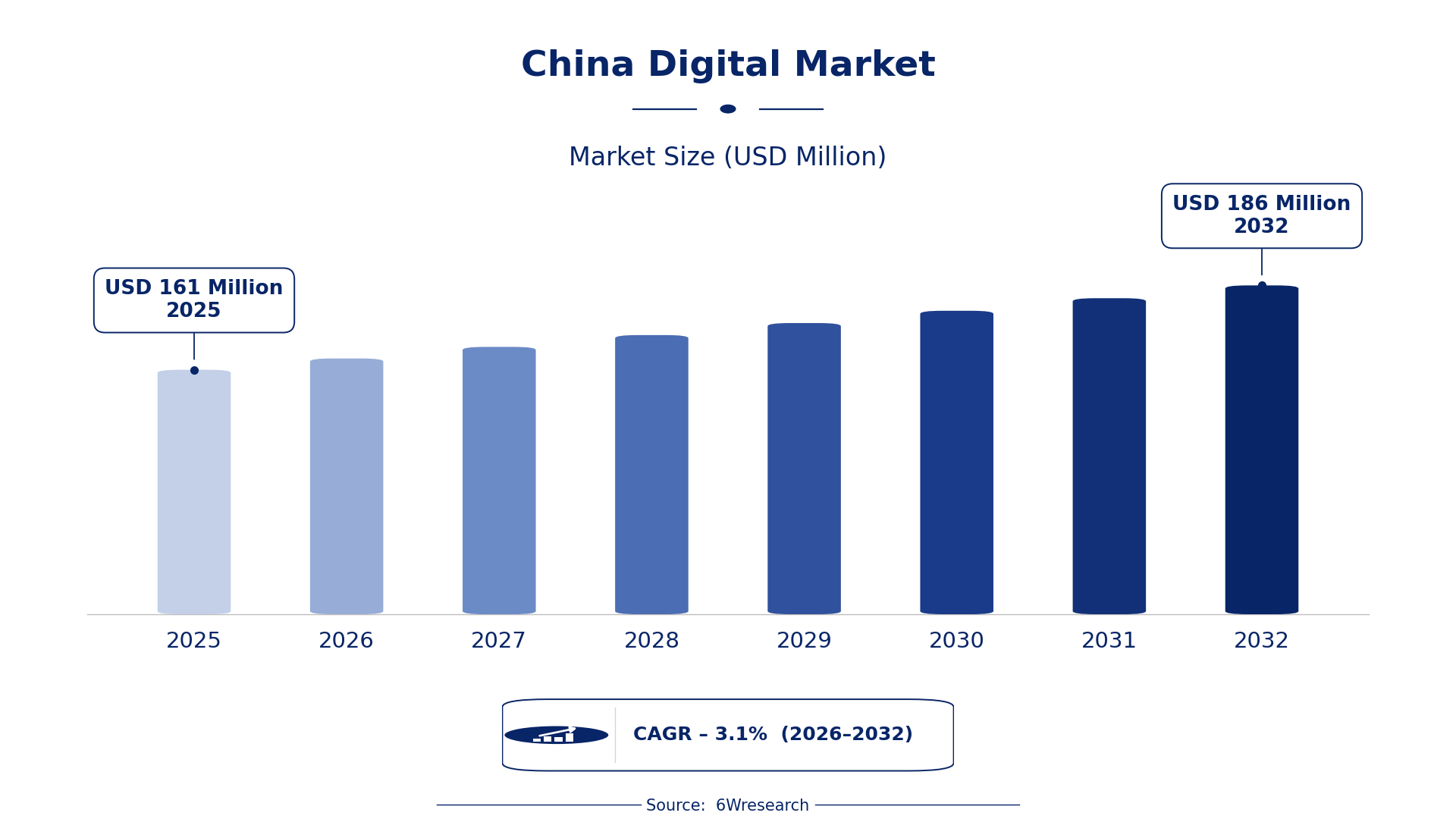
The China Digital Market was estimated at USD 161 Million in 2025 and is projected to reach USD 186 Million by 2032, growing at a CAGR of 3.1% from 2026 to 2032.
China Digital Market Synopsis
China's digital market stands out globally, driven by an online population exceeding 900 million users. This massive consumer base fuels the rapid growth of e-commerce, as platforms like Alibaba and JD.com continue to dominate the sector, reshaping retail dynamics.
Mobile payment systems like Alipay and WeChat Pay have revolutionized transaction methods, making digital payments an integral part of daily life. As technological advancements accelerate, sectors such as artificial intelligence and cloud computing gain traction, further enhancing the digital economy.
China Digital Market Year-wise Growth Rate and Key Drivers
This graph illustrates the annual growth rates of the China Digital Market from 2021 to 2032, highlighting a steady upward trajectory and projected expansion over the forecast period.
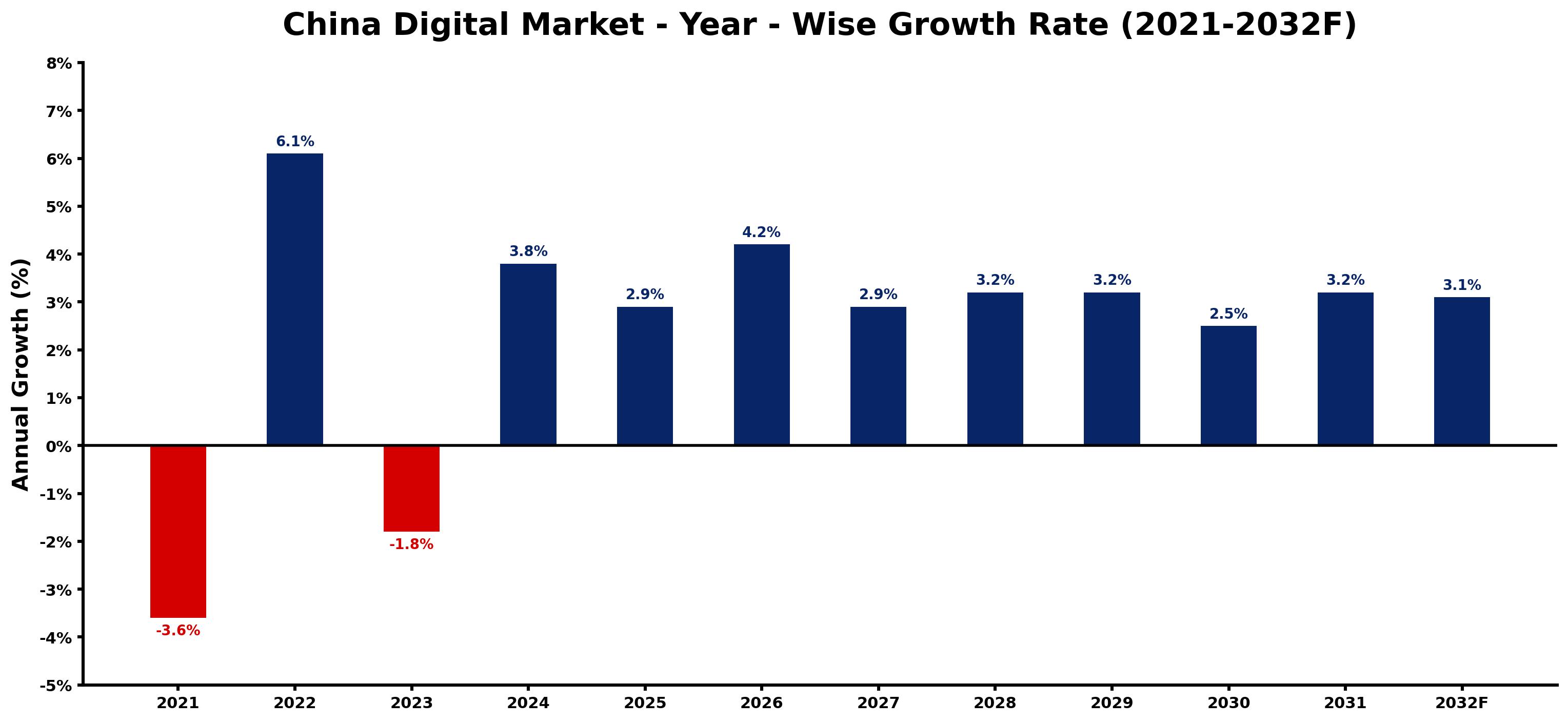
The table below presents the year‑wise growth rates along with the key drivers influencing the market
| Year | Growth Rate | Major Drivers |
| 2021 | -3.6% | Tencent's tightened regulation on online gaming content |
| 2022 | 6.1% | Growing mobile payment adoption enhances digital transaction volume. |
| 2023 | -1.8% | Decline in mobile app downloads amid stricter policies |
| 2024 | 3.8% | Increased internet penetration in rural areas boosts online engagement. |
| 2025 | 2.9% | Government's digital economy strategy accelerates tech innovation funding. |
| 2026 | 4.2% | Rise in e-commerce platforms fuels online shopping surge. |
| 2027 | 2.9% | Enhanced cybersecurity regulations drive demand for secure digital services. |
| 2028 | 3.2% | Smartphone usage growth expands access to digital content. |
| 2029 | 3.2% | Youth demographic's tech savviness drives digital consumption trends. |
| 2030 | 2.5% | Digital literacy programs improve user engagement and adoption. |
| 2031 | 3.2% | Investment in AI technologies enhances personalized digital experiences. |
| 2032 | 3.1% | Social media marketing adoption increases brand engagement online. |
Note: Market size estimations and growth projections presented in this report are based on 6Wresearch's proprietary forecasting methodology, utilizing the latest available industry data, government publications, and primary research inputs.
China Digital Market Key Takeaways
Below are some of the specific key takeaways from the market, including:
- The rapid expansion of e-commerce platforms continues to redefine consumer purchasing behavior.
- Social media and livestreaming are becoming essential tools for brands to engage with consumers.
- The adoption of mobile payment solutions is transforming the shopping experience.
- 5G technology is set to enhance connectivity and drive innovation in various applications.
- Data privacy and regulatory compliance remain critical concerns for businesses operating in this space.
Evaluation of Restraints in China Digital Market
Despite its growth, the China Digital Market faces notable restraints that hinder its full potential. Intense competition from local companies demands constant innovation, putting pressure on businesses to differentiate themselves. Navigating the intricate web of regulations and censorship laws complicates operations, especially for foreign entities. Additionally, the market's unique consumer preferences require localized strategies, which can be resource-intensive and challenging to execute. Data privacy concerns are increasingly scrutinized, as businesses must align with stringent regulations while fostering consumer trust.
China Digital Market Trends
A few trends are currently shaping the China Digital Market. The e-commerce sector is experiencing explosive growth, with platforms integrating innovative features to enhance customer experiences. Livestreaming e-commerce has surged, as influencers facilitate real-time interactions between brands and consumers, turning shopping into an engaging event.
Short video platforms are also gaining traction, with Douyin and Kuaishou leading the charge. These platforms not only entertain but also serve as powerful marketing tools, generating substantial advertising revenues. The widespread adoption of digital payments is transforming how consumers make purchases, further driving online retail growth.
China Digital Market Opportunities
Investment opportunities abound in the China Digital Market, particularly in e-commerce and fintech. With a growing middle class, there is a substantial demand for online retail solutions. Additionally, the fintech sector is gaining momentum, with innovative companies expanding their services to meet the needs of a tech-savvy consumer base. The advances in artificial intelligence present further opportunities, particularly for those developing applications that enhance user experiences. The digital entertainment industry is another key area, with platforms thriving on increasing viewer engagement and content consumption.
Government Initiatives in the China Digital Market
Government policy plays a crucial role in shaping the China Digital Market, balancing regulation with the need for innovation. Recent initiatives focus on enhancing cybersecurity while promoting technological advancement. The regulatory environment is stringent yet supportive of digital transformation, which is critical for businesses operating in this sector.
- A recently completed Cybersecurity Law aims to protect citizens' data and national security.
- Current efforts include a national initiative to upgrade digital infrastructure, enhancing connectivity across urban and rural areas.
- Plans for a new Data Security Law are underway, regulating data collection and usage practices.
- Ongoing support for the Made in China 2025 initiative promotes research in artificial intelligence and IoT technologies.
- Upcoming frameworks are expected to further streamline e-commerce regulations to foster growth.
Future Insights of the China Digital Market
Looking ahead to 2026-2032, the China Digital Market is set for continued growth, driven by increased internet penetration and rising consumer spending. Government initiatives aimed at fostering innovation will further propel the market. However, businesses must remain agile to navigate the complexities of regulatory scrutiny and evolving consumer preferences. The future will favor those who can innovate while maintaining compliance with the stringent regulatory landscape.
China Digital Market Latest Developments
In the past year, the China Digital Market has seen significant activity, reflecting a vibrant and rapidly changing environment. Companies are increasingly focusing on enhancing their digital offerings to meet consumer demands while adapting to regulatory changes. This trend signifies a shift towards more interactive and engaging consumer experiences.
- A major technology vendor launched a new AI-driven platform aimed at personalizing online shopping experiences in early 2025.
- In mid-2025, a leading regional operator initiated a project to enhance mobile payment systems across tier-2 cities.
- A partnership formed in Q2 2025 between a fintech startup and an established bank focuses on expanding digital banking solutions.
- Upcoming in late 2026 is a rollout of a nationwide digital literacy program designed to enhance consumer understanding of digital services.
- A new e-commerce feature leveraging augmented reality was unveiled in Q3 2025, aiming to enhance user engagement and shopping experiences.
China Digital Market - Key Attractiveness of the Report
- 10 Years of Market Numbers
- Historical Data Starting from 2022 to 2025
- Base Year: 2025
- Forecast Data until 2032
- Key Performance Indicators Impacting the Market
- Major Upcoming Developments and Projects
Key Highlights of the Report:
- China Digital Market Outlook
- Market Size of China Digital Market, 2025
- Forecast of China Digital Market, 2032
- Historical Data and Forecast of China Digital Revenues & Volume for the Period 2022-2032F
- China Digital Market Trend Evolution
- China Digital Market Drivers and Challenges
- China Digital Price Trends
- China Digital Porter's Five Forces
- China Digital Industry Life Cycle
- Historical Data and Forecast of China Digital Market Revenues & Volume By Software for the Period 2022-2032F
- Historical Data and Forecast of China Digital Market Revenues & Volume By CRM Software for the Period 2022-2032F
- Historical Data and Forecast of China Digital Market Revenues & Volume By Email Marketing Software for the Period 2022-2032F
- Historical Data and Forecast of China Digital Market Revenues & Volume By Social Media Advertising for the Period 2022-2032F
- China Digital Import Export Trade Statistics
- Market Opportunity Assessment By Software
- China Digital Top Companies Market Share
- China Digital Competitive Benchmarking By Technical and Operational Parameters
- China Digital Company Profiles
- China Digital Key Strategic Recommendations






































