China EdTech and Smart Classrooms Market Size & Growth Rate (2026-2032)
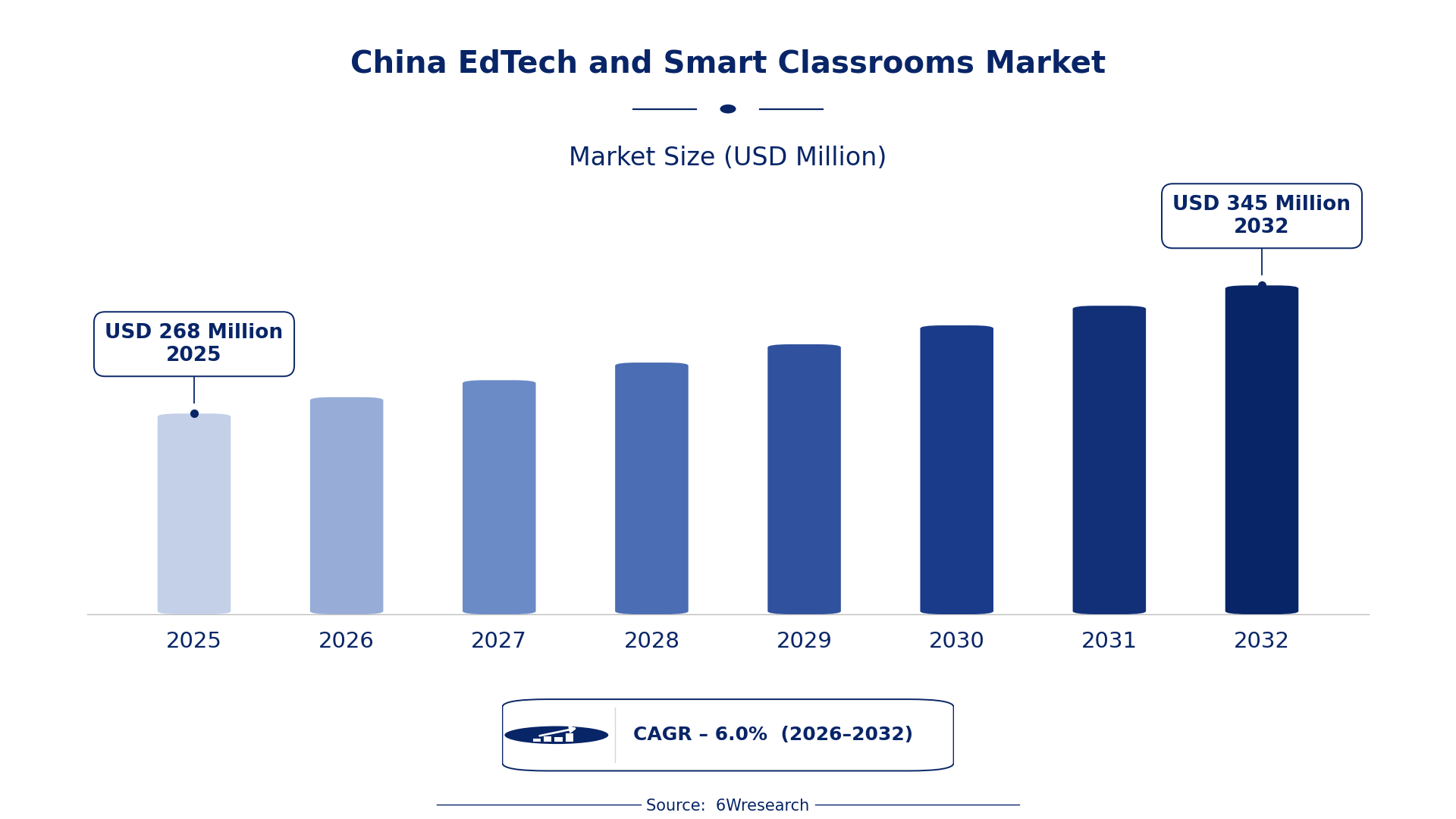
The China EdTech and Smart Classrooms Market was estimated at USD 268 Million in 2025 and is projected to reach USD 345 Million by 2032, growing at a CAGR of 6.0% from 2026 to 2032.
China EdTech and Smart Classrooms Market Synopsis
The demand for innovative educational solutions in China is surging, driven by a large student population eager for quality learning experiences. Schools and universities are increasingly investing in technology to enhance engagement, making smart classrooms a priority in the education sector.
As digital learning platforms gain traction, traditional educational methods are being transformed. This shift is not just a trend; it represents a fundamental change in how knowledge is imparted and absorbed across China.
China EdTech and Smart Classrooms Market Year-wise Growth Rate and Key Drivers
This graph illustrates the annual growth rates of the China EdTech and Smart Classrooms Market from 2021 to 2032, highlighting a steady upward trajectory and projected expansion over the forecast period.
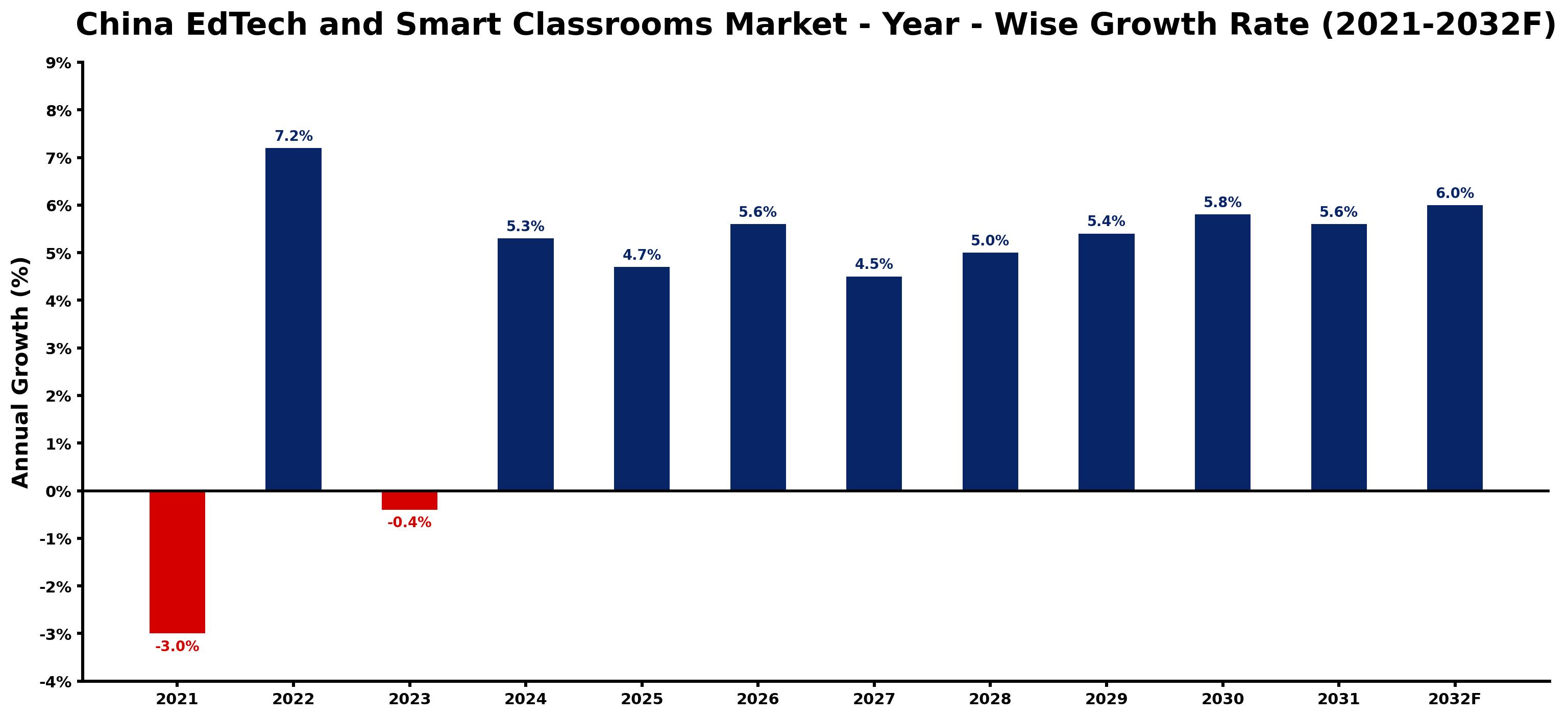
The table below presents the year‑wise growth rates along with the key drivers influencing the market
| Year | Growth Rate | Major Drivers |
| 2021 | -3.0% | New regulations limiting online tutoring hours instituted by MOE. |
| 2022 | 7.2% | Ministry of Education's push for digital learning initiatives. |
| 2023 | -0.4% | Decline in government funding for smart classroom initiatives. |
| 2024 | 5.3% | Increased funding for smart classroom technology integration. |
| 2025 | 4.7% | Growing urbanization driving demand for modern education solutions. |
| 2026 | 5.6% | Government incentives for AI-driven educational tools adoption. |
| 2027 | 4.5% | Rising parental investment in quality online learning platforms. |
| 2028 | 5.0% | Higher education sector's shift towards blended learning models. |
| 2029 | 5.4% | Corporate partnerships enhancing resources for school technology upgrades. |
| 2030 | 5.8% | Focus on personalized learning through data analytics tools. |
| 2031 | 5.6% | Local governments prioritizing educational technology in provincial budgets. |
| 2032 | 6.0% | Emerging EdTech startups driving innovation in learning environments. |
Note: Market size estimations and growth projections presented in this report are based on 6Wresearch's proprietary forecasting methodology, utilizing the latest available industry data, government publications, and primary research inputs.
China EdTech and Smart Classrooms Market Key Takeaways
Below are some of the specific key takeaways from the market, including:
- The rapid growth of online learning technologies is reshaping educational methods in China.
- Government initiatives are increasingly focused on integrating technology into classrooms.
- AI-driven educational tools are gaining popularity, catering to diverse learning needs.
- Data analytics is becoming essential for tracking student progress and outcomes.
- The rise of blended learning models is enhancing student engagement and effectiveness.
Evaluation of Restraints in China EdTech and Smart Classrooms Market
Regulatory hurdles pose significant challenges for the China EdTech and Smart Classrooms Market. The complex and often shifting regulatory environment can hinder the operations of EdTech companies. on top of that, disparities in technology adoption between urban and rural educational institutions exacerbate accessibility issues. Concerns regarding data privacy and security also linger, creating a cautious atmosphere for both educators and parents.
China EdTech and Smart Classrooms Market Trends
A noticeable trend in the market is the increasing demand for personalized learning solutions. Students and educators are looking for tailored educational experiences that cater to individual learning styles. The popularity of mobile learning apps is also on the rise, allowing learners to access resources anytime, anywhere.
Additionally, the development of AI-powered educational tools is transforming the way information is delivered. As educational institutions strive for improved outcomes, the integration of data analytics into the learning process is becoming a priority.
China EdTech and Smart Classrooms Market Opportunities
Investment opportunities in the China EdTech and Smart Classrooms Market are abundant. The surge in technology adoption in education creates a fertile ground for innovative solutions, particularly those focusing on online learning platforms and AI-driven tools. Smart classroom technologies such as interactive displays and educational software are areas ripe for development.
The Chinese government's ongoing support for modernization initiatives in education further enhances the investment landscape, making it an attractive sector for stakeholders looking to capitalize on growth.
Government Initiatives in the China EdTech and Smart Classrooms Market
Government policies are pivotal in shaping the China EdTech and Smart Classrooms Market. The regulatory framework is designed to promote technology integration while addressing concerns about data privacy and equitable access. Ongoing initiatives reflect a commitment to enhancing educational infrastructure across the country.
- A recently completed initiative launched the "Smart Campus" project, focusing on integrating advanced technologies in educational institutions.
- Current efforts include a national digital infrastructure upgrade program aimed at improving internet connectivity in rural schools.
- Upcoming regulations will mandate stricter data privacy measures for educational technology companies, expected to roll out by 2026.
- A planned public-private partnership is set to expand access to smart classroom technologies in underserved regions by 2028.
Future Insights of the China EdTech and Smart Classrooms Market
Looking ahead to 2026-2032, the prospects for the China EdTech and Smart Classrooms Market are promising. The continued growth in internet penetration and digital transformation will drive further investment. The increasing demand for online learning and personalized educational experiences will likely result in rapid technological advancements. on top of that, the lessons learned from the COVID-19 pandemic will continue to shape the evolution of educational practices and technologies.
China EdTech and Smart Classrooms Market Latest Developments
In the past year, the China EdTech and Smart Classrooms Market has witnessed notable developments that signal its growth trajectory. Companies are focusing on innovative solutions to enhance educational experiences while addressing regulatory challenges. This dynamic environment presents opportunities for industry players to adapt and thrive.
- A major technology vendor launched a comprehensive AI-powered learning platform in early 2025, aimed at enhancing personalized education.
- An ongoing initiative by a leading regional operator is currently upgrading digital infrastructure in several major cities, enhancing accessibility for students.
- A collaborative project between universities and tech firms is underway to develop virtual reality tools for immersive learning experiences.
- Plans are in place for a new interactive whiteboard technology rollout expected to begin in late 2026, targeting both urban and rural schools.
China EdTech and Smart Classrooms Market - Key Attractiveness of the Report
- 10 Years of Market Numbers
- Historical Data Starting from 2022 to 2025
- Base Year: 2025
- Forecast Data until 2032
- Key Performance Indicators Impacting the Market
- Major Upcoming Developments and Projects
Key Highlights of the Report:
- China EdTech and Smart Classrooms Market Outlook
- Market Size of China EdTech and Smart Classrooms Market, 2025
- Forecast of China EdTech and Smart Classrooms Market, 2032
- Historical Data and Forecast of China EdTech and Smart Classrooms Revenues & Volume for the Period 2022-2032F
- China EdTech and Smart Classrooms Market Trend Evolution
- China EdTech and Smart Classrooms Market Drivers and Challenges
- China EdTech and Smart Classrooms Price Trends
- China EdTech and Smart Classrooms Porter's Five Forces
- China EdTech and Smart Classrooms Industry Life Cycle
- Historical Data and Forecast of China EdTech and Smart Classrooms Market Revenues & Volume By Hardware for the Period 2022-2032F
- Historical Data and Forecast of China EdTech and Smart Classrooms Market Revenues & Volume By Interactive Displays for the Period 2022-2032F
- Historical Data and Forecast of China EdTech and Smart Classrooms Market Revenues & Volume By Interactive Projectors for the Period 2022-2032F
- Historical Data and Forecast of China EdTech and Smart Classrooms Market Revenues & Volume By Education System Solution for the Period 2022-2032F
- Historical Data and Forecast of China EdTech and Smart Classrooms Market Revenues & Volume By Learning Management System for the Period 2022-2032F
- Historical Data and Forecast of China EdTech and Smart Classrooms Market Revenues & Volume By Student Information and Administration System for the Period 2022-2032F
- Historical Data and Forecast of China EdTech and Smart Classrooms Market Revenues & Volume By Student Collaboration System for the Period 2022-2032F
- Historical Data and Forecast of China EdTech and Smart Classrooms Market Revenues & Volume By Student Response System for the Period 2022-2032F
- Historical Data and Forecast of China EdTech and Smart Classrooms Market Revenues & Volume By Learning and Gamification for the Period 2022-2032F
- Historical Data and Forecast of China EdTech and Smart Classrooms Market Revenues & Volume By Test Preparation for the Period 2022-2032F
- Historical Data and Forecast of China EdTech and Smart Classrooms Market Revenues & Volume By Classroom Management System for the Period 2022-2032F
- Historical Data and Forecast of China EdTech and Smart Classrooms Market Revenues & Volume By Document Management System for the Period 2022-2032F
- Historical Data and Forecast of China EdTech and Smart Classrooms Market Revenues & Volume By Deployment Type for the Period 2022-2032F
- Historical Data and Forecast of China EdTech and Smart Classrooms Market Revenues & Volume By Cloud for the Period 2022-2032F
- Historical Data and Forecast of China EdTech and Smart Classrooms Market Revenues & Volume By On-Premises for the Period 2022-2032F
- Historical Data and Forecast of China EdTech and Smart Classrooms Market Revenues & Volume By End User for the Period 2022-2032F
- Historical Data and Forecast of China EdTech and Smart Classrooms Market Revenues & Volume By K-12 for the Period 2022-2032F
- Historical Data and Forecast of China EdTech and Smart Classrooms Market Revenues & Volume By Higher Education for the Period 2022-2032F
- China EdTech and Smart Classrooms Import Export Trade Statistics
- Market Opportunity Assessment By Hardware
- Market Opportunity Assessment By Education System Solution
- Market Opportunity Assessment By Deployment Type
- Market Opportunity Assessment By End User
- China EdTech and Smart Classrooms Top Companies Market Share
- China EdTech and Smart Classrooms Competitive Benchmarking By Technical and Operational Parameters
- China EdTech and Smart Classrooms Company Profiles
- China EdTech and Smart Classrooms Key Strategic Recommendations






































