China Encapsulated Flavours Market Top 5 Importing Countries and Market Competition (HHI) Analysis
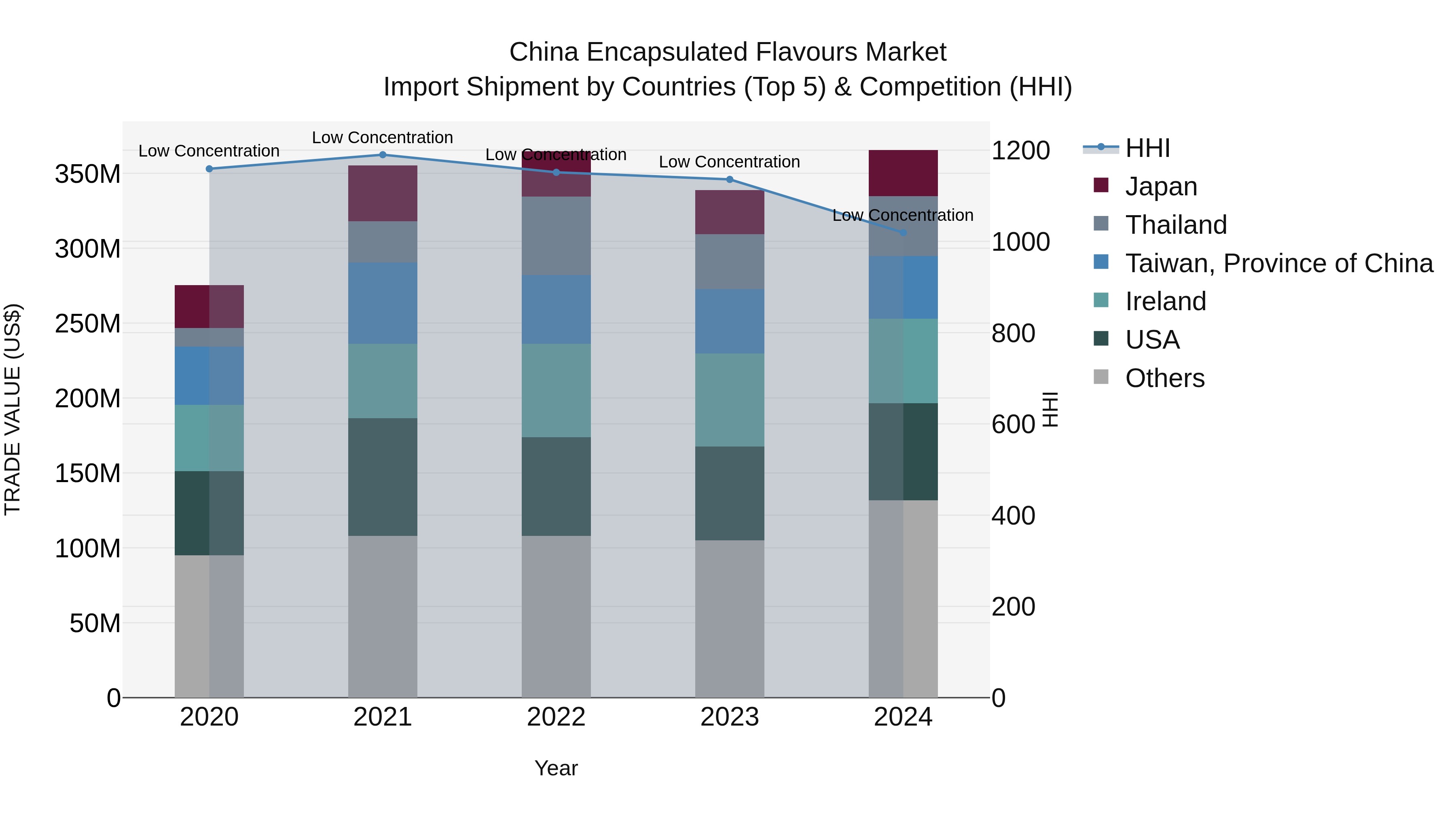
China encapsulated flavors import market continued to show steady growth in 2024, with the top exporting countries being the USA, Ireland, Taiwan, Thailand, and Singapore. The market remained relatively unconcentrated with a low Herfindahl-Hirschman Index (HHI). The compound annual growth rate (CAGR) from 2020 to 2024 was a robust 7.34%, indicating sustained expansion. Moreover, the growth rate from 2023 to 2024 accelerated to 7.87%, underscoring increasing demand for encapsulated flavors in China. This trend signals opportunities for both domestic and international suppliers to capitalize on the market`s positive trajectory.
China Encapsulated Flavours Market Overview
The China encapsulated flavors market is experiencing steady growth due to increasing demand for convenience and processed food products. Encapsulated flavors offer benefits such as extended shelf life, enhanced flavor retention, and controlled release, making them popular among food and beverage manufacturers. The market is driven by the expanding food and beverage industry, growing consumer preference for unique and exotic flavors, and technological advancements in encapsulation techniques. Key players in the market are investing in research and development to introduce innovative encapsulated flavor solutions that cater to changing consumer preferences. The market is also witnessing a trend towards natural and clean label encapsulated flavors to meet the rising demand for healthier food options. Overall, the China encapsulated flavors market is poised for further growth in the coming years.
China Encapsulated Flavours Market Trends
The encapsulated flavors market in China is witnessing a significant growth trend driven by the increasing demand for convenient and innovative food and beverage products. Consumers are seeking unique and intense flavor experiences, leading to a rise in the use of encapsulated flavors in various applications such as beverages, confectionery, and snacks. Manufacturers are focusing on developing encapsulation technologies to improve flavor stability, release control, and shelf life of products. Natural and clean label encapsulated flavors are gaining popularity among health-conscious consumers, driving the market towards more sustainable and transparent sourcing practices. Additionally, the growing foodservice industry in China is creating opportunities for encapsulated flavor suppliers to cater to the evolving tastes and preferences of the dynamic consumer base.
China Encapsulated Flavours Market Challenges
In the China encapsulated flavors market, challenges primarily revolve around regulatory compliance, intense competition, and consumer preferences. Meeting stringent regulations and safety standards set by the Chinese government can be complex and time-consuming, requiring manufacturers to invest significant resources in research and development. Additionally, the market is highly competitive with numerous local and international players vying for market share, leading to price wars and pressure on profit margins. Understanding and adapting to rapidly changing consumer preferences and trends also present a challenge, requiring companies to constantly innovate and introduce new flavors to stay relevant in the market. Overall, navigating these challenges requires a strategic approach and continuous market analysis to ensure sustained growth and success in the China encapsulated flavors market.
China Encapsulated Flavours Market Investment Opportunities
The China encapsulated flavors market presents lucrative investment opportunities due to the increasing demand for convenient and ready-to-use flavor solutions in the food and beverage industry. The market is driven by factors such as changing consumer preferences, growing urbanization, and the rising disposable income of the middle-class population. Investing in companies that specialize in producing encapsulated flavors for use in products like snacks, beverages, and dairy items could be a strategic move. Additionally, with the ongoing trend of clean label and natural ingredients, there is a growing demand for encapsulated flavors made from natural sources, providing further avenues for investment and innovation in this sector. Overall, the China encapsulated flavors market offers promising growth potential for investors looking to capitalize on the evolving food and beverage landscape in the region.
China Encapsulated Flavours Market Government Policy
The Chinese government has implemented several policies related to the encapsulated flavors market to ensure food safety and quality. The Food Safety Law of China, enforced by the China Food and Drug Administration (CFDA), regulates the production, distribution, and sale of food products, including encapsulated flavors. Additionally, the National Health Commission (NHC) oversees food safety standards and conducts inspections to ensure compliance with regulations. The government has also introduced initiatives to promote innovation and technology development in the food industry, which includes the encapsulated flavors market. These policies aim to enhance consumer protection, improve product quality, and stimulate growth in the encapsulated flavors sector while ensuring compliance with stringent food safety regulations.
China Encapsulated Flavours Market Future Outlook
The future outlook for the China encapsulated flavors market appears promising, with significant growth expected in the coming years. Factors driving this growth include increasing consumer demand for convenient and innovative food and beverage products, the rising popularity of flavored food items, and the growing food processing industry in the region. Additionally, advancements in encapsulation technologies are enabling manufacturers to develop more stable and effective flavor delivery systems, further fueling market expansion. Market players are likely to focus on product innovation, customization, and strategic partnerships to capitalize on these opportunities and gain a competitive edge in the evolving market landscape. Overall, the China encapsulated flavors market is anticipated to experience robust growth as manufacturers cater to changing consumer preferences and seek to enhance product offerings with unique and enhanced flavor profiles.
Key Highlights of the Report:
- China Encapsulated Flavours Market Outlook
- Market Size of China Encapsulated Flavours Market,2024
- Forecast of China Encapsulated Flavours Market, 2031
- Historical Data and Forecast of China Encapsulated Flavours Revenues & Volume for the Period 2021-2031
- China Encapsulated Flavours Market Trend Evolution
- China Encapsulated Flavours Market Drivers and Challenges
- China Encapsulated Flavours Price Trends
- China Encapsulated Flavours Porter's Five Forces
- China Encapsulated Flavours Industry Life Cycle
- Historical Data and Forecast of China Encapsulated Flavours Market Revenues & Volume By Product Type for the Period 2021-2031
- Historical Data and Forecast of China Encapsulated Flavours Market Revenues & Volume By Flavored Blends for the Period 2021-2031
- Historical Data and Forecast of China Encapsulated Flavours Market Revenues & Volume By Fragrance Blends for the Period 2021-2031
- Historical Data and Forecast of China Encapsulated Flavours Market Revenues & Volume By Essential Oils for the Period 2021-2031
- Historical Data and Forecast of China Encapsulated Flavours Market Revenues & Volume By Natural Extracts for the Period 2021-2031
- Historical Data and Forecast of China Encapsulated Flavours Market Revenues & Volume By Aroma Chemicals for the Period 2021 - 2029
- Historical Data and Forecast of China Encapsulated Flavours Market Revenues & Volume By Encapsulation Process for the Period 2021-2031
- Historical Data and Forecast of China Encapsulated Flavours Market Revenues & Volume By Physical Process for the Period 2021-2031
- Historical Data and Forecast of China Encapsulated Flavours Market Revenues & Volume By Physiochemical Process for the Period 2021-2031
- Historical Data and Forecast of China Encapsulated Flavours Market Revenues & Volume By Chemical Process for the Period 2021-2031
- Historical Data and Forecast of China Encapsulated Flavours Market Revenues & Volume By Extrusiuon for the Period 2021-2031
- Historical Data and Forecast of China Encapsulated Flavours Market Revenues & Volume By Spray Congealing and Chilling for the Period 2021 - 2029
- Historical Data and Forecast of China Encapsulated Flavours Market Revenues & Volume By Sprays Drying for the Period 2021 - 2029
- Historical Data and Forecast of China Encapsulated Flavours Market Revenues & Volume By Glass Encapsulation for the Period 2021 - 2029
- Historical Data and Forecast of China Encapsulated Flavours Market Revenues & Volume By Others for the Period 2021 - 2029
- Historical Data and Forecast of China Encapsulated Flavours Market Revenues & Volume By Flavor Type for the Period 2021-2031
- Historical Data and Forecast of China Encapsulated Flavours Market Revenues & Volume By Fruit Flavors for the Period 2021-2031
- Historical Data and Forecast of China Encapsulated Flavours Market Revenues & Volume By Nut Flavors for the Period 2021-2031
- Historical Data and Forecast of China Encapsulated Flavours Market Revenues & Volume By Chocolate Flavor for the Period 2021-2031
- Historical Data and Forecast of China Encapsulated Flavours Market Revenues & Volume By Spice Flavor for the Period 2021-2031
- Historical Data and Forecast of China Encapsulated Flavours Market Revenues & Volume By Vanilla Flavor for the Period 2021 - 2029
- Historical Data and Forecast of China Encapsulated Flavours Market Revenues & Volume By Citric Flavor for the Period 2021 - 2029
- Historical Data and Forecast of China Encapsulated Flavours Market Revenues & Volume By Berry Flavor for the Period 2021 - 2029
- Historical Data and Forecast of China Encapsulated Flavours Market Revenues & Volume By Others for the Period 2021 - 2029
- Historical Data and Forecast of China Encapsulated Flavours Market Revenues & Volume By Application for the Period 2021-2031
- Historical Data and Forecast of China Encapsulated Flavours Market Revenues & Volume By Pharmaceutical and Personal Care for the Period 2021-2031
- Historical Data and Forecast of China Encapsulated Flavours Market Revenues & Volume By Toiletries and Cleaners for the Period 2021-2031
- Historical Data and Forecast of China Encapsulated Flavours Market Revenues & Volume By Beverages and Instant drinks for the Period 2021-2031
- Historical Data and Forecast of China Encapsulated Flavours Market Revenues & Volume By Dairy Products for the Period 2021-2031
- Historical Data and Forecast of China Encapsulated Flavours Market Revenues & Volume By Frozen Food for the Period 2021 - 2029
- Historical Data and Forecast of China Encapsulated Flavours Market Revenues & Volume By Snacks for the Period 2021 - 2029
- Historical Data and Forecast of China Encapsulated Flavours Market Revenues & Volume By Cereal and Oatmeal for the Period 2021 - 2029
- Historical Data and Forecast of China Encapsulated Flavours Market Revenues & Volume By Bakery and Confectionery for the Period 2021 - 2029
- China Encapsulated Flavours Import Export Trade Statistics
- Market Opportunity Assessment By Product Type
- Market Opportunity Assessment By Encapsulation Process
- Market Opportunity Assessment By Flavor Type
- Market Opportunity Assessment By Application
- China Encapsulated Flavours Top Companies Market Share
- China Encapsulated Flavours Competitive Benchmarking By Technical and Operational Parameters
- China Encapsulated Flavours Company Profiles
- China Encapsulated Flavours Key Strategic Recommendations






































