China Essential Oil Market Top 5 Importing Countries and Market Competition (HHI) Analysis
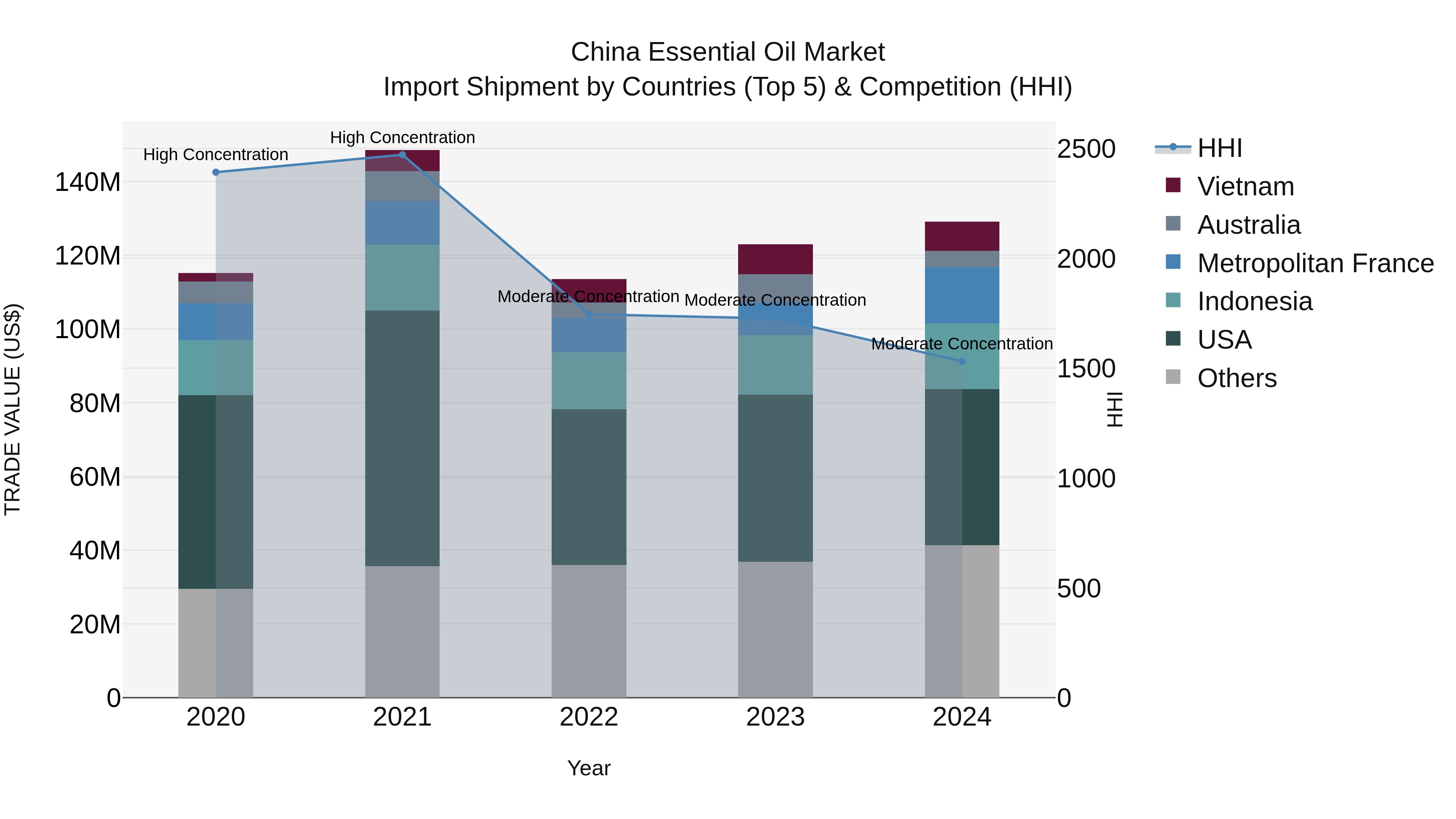
In 2024, China essential oil import market continued to see steady growth with a moderate concentration level, as indicated by the Herfindahl-Hirschman Index (HHI). The top countries exporting to China included the USA, Indonesia, Metropolitan France, Vietnam, and Madagascar. The Compound Annual Growth Rate (CAGR) from 2020 to 2024 stood at 2.9%, showing a consistent upward trend. Additionally, the growth rate from 2023 to 2024 was notably strong at 4.99%, reflecting a positive outlook for the essential oil import market in China.
China Essential Oil Market Overview
The China essential oil market is experiencing significant growth driven by the increasing consumer awareness of the benefits of natural products in the beauty and wellness industries. The market is witnessing a surge in demand for essential oils due to their therapeutic properties and aromatherapy applications. Key players in the market are focusing on product innovation, expanding distribution channels, and strategic partnerships to gain a competitive edge. With the growing popularity of traditional Chinese medicine and the trend towards natural and organic products, the essential oil market in China is expected to continue its upward trajectory. Factors such as rising disposable income, changing consumer preferences, and a booming e-commerce sector are further fueling the growth of this market.
China Essential Oil Market Trends and Opportunities
The China Essential Oil Market is experiencing significant growth driven by factors such as increasing consumer awareness of natural and organic products, growing demand for aromatherapy, and a rising focus on health and wellness. Eucalyptus, lavender, and tea tree oils are among the most popular essential oils in China, with a growing interest in unique and exotic oils like ylang-ylang and bergamot. Opportunities exist for market players to expand their product offerings, particularly in the beauty and personal care sector, as Chinese consumers are increasingly seeking natural alternatives to traditional products. Additionally, the e-commerce boom in China presents a lucrative channel for essential oil brands to reach a wider audience and capitalize on the growing trend of online shopping. Overall, the China Essential Oil Market is poised for continued growth and innovation.
China Essential Oil Market Challenges
The China Essential Oil Market faces challenges such as regulatory complexities due to strict government regulations on imports, labeling, and quality standards. Additionally, there is a lack of standardization in the industry, leading to varying levels of quality and authenticity of essential oils in the market. Counterfeiting and adulteration are prevalent issues, impacting consumer trust and overall market growth. Limited awareness and education about essential oils among Chinese consumers also pose a challenge, as many are unfamiliar with the benefits and uses of these products. Furthermore, competition from local and international brands, as well as volatile raw material prices, add to the complexities of operating in the China Essential Oil Market.
China Essential Oil Market Drivers
The China Essential Oil Market is primarily driven by the increasing demand for natural and organic products in various industries such as cosmetics, aromatherapy, and food and beverages. Consumers are becoming more health-conscious and are seeking products that offer therapeutic benefits and are free from synthetic ingredients. Additionally, the growing popularity of traditional Chinese medicine and the rising disposable income among the Chinese population are also fueling the demand for essential oils. Furthermore, the expanding e-commerce sector in China has made essential oils more accessible to a wider audience, boosting market growth. Manufacturers are focusing on product innovation and expanding their product portfolios to cater to the diverse needs and preferences of consumers, further driving the growth of the essential oil market in China.
China Essential Oil Market Government Policy
The Chinese government has implemented various policies related to the essential oil market, primarily focusing on quality control, safety standards, and industry regulations. These policies aim to ensure the authenticity and purity of essential oils, protect consumer health, and promote sustainable practices within the industry. For instance, the State Food and Drug Administration (SFDA) regulates the production and labeling of essential oils to prevent adulteration and misbranding. Additionally, the government has issued guidelines on the cultivation, extraction, and distribution of essential oils to maintain quality and consistency. Furthermore, environmental regulations and sustainability initiatives have been introduced to encourage responsible sourcing and production practices in the essential oil market. Overall, these government policies play a crucial role in shaping the development and growth of the essential oil industry in China.
China Essential Oil Market Future Outlook
The China Essential Oil Market is poised for significant growth in the coming years due to increasing consumer interest in natural products and aromatherapy. The market is expected to benefit from rising disposable incomes, changing consumer preferences towards holistic health and wellness, and the growing popularity of essential oils in various industries such as cosmetics, personal care, and food & beverage. Additionally, the expanding e-commerce sector in China is providing essential oil companies with new opportunities to reach a wider customer base. With a shift towards sustainable and eco-friendly products, the demand for high-quality essential oils is projected to surge, driving market expansion and innovation in product offerings and distribution channels in the foreseeable future.
Key Highlights of the Report:
- China Essential Oil Market Outlook
- Market Size of China Essential Oil Market, 2024
- Forecast of China Essential Oil Market, 2031
- Historical Data and Forecast of China Essential Oil Revenues & Volume for the Period 2021- 2031
- China Essential Oil Market Trend Evolution
- China Essential Oil Market Drivers and Challenges
- China Essential Oil Price Trends
- China Essential Oil Porter's Five Forces
- China Essential Oil Industry Life Cycle
- Historical Data and Forecast of China Essential Oil Market Revenues & Volume By Type for the Period 2021- 2031
- Historical Data and Forecast of China Essential Oil Market Revenues & Volume By Citrus Oils for the Period 2021- 2031
- Historical Data and Forecast of China Essential Oil Market Revenues & Volume By Herb Oils for the Period 2021- 2031
- Historical Data and Forecast of China Essential Oil Market Revenues & Volume By Aromatic Oils for the Period 2021- 2031
- Historical Data and Forecast of China Essential Oil Market Revenues & Volume By Mint Oils for the Period 2021- 2031
- Historical Data and Forecast of China Essential Oil Market Revenues & Volume By Spice Oils for the Period 2021- 2031
- Historical Data and Forecast of China Essential Oil Market Revenues & Volume By Spice Seed Oils for the Period 2021- 2031
- Historical Data and Forecast of China Essential Oil Market Revenues & Volume By Others for the Period 2021- 2031
- Historical Data and Forecast of China Essential Oil Market Revenues & Volume By Parts for the Period 2021- 2031
- Historical Data and Forecast of China Essential Oil Market Revenues & Volume By Flowers for the Period 2021- 2031
- Historical Data and Forecast of China Essential Oil Market Revenues & Volume By Leaves for the Period 2021- 2031
- Historical Data and Forecast of China Essential Oil Market Revenues & Volume By Fruit for the Period 2021- 2031
- Historical Data and Forecast of China Essential Oil Market Revenues & Volume By Cloves for the Period 2021- 2031
- Historical Data and Forecast of China Essential Oil Market Revenues & Volume By Seed for the Period 2021- 2031
- Historical Data and Forecast of China Essential Oil Market Revenues & Volume By Bark for the Period 2021- 2031
- Historical Data and Forecast of China Essential Oil Market Revenues & Volume By Extraction Method for the Period 2021- 2031
- Historical Data and Forecast of China Essential Oil Market Revenues & Volume By Cold Pressed for the Period 2021- 2031
- Historical Data and Forecast of China Essential Oil Market Revenues & Volume By Solvent Extraction for the Period 2021- 2031
- Historical Data and Forecast of China Essential Oil Market Revenues & Volume By Supercritical Extraction for the Period 2021- 2031
- Historical Data and Forecast of China Essential Oil Market Revenues & Volume By Enzymatic Extraction for the Period 2021- 2031
- Historical Data and Forecast of China Essential Oil Market Revenues & Volume By Others for the Period 2021- 2031
- Historical Data and Forecast of China Essential Oil Market Revenues & Volume By Application for the Period 2021- 2031
- Historical Data and Forecast of China Essential Oil Market Revenues & Volume By Food & Beverages for the Period 2021- 2031
- Historical Data and Forecast of China Essential Oil Market Revenues & Volume By Aromatherapy for the Period 2021- 2031
- Historical Data and Forecast of China Essential Oil Market Revenues & Volume By Personal Care for the Period 2021- 2031
- Historical Data and Forecast of China Essential Oil Market Revenues & Volume By Cosmetic for the Period 2021- 2031
- Historical Data and Forecast of China Essential Oil Market Revenues & Volume By Home Care for the Period 2021- 2031
- Historical Data and Forecast of China Essential Oil Market Revenues & Volume By Dietary Supplements for the Period 2021- 2031
- Historical Data and Forecast of China Essential Oil Market Revenues & Volume By Sports Nutrition for the Period 2021- 2031
- Historical Data and Forecast of China Essential Oil Market Revenues & Volume By Others for the Period 2021- 2031
- China Essential Oil Import Export Trade Statistics
- Market Opportunity Assessment By Type
- Market Opportunity Assessment By Parts
- Market Opportunity Assessment By Extraction Method
- Market Opportunity Assessment By Application
- China Essential Oil Top Companies Market Share
- China Essential Oil Competitive Benchmarking By Technical and Operational Parameters
- China Essential Oil Company Profiles
- China Essential Oil Key Strategic Recommendations






































