China Gamification in Education Market Size & Growth Rate (2026-2032)
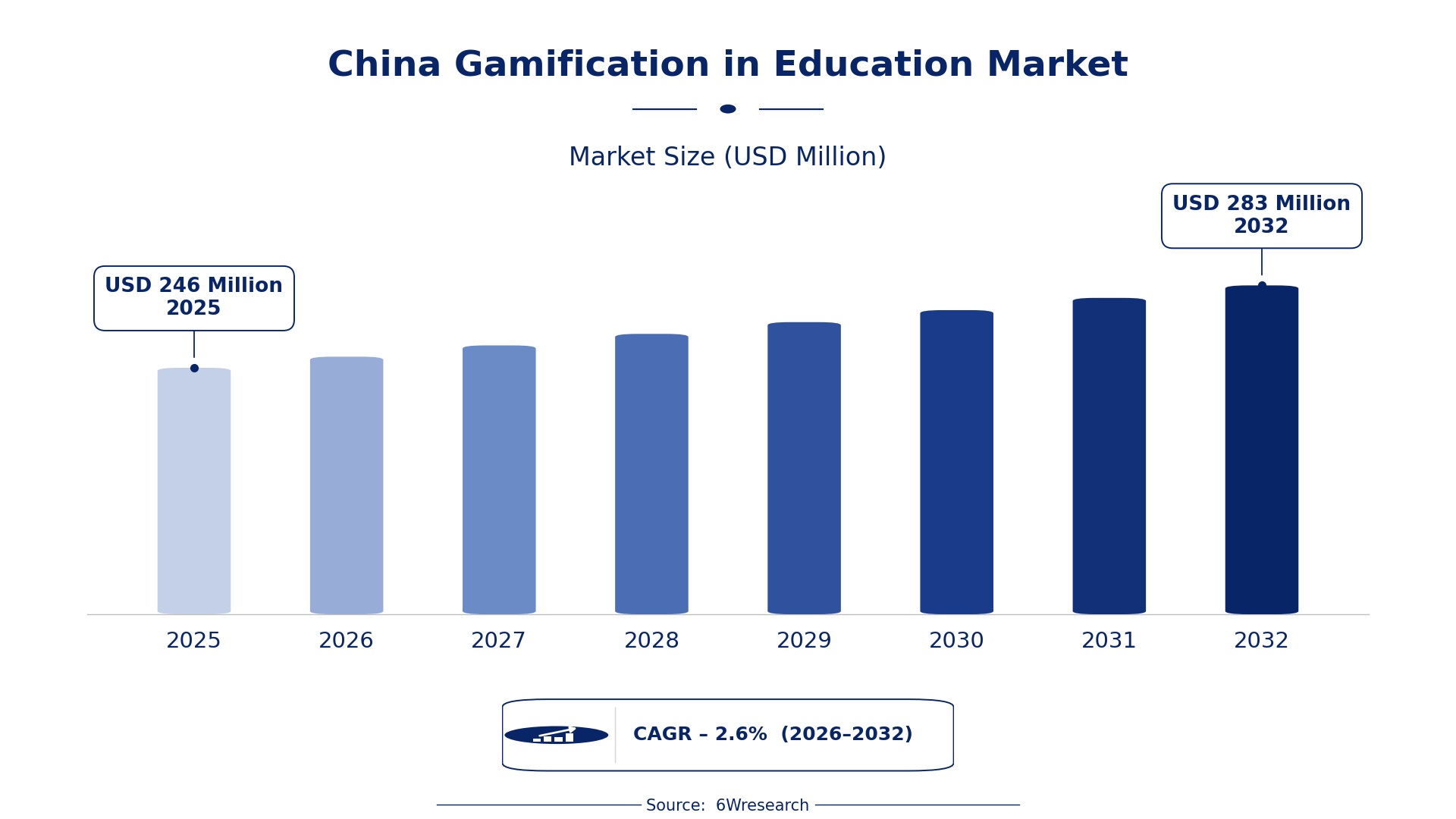
The China Gamification in Education Market was estimated at USD 246 Million in 2025 and is projected to reach USD 283 Million by 2032, growing at a CAGR of 2.6% from 2026 to 2032.
China Gamification in Education Market Synopsis
The integration of gamification in education is reshaping the traditional learning environment across China. With educational institutions increasingly adopting technology-driven methods, gamification has emerged as a key strategy to enhance student engagement and improve learning outcomes.
As both established firms and emerging startups focus on creating innovative gamified learning platforms, the demand for interactive educational tools is on the rise. The Chinese government's commitment to modernizing education further fuels this trend, positioning the gamification market for substantial growth.
China Gamification in Education Market Year-wise Growth Rate and Key Drivers
This graph illustrates the annual growth rates of the China Gamification in Education Market from 2021 to 2032, highlighting a steady upward trajectory and projected expansion over the forecast period.
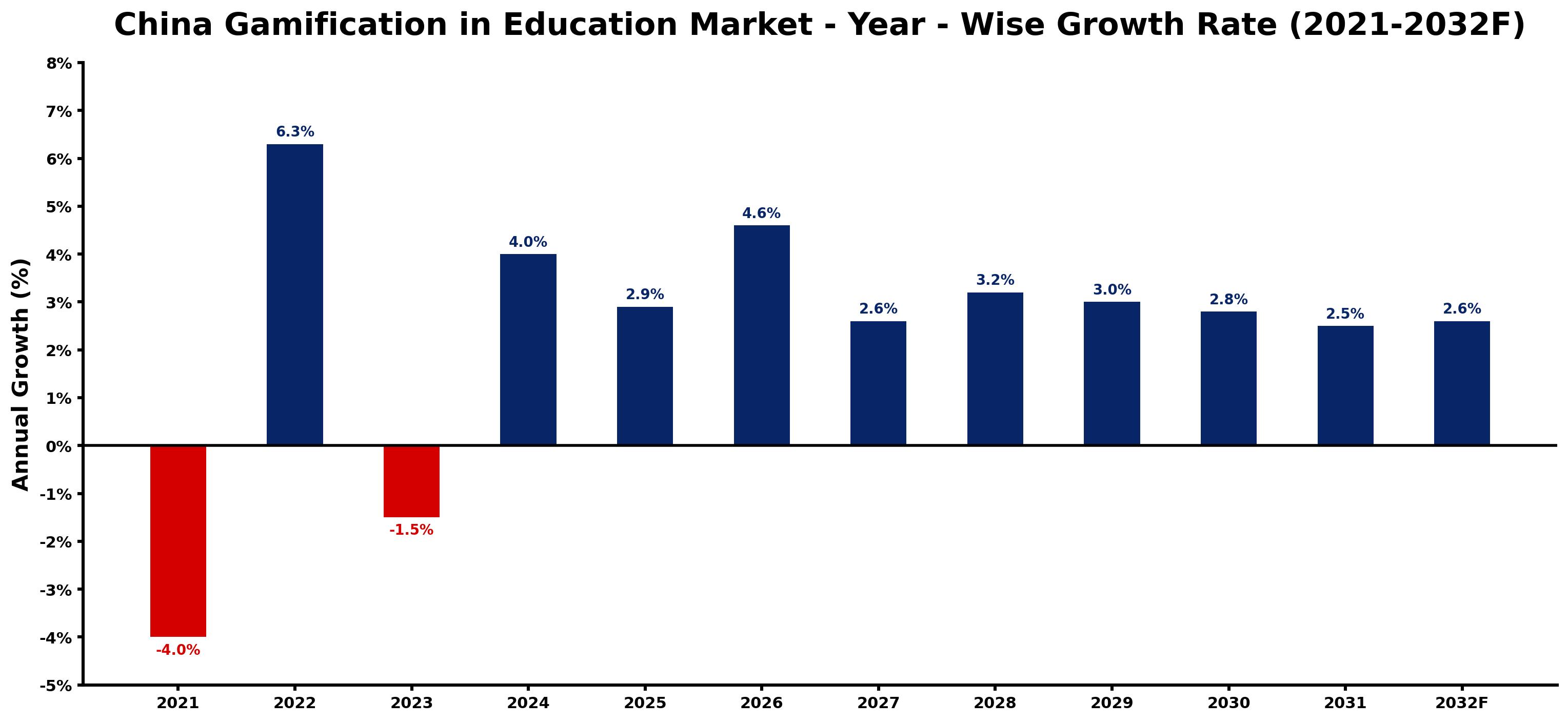
The table below presents the year‑wise growth rates along with the key drivers influencing the market
| Year | Growth Rate | Major Drivers |
| 2021 | -4.0% | Criticism over data privacy by China's Ministry of Education. |
| 2022 | 6.3% | Implementation of 14th Five-Year Plan for education reform |
| 2023 | -1.5% | Delayed adoption of gamification due to rigid curriculum. |
| 2024 | 4.0% | Growth in mobile learning applications among school-aged children |
| 2025 | 2.9% | Increased focus on student engagement in rural education |
| 2026 | 4.6% | Government push for personalized learning solutions in classrooms |
| 2027 | 2.6% | Rise in after-school programs utilizing game-based learning |
| 2028 | 3.2% | Adoption of AR/VR technologies in educational gamification |
| 2029 | 3.0% | Development of localized curriculum with gamification strategies |
| 2030 | 2.8% | Partnerships with local game developers for educational content |
| 2031 | 2.5% | Boost in AI-driven gamified assessments for better learning |
| 2032 | 2.6% | Supportive policies promoting innovation in educational technologies |
Note: Market size estimations and growth projections presented in this report are based on 6Wresearch's proprietary forecasting methodology, utilizing the latest available industry data, government publications, and primary research inputs.
China Gamification in Education Market Key Takeaways
Below are some of the specific key takeaways from the market, including:
- Rapid growth driven by the increased adoption of technology in educational settings.
- Mobile gamification applications are gaining popularity among students for their engaging content.
- Integration of gamification elements into traditional curricula is becoming commonplace.
- The market is witnessing an influx of gamified content tailored specifically to the Chinese educational framework.
- Investment opportunities are expanding as educational institutions seek innovative learning solutions.
Evaluation of Restraints in China Gamification in Education Market
Despite its growth, the China Gamification in Education Market faces several restraints. Regulatory restrictions on gaming content create hurdles for developers aiming to create educational tools. Concerns regarding screen time among students also pose challenges for educators and parents alike. on top of that, the lack of standardized guidelines for implementing gamification effectively complicates the integration of these solutions into curricula. Ensuring that gamified tools align with educational objectives remains an ongoing challenge in this dynamic market.
China Gamification in Education Market Trends
Current trends indicate a strong shift towards mobile gamification applications, which have proven to be engaging and effective in enhancing learning. Educators are increasingly integrating game mechanics, such as points and leaderboards, into traditional classroom environments. This trend reflects a broader movement towards interactive learning, where gamification serves to motivate students and foster participation. Additionally, there's a growing focus on developing educational games aligned with the Chinese curriculum, addressing students' specific learning needs.
China Gamification in Education Market Opportunities
The potential for growth within the China Gamification in Education Market is substantial. As educational institutions recognize the benefits of gamified learning, investment opportunities are expanding. Companies focused on creating gamified educational platforms, developing engaging content, and providing technology integration services are likely to see significant returns. Collaborations with schools and universities will further enhance market penetration, creating a fertile ground for innovative solutions that cater to the unique demands of the Chinese education system.
Government Initiatives in the China Gamification in Education Market
The Chinese government plays a crucial role in shaping the Gamification in Education Market through supportive policies and regulatory measures. By promoting the integration of technology in education, the government aims to elevate learning experiences and outcomes. Recent guidelines encourage the use of gamified elements in teaching, while initiatives like "Internet + Education" focus on leveraging technology to improve educational quality. The balance between fostering innovation and ensuring educational standards is paramount in this evolving market.
- A set of guidelines released in 2018 encouraging gamification in education has been successfully implemented.
- The "Internet + Education" initiative, currently underway, aims to enhance the quality of education through technology integration.
- A planned program to develop educational gaming platforms is expected to launch in 2026, targeting curriculum alignment.
- Ongoing evaluations by the Ministry of Education ensure that gamification adheres to educational standards and promotes positive values.
- Future initiatives to enhance digital infrastructure in schools are anticipated to support gamified learning environments.
Future Insights of the China Gamification in Education Market
Looking ahead to 2026-2032, the China Gamification in Education Market is set for notable growth driven by technological advancements and an increasing emphasis on interactive learning. The rise of EdTech startups and government support will continue to pave the way for innovative educational solutions. As artificial intelligence and virtual reality become integrated into gamified learning platforms, the overall educational experience is expected to enhance significantly, providing students with richer, more engaging learning opportunities.
China Gamification in Education Market Latest Developments
In the past year, the China Gamification in Education Market has seen a flurry of activity, with various companies launching innovative products aimed at enhancing student engagement. The surge in demand for interactive educational tools has prompted both established firms and newcomers to develop unique gamified learning solutions.
- A major technology vendor launched a new gamified learning platform in Q1 2025, designed specifically for primary education.
- An initiative to integrate gamified content into online learning modules is currently underway, having begun in mid-2025.
- A collaborative project between educational institutions and tech companies aimed at developing interactive learning games is planned for late 2026.
- In early 2025, a regional education authority completed a pilot program successfully integrating gamification into STEM curricula.
- Upcoming workshops in 2026 will focus on training educators in gamification techniques to enhance classroom engagement.
China Gamification in Education Market - Key Attractiveness of the Report
- 10 Years of Market Numbers
- Historical Data Starting from 2022 to 2025
- Base Year: 2025
- Forecast Data until 2032
- Key Performance Indicators Impacting the Market
- Major Upcoming Developments and Projects
Key Highlights of the Report:
- China Gamification in Education Market Outlook
- Market Size of China Gamification in Education Market, 2025
- Forecast of China Gamification in Education Market, 2032
- Historical Data and Forecast of China Gamification in Education Revenues & Volume for the Period 2022-2032F
- China Gamification in Education Market Trend Evolution
- China Gamification in Education Market Drivers and Challenges
- China Gamification in Education Price Trends
- China Gamification in Education Porter's Five Forces
- China Gamification in Education Industry Life Cycle
- Historical Data and Forecast of China Gamification in Education Market Revenues & Volume By Offering for the Period 2022-2032F
- Historical Data and Forecast of China Gamification in Education Market Revenues & Volume By Software for the Period 2022-2032F
- Historical Data and Forecast of China Gamification in Education Market Revenues & Volume By Services for the Period 2022-2032F
- Historical Data and Forecast of China Gamification in Education Market Revenues & Volume By End User for the Period 2022-2032F
- Historical Data and Forecast of China Gamification in Education Market Revenues & Volume By Academic for the Period 2022-2032F
- Historical Data and Forecast of China Gamification in Education Market Revenues & Volume By Corporate Training for the Period 2022-2032F
- Historical Data and Forecast of China Gamification in Education Market Revenues & Volume By Deployment Mode for the Period 2022-2032F
- Historical Data and Forecast of China Gamification in Education Market Revenues & Volume By Cloud for the Period 2022-2032F
- Historical Data and Forecast of China Gamification in Education Market Revenues & Volume By On-Premises for the Period 2022-2032F
- China Gamification in Education Import Export Trade Statistics
- Market Opportunity Assessment By Offering
- Market Opportunity Assessment By End User
- Market Opportunity Assessment By Deployment Mode
- China Gamification in Education Top Companies Market Share
- China Gamification in Education Competitive Benchmarking By Technical and Operational Parameters
- China Gamification in Education Company Profiles
- China Gamification in Education Key Strategic Recommendations






































