China Hybrid Cloud Market Size & Growth Rate (2026-2032)
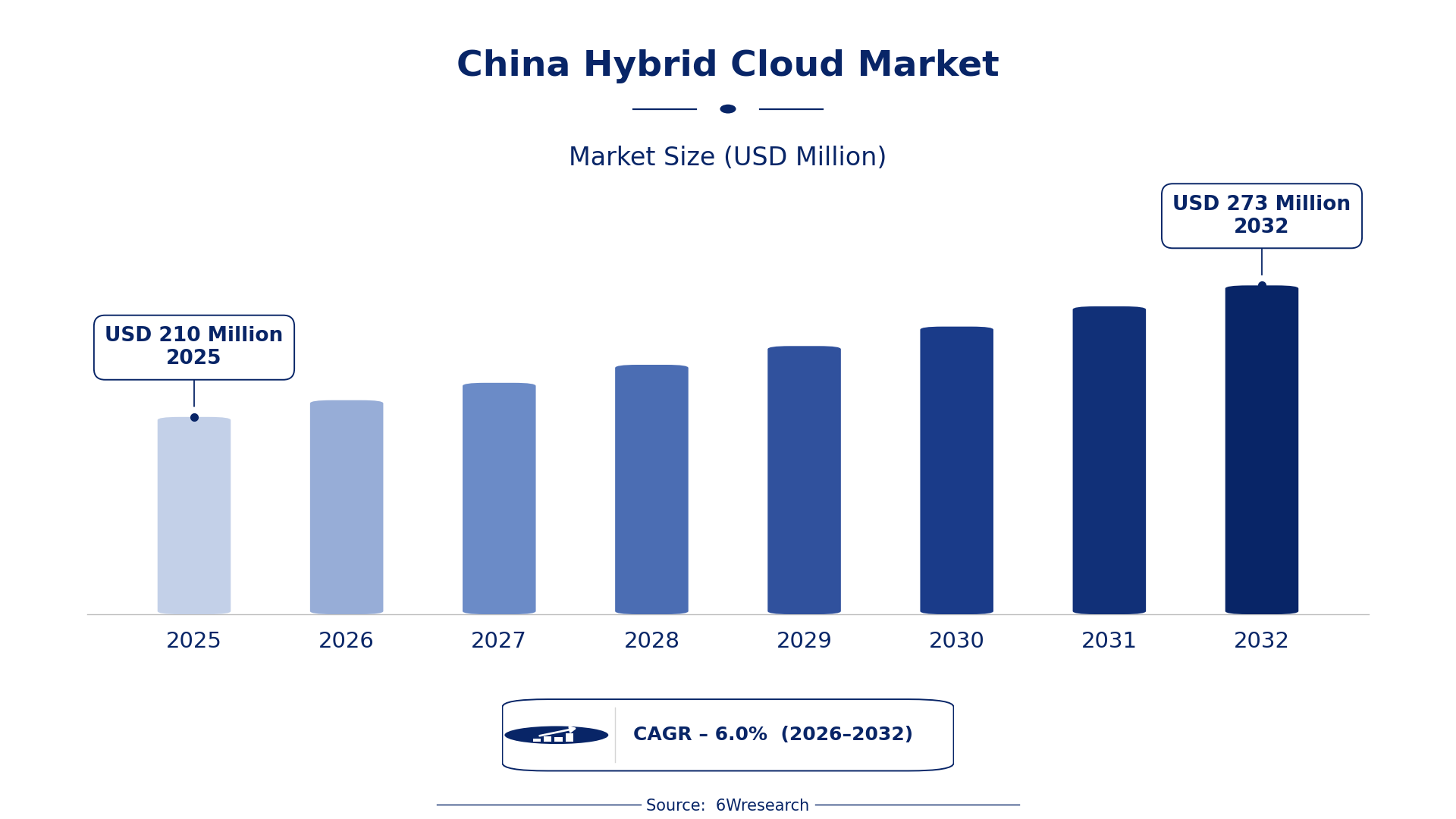
The China Hybrid Cloud Market was estimated at USD 210 Million in 2025 and is projected to reach USD 273 Million by 2032, growing at a CAGR of 6.0% from 2026 to 2032.
China Hybrid Cloud Market Synopsis
The demand for hybrid cloud solutions in China is soaring as enterprises increasingly seek to balance operational flexibility with stringent data security requirements. Organizations are recognizing the value of combining public and private cloud services to optimize workload management and enhance compliance with local regulations.
Driven by rapid digital transformation initiatives, businesses across various sectors are turning to hybrid cloud architectures to improve efficiency. The shift is also fueled by the growing prevalence of cloud-based applications, making hybrid environments essential for achieving strategic IT objectives.
China Hybrid Cloud Market Year-wise Growth Rate and Key Drivers
This graph illustrates the annual growth rates of the China Hybrid Cloud Market from 2021 to 2032, highlighting a steady upward trajectory and projected expansion over the forecast period.
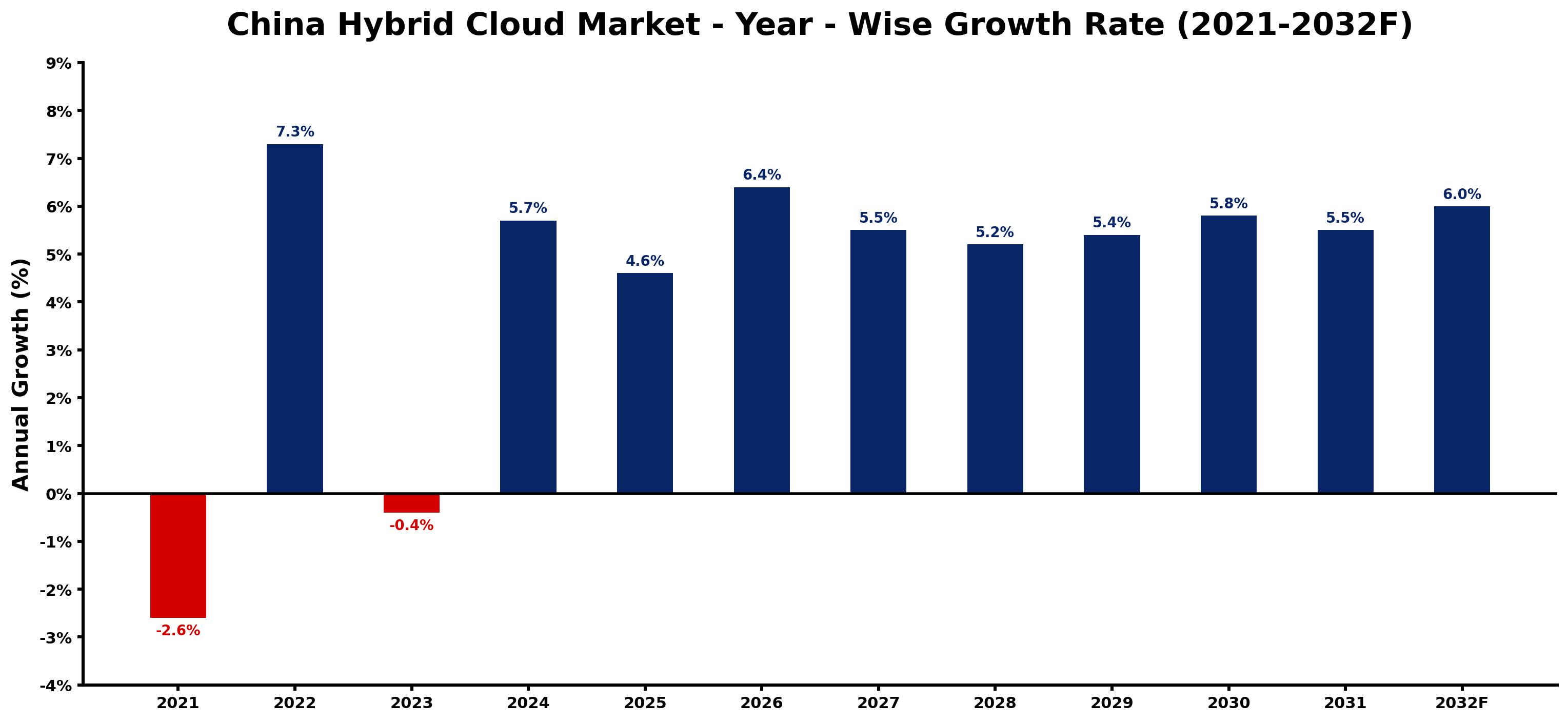
The table below presents the year‑wise growth rates along with the key drivers influencing the market
| Year | Growth Rate | Major Drivers |
| 2021 | -2.6% | Slower investment in digital infrastructure by local governments |
| 2022 | 7.3% | China's new data security regulations promoting cloud adoption. |
| 2023 | -0.4% | Rising energy costs affecting data center operations |
| 2024 | 5.7% | Increased enterprise focus on cost-efficient hybrid solutions. |
| 2025 | 4.6% | Growing interest in AI applications requiring scalable cloud resources. |
| 2026 | 6.4% | Local governments incentivizing technology innovation in cloud sectors. |
| 2027 | 5.5% | Major companies migrating to hybrid cloud for flexibility. |
| 2028 | 5.2% | Investment in green data centers aligning with sustainability goals. |
| 2029 | 5.4% | Rise in remote work fueling hybrid cloud service needs. |
| 2030 | 5.8% | Support for digital economy initiatives enhancing hybrid deployment. |
| 2031 | 5.5% | Emergence of startup ecosystem advocating hybrid cloud technologies. |
| 2032 | 6.0% | Enhanced partnerships among tech firms driving hybrid cloud solutions. |
Note: Market size estimations and growth projections presented in this report are based on 6Wresearch's proprietary forecasting methodology, utilizing the latest available industry data, government publications, and primary research inputs.
China Hybrid Cloud Market Key Takeaways
Below are some of the specific key takeaways from the market, including:
- The hybrid cloud market is experiencing steady growth due to increasing digital transformation efforts.
- Organizations are prioritizing data security and compliance as they adopt hybrid cloud solutions.
- Government policies are actively promoting the expansion of domestic cloud infrastructure.
- Technological advancements are facilitating better integration and management of hybrid systems.
- Cost-effective IT management is a key driver for businesses exploring hybrid cloud options.
Evaluation of Restraints in China Hybrid Cloud Market
Despite the promising growth trajectory, the China hybrid cloud market faces notable restraints. Integration complexity remains a significant hurdle for many organizations attempting to create effective hybrid environments. The challenge lies in the need for seamless communication between on-premises and cloud resources, which can complicate resource management. on top of that, as data security threats evolve, ensuring compliance across multiple platforms becomes increasingly intricate, requiring continuous adaptation from businesses.
China Hybrid Cloud Market Trends
Several trends are currently shaping the China hybrid cloud market. One notable trend is the increasing adoption of Artificial Intelligence (AI) and Machine Learning (ML) technologies within hybrid environments, enhancing data processing and analytics capabilities. Additionally, businesses are focusing on multi-cloud strategies, leveraging various cloud providers to avoid vendor lock-in and improve resilience. Enhanced data sovereignty concerns are also prompting companies to prioritize local data storage solutions, pushing the hybrid cloud market forward.
China Hybrid Cloud Market Opportunities
The hybrid cloud market in China presents several lucrative growth opportunities. As enterprises continue their digital transformation journeys, the demand for tailored hybrid cloud solutions is expected to rise. Organizations looking to optimize operational efficiency will invest in new technologies that enhance interoperability and security. There is also potential for partnerships between cloud service providers and local businesses to create customized solutions that address specific industry needs, particularly in finance and healthcare.
Government Initiatives in the China Hybrid Cloud Market
Government policy plays a crucial role in shaping the hybrid cloud market in China. The focus is on promoting domestic cloud providers while ensuring data security and compliance with local regulations. By encouraging state-owned enterprises to adopt hybrid solutions, the government aims to enhance overall IT infrastructure efficiency and support industry innovation.
- A national digital infrastructure upgrade programme recently launched to enhance cloud service capabilities across various sectors.
- Current initiatives are underway to develop a regulatory framework aimed at improving data security and compliance in hybrid environments.
- A planned public-private partnership expected to expand cloud infrastructure access by 2028.
- Ongoing efforts to support domestic cloud providers through subsidies and incentives to foster innovation and competitiveness.
- A new government policy introduced in 2025 mandates that public sector organizations adopt hybrid cloud solutions for improved efficiency.
Future Insights of the China Hybrid Cloud Market
Looking ahead to 2026-2032, the China hybrid cloud market is set for sustained growth, driven by continuous advancements in cloud technologies and increasing enterprise investment in IT modernization. As businesses strive to improve operational efficiencies while adhering to regulatory mandates, hybrid cloud solutions will become essential. The integration of emerging technologies, such as AI and data analytics, will further enhance the appeal of hybrid cloud environments, making them a cornerstone of future IT strategies.
China Hybrid Cloud Market Latest Developments
In the past year, the China hybrid cloud market has witnessed significant activity, highlighting a shift towards more integrated solutions. As businesses adapt to new challenges, innovations and partnerships have emerged that promise to reshape the market's future.
- A major technology vendor announced the rollout of a new hybrid cloud management platform in Q2 2025, aimed at simplifying resource integration.
- A partnership between regional operators and cloud providers is currently underway, focusing on expanding cloud services in underserved areas, initiated in early 2025.
- A product upgrade enhancing data security features in hybrid environments was completed in late 2025, responding to growing compliance demands.
- An initiative to develop a set of industry-specific hybrid cloud solutions is planned for mid-2026, targeting sectors such as healthcare and finance.
- Recent collaborations between local governments and cloud firms have begun, aimed at fostering innovation in cloud technology, currently in the planning phase.
China Hybrid Cloud Market - Key Attractiveness of the Report
- 10 Years of Market Numbers
- Historical Data Starting from 2022 to 2025
- Base Year: 2025
- Forecast Data until 2032
- Key Performance Indicators Impacting the Market
- Major Upcoming Developments and Projects
Key Highlights of the Report:
- China Hybrid Cloud Market Outlook
- Market Size of China Hybrid Cloud Market, 2025
- Forecast of China Hybrid Cloud Market, 2032
- Historical Data and Forecast of China Hybrid Cloud Revenues & Volume for the Period 2022-2032F
- China Hybrid Cloud Market Trend Evolution
- China Hybrid Cloud Market Drivers and Challenges
- China Hybrid Cloud Price Trends
- China Hybrid Cloud Porter's Five Forces
- China Hybrid Cloud Industry Life Cycle
- Historical Data and Forecast of China Hybrid Cloud Market Revenues & Volume By Service Type for the Period 2022-2032F
- Historical Data and Forecast of China Hybrid Cloud Market Revenues & Volume By Cloud management and orchestration for the Period 2022-2032F
- Historical Data and Forecast of China Hybrid Cloud Market Revenues & Volume By Disaster recovery for the Period 2022-2032F
- Historical Data and Forecast of China Hybrid Cloud Market Revenues & Volume By Hybrid hosting for the Period 2022-2032F
- Historical Data and Forecast of China Hybrid Cloud Market Revenues & Volume By Component for the Period 2022-2032F
- Historical Data and Forecast of China Hybrid Cloud Market Revenues & Volume By Solution for the Period 2022-2032F
- Historical Data and Forecast of China Hybrid Cloud Market Revenues & Volume By Services for the Period 2022-2032F
- Historical Data and Forecast of China Hybrid Cloud Market Revenues & Volume By Organization Size for the Period 2022-2032F
- Historical Data and Forecast of China Hybrid Cloud Market Revenues & Volume By SMEs for the Period 2022-2032F
- Historical Data and Forecast of China Hybrid Cloud Market Revenues & Volume By Large Enterprises for the Period 2022-2032F
- Historical Data and Forecast of China Hybrid Cloud Market Revenues & Volume By Service Model for the Period 2022-2032F
- Historical Data and Forecast of China Hybrid Cloud Market Revenues & Volume By Infrastructure-as-a-Service for the Period 2022-2032F
- Historical Data and Forecast of China Hybrid Cloud Market Revenues & Volume By Platform-as-a-Service for the Period 2022-2032F
- Historical Data and Forecast of China Hybrid Cloud Market Revenues & Volume By Software-as-a-Service for the Period 2022-2032F
- Historical Data and Forecast of China Hybrid Cloud Market Revenues & Volume By Vertical for the Period 2022-2032F
- Historical Data and Forecast of China Hybrid Cloud Market Revenues & Volume By BFSI for the Period 2022-2032F
- Historical Data and Forecast of China Hybrid Cloud Market Revenues & Volume By IT and Telecommunications for the Period 2022-2032F
- Historical Data and Forecast of China Hybrid Cloud Market Revenues & Volume By Healthcare for the Period 2022-2032F
- Historical Data and Forecast of China Hybrid Cloud Market Revenues & Volume By Retail for the Period 2022-2032F
- Historical Data and Forecast of China Hybrid Cloud Market Revenues & Volume By Media and entertainment for the Period 2022-2032F
- Historical Data and Forecast of China Hybrid Cloud Market Revenues & Volume By Manufacturing for the Period 2022-2032F
- Historical Data and Forecast of China Hybrid Cloud Market Revenues & Volume By Government for the Period 2022-2032F
- Historical Data and Forecast of China Hybrid Cloud Market Revenues & Volume By Transportation for the Period 2022-2032F
- China Hybrid Cloud Import Export Trade Statistics
- Market Opportunity Assessment By Service Type
- Market Opportunity Assessment By Component
- Market Opportunity Assessment By Organization Size
- Market Opportunity Assessment By Service Model
- Market Opportunity Assessment By Vertical
- China Hybrid Cloud Top Companies Market Share
- China Hybrid Cloud Competitive Benchmarking By Technical and Operational Parameters
- China Hybrid Cloud Company Profiles
- China Hybrid Cloud Key Strategic Recommendations






































