China Inflatable Pools Market Size, Share & Growth Rate
The China Inflatable Pools Market was estimated at USD 105 Million in 2025 and is projected to reach USD 121 Million by 2032, growing at a CAGR of 2.0% from 2026 to 2032. This growth trajectory is being fueled by rising disposable incomes among urban consumers, who are increasingly seeking affordable and convenient leisure options to accommodate their lifestyles. Moreover, urbanization continues to drive interest in inflatable pools as practical alternatives to traditional, more permanent swimming pool solutions, particularly in densely populated areas.
China Inflatable Pools Market Year-wise Growth Rate and Key Drivers
This graph highlights how the China Inflatable Pools Market has steadily grown over the years, supported by major growth factors.
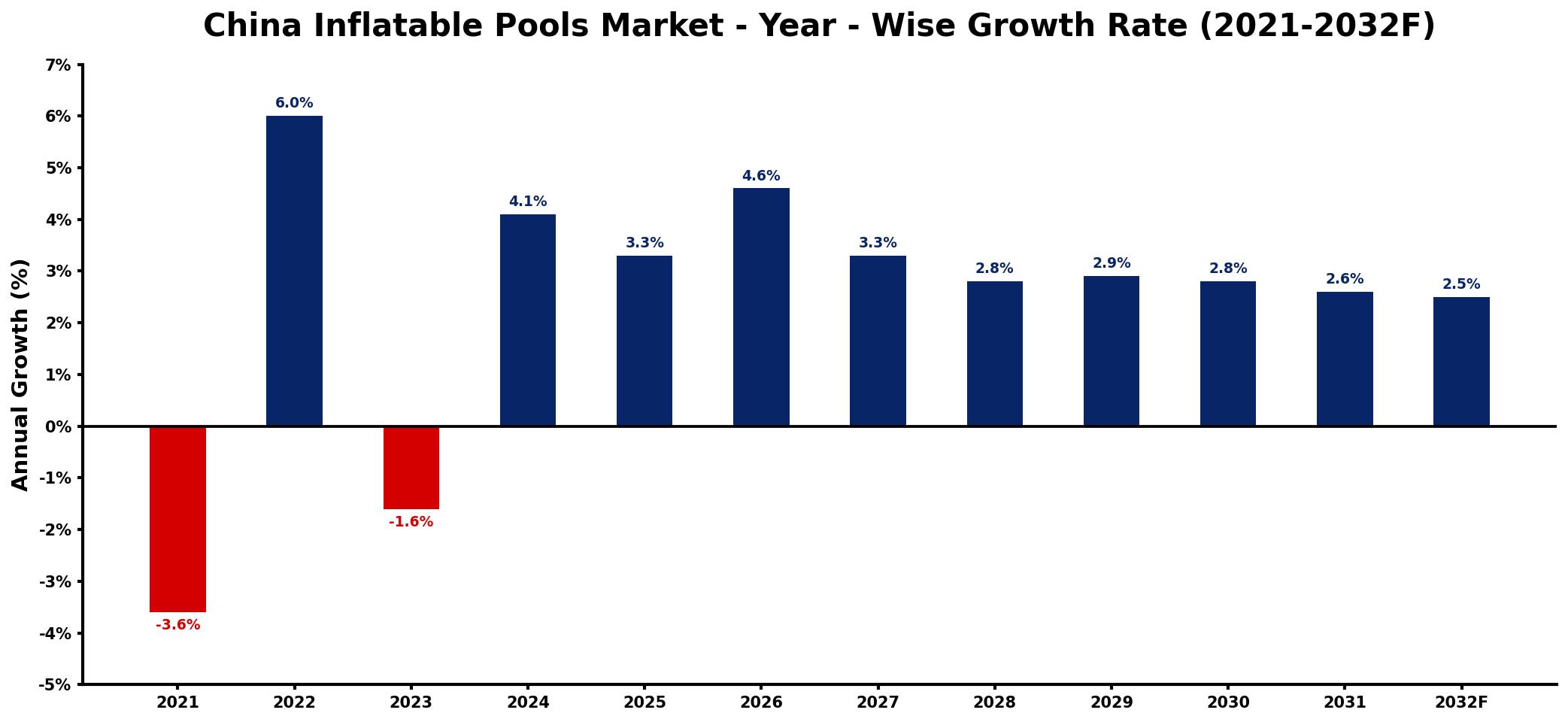
The table below presents the year‑wise growth rates along with the key drivers influencing the market
| Year | Growth Rate | Major Drivers |
| 2021 | -3.6% | decreased consumer spending on leisure |
| 2022 | 6.0% | growing interest in outdoor activities |
| 2023 | -1.6% | falling disposable income levels |
| 2024 | 4.1% | increased investment in recreational spaces |
| 2025 | 3.3% | rising demand for home entertainment |
| 2026 | 4.6% | expansion of summer recreation trends |
| 2027 | 3.3% | growing popularity of backyard leisure |
| 2028 | 2.8% | increased focus on family activities |
| 2029 | 2.9% | rising awareness of wellness benefits |
| 2030 | 2.8% | stronger distribution network expansion |
| 2031 | 2.6% | growing trend of staycations |
| 2032 | 2.5% | increased availability of affordable alternatives |
Note: Market size estimations and growth projections presented in this report are based on 6Wresearch's proprietary forecasting methodology, utilizing the latest available industry data, government publications, and primary research inputs.
China Inflatable Pools Market Synopsis
The demand for inflatable pools in China is primarily propelled by families with children, who favor the safety and accessibility these pools offer for at-home recreation. The availability of various sizes, shapes, and designs allows consumers to select options that best suit their space and usage requirements.
Additionally, the rise of e-commerce platforms has revolutionized how consumers purchase inflatable pools, providing them with a wider selection and easier access to quality products. This shift in purchasing behavior is contributing to heightened competition and innovation among manufacturers in the sector.
China Inflatable Pools Market Key Takeaways
- The market is experiencing steady growth, driven by urbanization and rising disposable incomes.
- Innovations in product design focus on durability and safety features to meet consumer demands.
- Online shopping trends are expanding market access and influencing consumer preferences.
- Regulatory frameworks are evolving to ensure product quality and consumer safety.
- Environmental consciousness is prompting interest in sustainable materials for inflatable pool manufacturing.
Evaluation of Restraints in China Inflatable Pools Market
Despite the promising growth outlook, the China Inflatable Pools Market contends with significant challenges. Intense competition from both domestic and international manufacturers exerts pressure on pricing and market share. Additionally, fluctuating raw material costs can impact profitability and operational stability. Concerns regarding product safety and quality, exacerbated by issues of counterfeiting and unauthorized production, may undermine consumer trust. The seasonal nature of demand further complicates inventory management, compelling manufacturers to strategize carefully to navigate these market constraints.
China Inflatable Pools Market Trends
Current trends in the China Inflatable Pools Market highlight a growing preference for eco-friendly materials and sustainable production processes. Manufacturers are increasingly innovating by incorporating features that enhance the user experience, such as built-in safety mechanisms and unique design aesthetics. Furthermore, marketing strategies are evolving to resonate with environmentally conscious consumers, promoting the benefits of eco-friendly products alongside traditional attributes of convenience and affordability.
China Inflatable Pools Market Opportunities
Investment opportunities in this market are robust, particularly for brands that prioritize innovative design and sustainable materials. The demand for multifunctional inflatable products, such as spas or themed play pools for children, presents avenues for differentiation and niche targeting. Collaborating with e-commerce platforms can facilitate broader market reach, enabling businesses to capitalize on growing online shopping trends and ultimately enhance their profitability.
Government Initiatives in the China Inflatable Pools Market
The Chinese government has been proactive in establishing regulations aimed at improving product safety and quality within the inflatable pools market. Initiatives promoting environmentally friendly materials underscore a commitment to sustainability in manufacturing. Additionally, the government is fostering technological innovation in product design, helping to maintain a competitive and responsible industry landscape that prioritizes consumer safety and environmental stewardship.
Future Insights of the China Inflatable Pools Market
Looking ahead to 2026-2032, the China Inflatable Pools Market is poised for steady expansion. Factors such as increasing disposable incomes and a growing preference for leisure activities at home will sustain consumer interest. Urban residents seeking space-efficient recreational options will drive demand further. As manufacturers continue to innovate and adapt to evolving consumer preferences, the market landscape is expected to grow more competitive, paving the way for enhanced product offerings and diversified consumer engagement strategies.
China Inflatable Pools Market Latest Developments (2025 - 2026)
Recent developments in the China Inflatable Pools Market indicate a shift toward improved product safety and design innovations. Manufacturers are increasingly investing in research and development to create more durable and aesthetically appealing products. Furthermore, collaborations with online retail platforms are being prioritized to enhance distribution channels and improve customer reach.
China Inflatable Pools Market - Key Attractiveness of the Report
- 10 Years of Market Numbers
- Historical Data Starting from 2022 to 2025
- Base Year: 2025
- Forecast Data until 2032
- Key Performance Indicators Impacting the Market
- Major Upcoming Developments and Projects
Key Highlights of the Report:
- China Inflatable Pools Market Outlook
- Market Size of China Inflatable Pools Market, 2025
- Forecast of China Inflatable Pools Market, 2032
- Historical Data and Forecast of China Inflatable Pools Revenues & Volume for the Period 2022-2032F
- China Inflatable Pools Market Trend Evolution
- China Inflatable Pools Market Drivers and Challenges
- China Inflatable Pools Price Trends
- China Inflatable Pools Porter's Five Forces
- China Inflatable Pools Industry Life Cycle
- Historical Data and Forecast of China Inflatable Pools Market Revenues & Volume By Capacity for the Period 2022-2032F
- Historical Data and Forecast of China Inflatable Pools Market Revenues & Volume By Maximum 3 Individuals for the Period 2022-2032F
- Historical Data and Forecast of China Inflatable Pools Market Revenues & Volume By Maximum 6 Individuals for the Period 2022-2032F
- Historical Data and Forecast of China Inflatable Pools Market Revenues & Volume By Maximum 12 Individuals for the Period 2022-2032F
- Historical Data and Forecast of China Inflatable Pools Market Revenues & Volume By Age for the Period 2022-2032F
- Historical Data and Forecast of China Inflatable Pools Market Revenues & Volume By Up To 4 Years for the Period 2022-2032F
- Historical Data and Forecast of China Inflatable Pools Market Revenues & Volume By 5 To 10 Years for the Period 2022-2032F
- Historical Data and Forecast of China Inflatable Pools Market Revenues & Volume By 11 Years & Above for the Period 2022-2032F
- Historical Data and Forecast of China Inflatable Pools Market Revenues & Volume By Shape for the Period 2022-2032F
- Historical Data and Forecast of China Inflatable Pools Market Revenues & Volume By Round for the Period 2022-2032F
- Historical Data and Forecast of China Inflatable Pools Market Revenues & Volume By Rectangle for the Period 2022-2032F
- Historical Data and Forecast of China Inflatable Pools Market Revenues & Volume By Square for the Period 2022-2032F
- Historical Data and Forecast of China Inflatable Pools Market Revenues & Volume By Oval for the Period 2022-2032F
- Historical Data and Forecast of China Inflatable Pools Market Revenues & Volume By Others for the Period 2022-2032F
- Historical Data and Forecast of China Inflatable Pools Market Revenues & Volume By Distribution Channel for the Period 2022-2032F
- Historical Data and Forecast of China Inflatable Pools Market Revenues & Volume By Store Based for the Period 2022-2032F
- Historical Data and Forecast of China Inflatable Pools Market Revenues & Volume By Non Store Based for the Period 2022-2032F
- China Inflatable Pools Import Export Trade Statistics
- Market Opportunity Assessment By Capacity
- Market Opportunity Assessment By Age
- Market Opportunity Assessment By Shape
- Market Opportunity Assessment By Distribution Channel
- China Inflatable Pools Top Companies Market Share
- China Inflatable Pools Competitive Benchmarking By Technical and Operational Parameters
- China Inflatable Pools Company Profiles
- China Inflatable Pools Key Strategic Recommendations






































