China Marine Composites Market Top 5 Importing Countries and Market Competition (HHI) Analysis
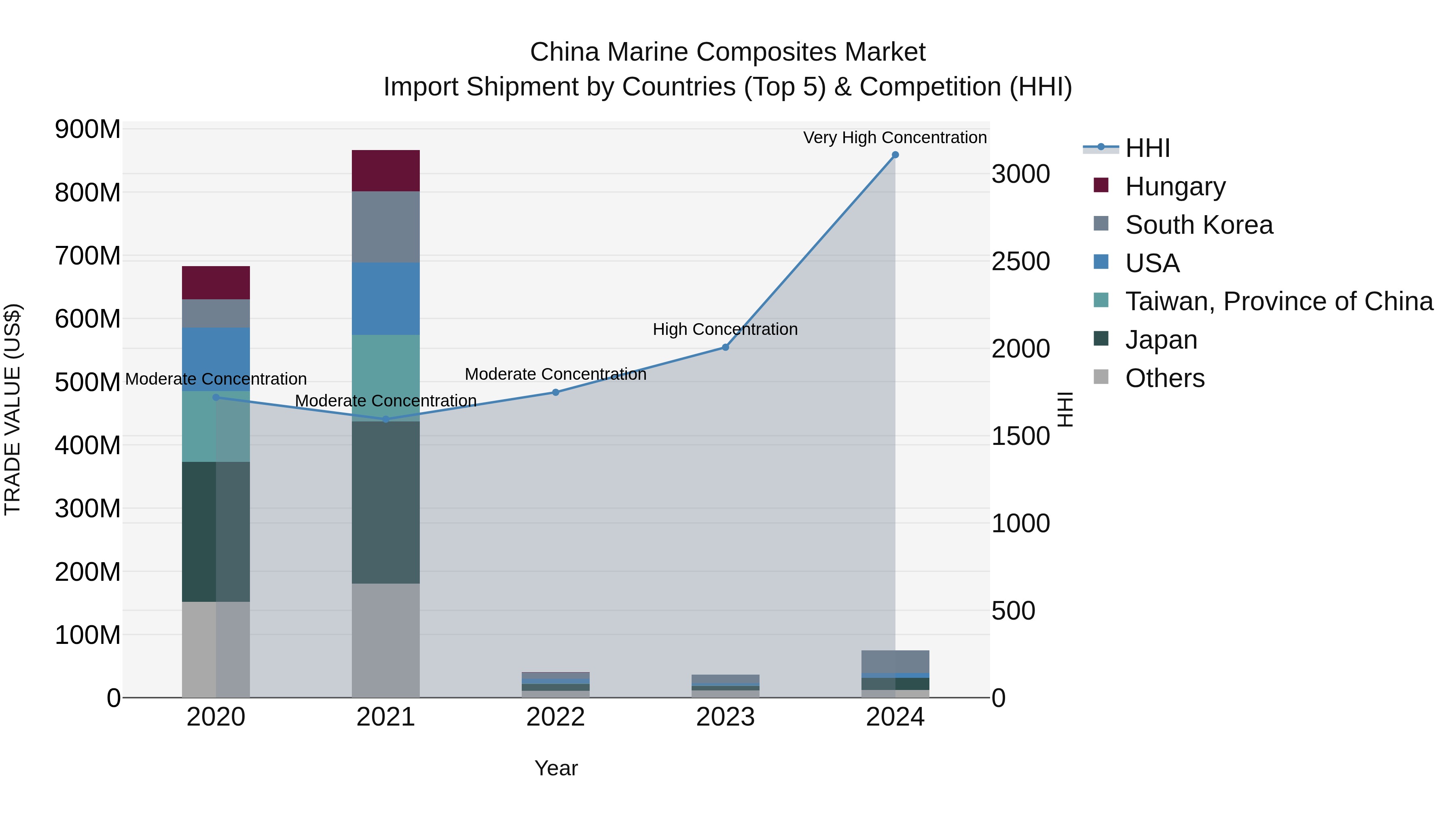
China marine composites import market saw a significant shift in 2024, with South Korea, Japan, USA, Germany, and Netherlands emerging as the top exporting countries. The market experienced a surge in concentration levels, reaching a very high level compared to 2023. Despite a steep negative CAGR of -42.43% from 2020 to 2024, the growth rate in 2024 alone was an impressive 104.67%. These dynamics suggest a rapidly evolving landscape in the marine composites sector, with key players intensifying their presence in the Chinese market.
China Marine Composites Market Growth Rate
According to 6Wresearch internal database and industry insights, the China Marine Composites Market is projected to grow at a compound annual growth rate (CAGR) of 7.3% during the forecast period (2025–2031).
Five-Year Growth Trajectory of the China Marine Composites Market with Core Drivers
Below mentioned are the evaluation of year-wise growth rate along with key drivers:
| Year | Est. Annual Growth (%) | Growth Drivers |
| 2020 | 3.2 | Steady demand from shipbuilding and coastal infrastructure repair. |
| 2021 | 4.5 | Recovery in yacht and passenger ferry construction post-industry stabilization. |
| 2022 | 5.8 | Expansion of naval fleet modernization and adoption of lightweight hull materials. |
| 2023 | 6.6 | Surge in polymer composite integration in high-performance vessels. |
| 2024 | 7 | Increased export-oriented manufacturing of boats and marine parts. |
Topics Covered in the China Marine Composites Market Report
The China Marine Composites Market report thoroughly covers the market by composite type, fiber type, resin type, and vessel type. The market report provides an unbiased and detailed analysis of ongoing market trends, opportunities/high growth areas, and market drivers, which would help stakeholders devise and align their market strategies according to the current and future market dynamics.
China Marine Composites Market Highlights
| Report Name | China Marine Composites Market |
| Forecast period | 2025-2031 |
| CAGR | 7.3% |
| Growing Sector | Polymer Matrix Composites (PMCs) |
China Marine Composites Market Synopsis
The China Marine Composites Market is expanding rapidly, driven by the adoption of lightweight materials, increasing shipbuilding production, and rising naval modernization investments. Growth in the market is being propelled by technological progress in polymer matrix composites and rising demand for durable, high-performance marine structures. China Marine Composites Market Growth is further accelerated by government-led initiatives encouraging innovation in fiber-reinforced materials and the expansion of domestic manufacturing hubs in coastal provinces like Jiangsu, Zhejiang, and Guangdong, reinforcing China global leadership in marine composite production.
Evaluation of Growth Drivers in the China Marine Composites Market
Below mentioned are some growth drivers and their impact on market dynamics:
| Drivers | Primary Segments Affected | Why It Matters |
| Naval & Defense Modernization | Metal & Ceramic Matrix Composites | Enhances strength, corrosion resistance, and durability in naval applications. |
| Growth in Yacht & Passenger Ferry Production | Polymer Matrix Composites | Drives demand for lightweight and high-strength hull structures. |
| Technological Advancements in Fiber Manufacturing | Carbon & Glass Fiber | Improves fatigue resistance and structural performance in vessel components. |
| Expanding Coastal Infrastructure | Polyester & Epoxy Resins | Supports composite use in docks, pontoons, and bridge repairs. |
| Shift Toward Sustainable Materials | Natural & Aramid Fibers | Promotes bio-based composite innovation for eco-friendly manufacturing. |
China Marine Composites Market is expected to grow significantly, with a CAGR of 7.3% during the forecast period of 2025-2031. The China Marine Composites Market is expected to expand consistently, supported by innovations in resin formulation, growing automation in composite production, and significant government support for naval and shipbuilding advancements. The shift toward lightweight and high-strength materials is improving sustainability and operational efficiency. Combined with increased manufacturing capacity and technological progress, these factors are reinforcing China global leadership in advanced marine composite material production and boosting its competitiveness in the international maritime industry.
Evaluation of Restraints in the China Marine Composites Market
Below mentioned are some major restraints and their influence on market dynamics:
| Restraints | Primary Segments Affected | What This Means |
| High Production & Processing Costs | Carbon Fiber, Epoxy Composites | Limits small-scale manufacturers’ participation. |
| Complex Manufacturing Processes | MMC & CMC | Requires advanced curing systems and technical expertise. |
| Recycling & Disposal Challenges | Thermoset Resins | Hinders sustainable waste management and reuse. |
| Raw Material Price Volatility | Vinyl Ester & Epoxy | Increases production uncertainty and margin compression. |
| Limited Skilled Workforce | All Composite Types | Slows adoption of automation and precision fabrication. |
China Marine Composites Market Challenges
Despite the steady expansion of the market for China Marine Composites Industry, they experience challenges related to the high capital needed for modern equipment, limited domestic supply of specialty fibers, and complex technical requirements for curing multilayer of resin, among other challenges also being unable to manage composite waste or to find a significant number of trained personnel to produce high-precision, high-value products in many of their applications. Additionally, SMEs face barriers when trying to scale businesses due to expensive automation systems and stringent Marine quality certification that affects orders.
China Marine Composites Market Trends
Some major trends contributing to the development of the China Marine Composites Market are:
- Automation in Composite Fabrication: Robotic filament winding and advanced vacuum infusion technologies are creating a paradigm shift in composite manufacturing by improving precision, efficiency, and repeatability, decreasing human error, and ensuring consistent quality in large-scale marine structures
- Hybrid Fiber Integration: The design of composites utilizing carbon, glass, and natural fibers steps into the domain of high strength/low weight composites with enhanced performance and cost efficiencies to evolve marine hull reinforcement and vessel design
- Sustainable Marine Solutions: The marine industry is increasingly looking to bio-based epoxies and recyclable thermoplastics to limit environmental impacts and adhere to the pressures of international green manufacturing regulations and the goals of carbon neutrality.
- 3D Printing of Composite Components: As an additive manufacturing technique, 3D printing enables rapid and tailored production of marine parts with complex geometries, reduced lead times, and reduced prototyping costs for shipbuilders and component suppliers.
Investment Opportunities in the China Marine Composites Market
Here are some investment opportunities in the China Marine Composites Industry:
- High-Performance Resins: Investing in low-VOC epoxy and polyester systems, for marine safety as well as for sustainable projects.
- Localized Fiber Manufacturing: Developing domestic carbon fibers as well as glass fiber plants to reduce reliance on imported products.
- Advanced Naval Applications: Expand defense-grade capabilities for composite fabrication to use composites for hull armor and lightweight decks.
- Infrastructure Renovation Projects: Use composites for bridge reinforcement or repair as well as seawalls and harbor and coastal infrastructure.
- Smart Material Development: Continue to innovate and develop self-healing resins, sensors to measure structural integrity in real time.
Top 5 Leading Players in the China Marine Composites Market
Here are some top companies contributing to China Marine Composites Market Share:
1. China Jushi Co., Ltd.
| Company Name | China Jushi Co., Ltd. |
| Established Year | 1993 |
| Headquarters | Tongxiang, Zhejiang, China |
| Official Website | Click Here |
A leading manufacturer of fiberglass and composite materials offering E-glass and S-glass fibers widely used in marine and industrial applications.
2. Sinoma Science & Technology Co., Ltd.
| Company Name | Sinoma Science & Technology Co., Ltd. |
| Established Year | 2001 |
| Headquarters | Nanjing, China |
| Official Website | Click Here |
Specializes in advanced composites and structural materials used in wind, marine, and aerospace applications, emphasizing eco-friendly production.
3. Hengshen Co., Ltd.
| Company Name | Hengshen Co., Ltd. |
| Established Year | 2007 |
| Headquarters | Taicang, Jiangsu, China |
| Official Website | - |
Focuses on carbon fiber and resin composite manufacturing for marine, aviation, and energy industries with strong R&D infrastructure.
4. Sino Composites Co., Ltd.
| Company Name | Sino Composites Co., Ltd. |
| Established Year | 1998 |
| Headquarters | Shanghai, China |
| Official Website | Click Here |
Produces advanced polymer composites and hybrid reinforcements for shipbuilding, construction, and automotive sectors.
5. Kingfa Sci & Tech Co., Ltd.
| Company Name | Kingfa Sci & Tech Co., Ltd. |
| Established Year | 1993 |
| Headquarters | Guangzhou, China |
| Official Website | Click Here |
A major supplier of polymer-based composites and thermoplastics for marine structures, emphasizing sustainable and recyclable solutions.
Government Regulations Introduced in the China Marine Composites Market
According to Chinese Government data, The Chinese government actively supports the marine composites industry under the Made in China 2025 initiative, fostering innovation in advanced and lightweight materials. The Ministry of Industry and Information Technology (MIIT) promotes domestic production capabilities, while the China Classification Society (CCS) enforces strict certification for ship safety and material performance. Moreover, the National Key R&D Program finances research on bio-based and recyclable composites, aligning the sector with China long-term sustainability, energy efficiency, and green manufacturing objectives across the marine industry.
Future Insights of the China Marine Composites Market
The China Marine Composites Market is expected to grow consistently, driven by the expansion of shipbuilding activities and a rising focus on sustainable, eco-friendly materials. Increasing exports, advancements in hybrid fiber technologies, and improved domestic supply chains are strengthening industry resilience. Moreover, the adoption of digital manufacturing, simulation software, and robotics is enhancing production efficiency and precision, positioning China as a global leader in innovative marine composite solutions and next-generation lightweight vessel manufacturing across international markets.
Market Segmentation Analysis
The report offers a comprehensive study of the subsequent market segments and their leading categories.
Polymer Matrix Composites (PMC) to Dominate the Market – By Composite Type
According to Ritika Kalra, Senior Research Analyst, 6Wresearch, the Polymer Matrix Composite (PMC) segment holds the largest market share due to its widespread usage in boat hulls, decks, and interior components. PMCs offer excellent corrosion resistance, flexibility, and cost-efficiency, making them the preferred material for both commercial and recreational vessel manufacturing.
Glass Fiber to Dominate the Market – By Fiber Type
The Glass Fiber segment leads the market owing to its high tensile strength, durability, and affordability. It is widely used in shipbuilding, personal watercraft, and ferry construction, providing structural reliability and reduced weight, which enhances fuel efficiency and performance in marine vessels.
Epoxy Resin to Dominate the Market – By Resin Type
The Epoxy Resin segment dominates due to its superior bonding strength, chemical resistance, and compatibility with various fiber reinforcements. It is extensively used in high-performance boats, naval vessels, and composite repair applications requiring structural integrity under dynamic marine conditions.
Power Boats to Dominate the Market – By Vessel Type
The Power Boats category accounts for the largest share due to increased demand for lightweight, high-speed recreational and patrol vessels. Composites help reduce maintenance costs and enhance design flexibility, driving strong adoption in both domestic and export-oriented manufacturing sectors.
Key Attractiveness of the Report
- 10 Years Market Numbers.
- Historical Data Starting from 2021 to 2024.
- Base Year: 2024.
- Forecast Data until 2031.
- Key Performance Indicators Impacting the Market.
- Major Upcoming Developments and Projects.
Key Highlights of the Report:
- China Marine Composites Market Outlook
- Market Size of China Marine Composites Market, 2024
- Forecast of China Marine Composites Market, 2031
- Historical Data and Forecast of China Marine Composites Revenues & Volume for the Period 2021-2031
- China Marine Composites Market Trend Evolution
- China Marine Composites Market Drivers and Challenges
- China Marine Composites Price Trends
- China Marine Composites Porter's Five Forces
- China Marine Composites Industry Life Cycle
- Historical Data and Forecast of China Marine Composites Market Revenues & Volume By Composite Type for the Period 2021-2031
- Historical Data and Forecast of China Marine Composites Market Revenues & Volume By Metal Matrix Composite (MMC) for the Period 2021-2031
- Historical Data and Forecast of China Marine Composites Market Revenues & Volume By Ceramic Matrix Composite (CMC) for the Period 2021-2031
- Historical Data and Forecast of China Marine Composites Market Revenues & Volume By Polymer Matrix Composite (PMC) for the Period 2021-2031
- Historical Data and Forecast of China Marine Composites Market Revenues & Volume By Fiber Type for the Period 2021-2031
- Historical Data and Forecast of China Marine Composites Market Revenues & Volume By Glass Fiber for the Period 2021-2031
- Historical Data and Forecast of China Marine Composites Market Revenues & Volume By Carbon Fiber for the Period 2021-2031
- Historical Data and Forecast of China Marine Composites Market Revenues & Volume By Others for the Period 2021-2031
- Historical Data and Forecast of China Marine Composites Market Revenues & Volume By Aramid for the Period 2021-2031
- Historical Data and Forecast of China Marine Composites Market Revenues & Volume By Natural Fibers for the Period 2021-2031
- Historical Data and Forecast of China Marine Composites Market Revenues & Volume By Resin Type for the Period 2021-2031
- Historical Data and Forecast of China Marine Composites Market Revenues & Volume By Polyester for the Period 2021-2031
- Historical Data and Forecast of China Marine Composites Market Revenues & Volume By Vinyl Ester for the Period 2021-2031
- Historical Data and Forecast of China Marine Composites Market Revenues & Volume By Epoxy for the Period 2021-2031
- Historical Data and Forecast of China Marine Composites Market Revenues & Volume By Thermoplastic for the Period 2021-2031
- Historical Data and Forecast of China Marine Composites Market Revenues & Volume By Others for the Period 2021-2031
- Historical Data and Forecast of China Marine Composites Market Revenues & Volume By Phenolic for the Period 2021-2031
- Historical Data and Forecast of China Marine Composites Market Revenues & Volume By Acrylic for the Period 2021-2031
- Historical Data and Forecast of China Marine Composites Market Revenues & Volume By Vessel Type for the Period 2021-2031
- Historical Data and Forecast of China Marine Composites Market Revenues & Volume By Power Boats for the Period 2021-2031
- Historical Data and Forecast of China Marine Composites Market Revenues & Volume By Sailboats for the Period 2021-2031
- Historical Data and Forecast of China Marine Composites Market Revenues & Volume By Cruise Ships for the Period 2021-2031
- Historical Data and Forecast of China Marine Composites Market Revenues & Volume By Others for the Period 2021-2031
- Historical Data and Forecast of China Marine Composites Market Revenues & Volume By Cargo Vessels for the Period 2021-2031
- Historical Data and Forecast of China Marine Composites Market Revenues & Volume By Naval Boats for the Period 2021-2031
- Historical Data and Forecast of China Marine Composites Market Revenues & Volume By Jet Boats for the Period 2021-2031
- Historical Data and Forecast of China Marine Composites Market Revenues & Volume By Personal Watercraft for the Period 2021-2031
- China Marine Composites Import Export Trade Statistics
- Market Opportunity Assessment By Composite Type
- Market Opportunity Assessment By Fiber Type
- Market Opportunity Assessment By Resin Type
- Market Opportunity Assessment By Vessel Type
- China Marine Composites Top Companies Market Share
- China Marine Composites Competitive Benchmarking By Technical and Operational Parameters
- China Marine Composites Company Profiles
- China Marine Composites Key Strategic Recommendations
Market Covered
The report subsequently covers the market by following segments and subsegments:
By Composite Type
- Metal Matrix Composite (MMC)
- Ceramic Matrix Composite (CMC)
- Polymer Matrix Composite (PMC)
By Fiber Type
- Glass Fiber
- Carbon Fiber
- Aramid
- Natural Fibers
- Others
By Resin Type
- Polyester
- Vinyl Ester
- Epoxy
- Thermoplastic
- Phenolic
- Acrylic
- Others
By Vessel Type
- Power Boats
- Sailboats
- Cruise Ships
- Cargo Vessels
- Naval Boats
- Jet Boats
- Personal Watercraft
- Others






































