China Modular Kitchen Market Size, Share & Growth Rate
The China Modular Kitchen Market was estimated at USD 188 Million in 2025 and is projected to reach USD 215 Million by 2032, growing at a CAGR of 1.9% from 2026 to 2032. This growth is largely driven by the evolving consumer preferences towards personalized and efficient kitchen spaces. The increasing urbanization and rising disposable incomes are creating a fertile ground for investments in modern and functional kitchen solutions, making modular kitchens an attractive choice for many homeowners and designers.
China Modular Kitchen Market Year-wise Growth Rate and Key Drivers
This graph highlights how the China Modular Kitchen Market has steadily grown over the years, supported by major growth factors.
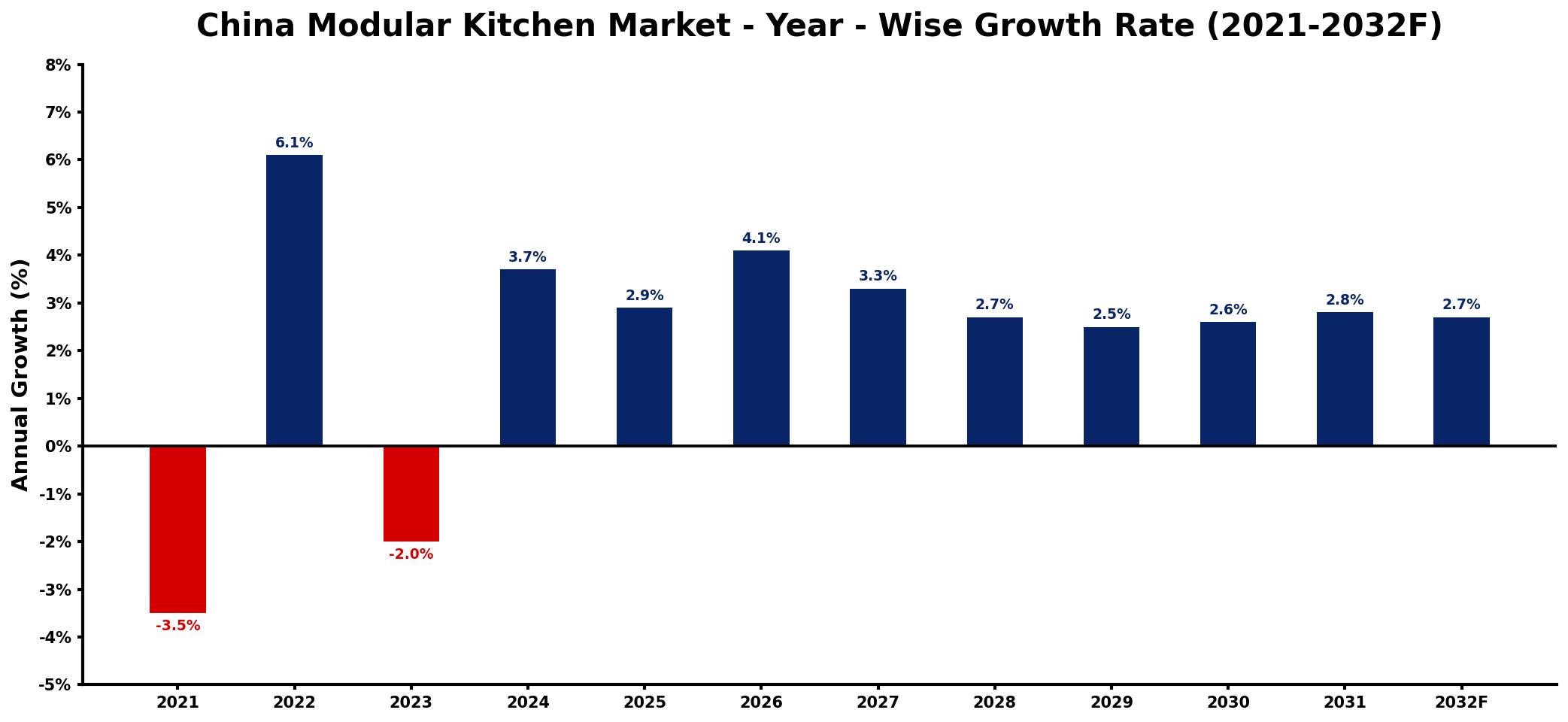
The table below presents the year‑wise growth rates along with the key drivers influencing the market
| Year | Growth Rate | Major Drivers |
| 2021 | -3.5% | decrease in consumer spending habits |
| 2022 | 6.1% | rise in urban housing projects |
| 2023 | -2.0% | reduction in disposable income levels |
| 2024 | 3.7% | growth in home renovation trends |
| 2025 | 2.9% | increase in eco-friendly materials |
| 2026 | 4.1% | expansion of online retail channels |
| 2027 | 3.3% | surge in real estate investments |
| 2028 | 2.7% | development of smart home technologies |
| 2029 | 2.5% | growing downstream application demand |
| 2030 | 2.6% | growing regional consumption patterns |
| 2031 | 2.8% | strengthening international trade flows |
| 2032 | 2.7% | increased pharmaceutical industry usage |
Note: Market size estimations and growth projections presented in this report are based on 6Wresearch's proprietary forecasting methodology, utilizing the latest available industry data, government publications, and primary research inputs.
China Modular Kitchen Market Synopsis
In recent years, the China Modular Kitchen Market has seen a remarkable shift, reflecting a growing inclination towards customization and aesthetic appeal. Homeowners are increasingly opting for modular solutions that not only optimize space but also elevate the overall design of their kitchens.
The trend of home improvement has propelled the demand for modular kitchens, as consumers seek to create functional yet visually appealing cooking spaces. This market is characterized by a focus on innovation, with a strong emphasis on the integration of advanced materials and technologies.
China Modular Kitchen Market Key Takeaways
- The market is experiencing steady growth driven by urbanization and rising disposable incomes.
- Customization and design flexibility are key drivers for consumer preference in modular kitchens.
- Investment in sustainable materials is becoming a priority as environmental consciousness increases.
- Continuous innovation is essential to meet evolving consumer demands and preferences.
- Government policies are influencing safety standards and promoting sustainable practices within the industry.
Evaluation of Restraints in China Modular Kitchen Market
Despite its growth potential, the China Modular Kitchen Market faces notable restraints that could impede expansion. One significant challenge is the relatively high cost of modular kitchen systems, which may deter potential customers, particularly in lower-income segments. Additionally, the market is pressured to continuously innovate in terms of design and materials to keep pace with changing consumer preferences. Regulatory requirements, especially regarding safety and environmental impact, further complicate market dynamics, necessitating adherence to stringent standards while maintaining competitive pricing.
China Modular Kitchen Market Trends
Current trends in the China Modular Kitchen Market indicate a strong preference for space-efficient designs that cater to smaller living environments. The incorporation of smart technologies is increasingly resonating with tech-savvy consumers, who appreciate functionalities that enhance kitchen efficiency. Additionally, there is a growing interest in eco-friendly materials and sustainable design practices, which reflect a broader shift towards environmentally conscious consumer behavior.
China Modular Kitchen Market Opportunities
Opportunities for growth in the China Modular Kitchen Market are significant, especially in urban centers where space is at a premium. Companies that focus on integrating innovative technologies and sustainable materials into their offerings can capitalize on consumer demands for efficiency and environmental responsibility. Moreover, targeting the burgeoning middle class with affordable yet stylish modular solutions presents a lucrative path for expansion. As more homeowners invest in remodeling their kitchens, the potential for enhanced functionality and personalized designs continues to rise.
Government Initiatives in the China Modular Kitchen Market
The Chinese government is actively influencing the modular kitchen market through policies that promote safety and quality standards in building materials and interior design. By setting rigorous performance benchmarks, the government aims to enhance consumer protection and encourage the adoption of advanced kitchen technologies. Additionally, there are initiatives focusing on sustainable practices, with funding and research incentives designed to support the development of eco-friendly materials in kitchen design.
Future Insights of the China Modular Kitchen Market
Looking ahead to 2026-2032, the China Modular Kitchen Market is poised for transformation driven by technological advancements and shifting consumer preferences. As urbanization continues, the demand for customizable and efficient kitchen solutions will likely escalate. Moreover, innovations in smart home technologies and sustainable design will play pivotal roles in shaping the future landscape of this market. Companies that can adapt to these emerging trends are expected to secure a competitive edge in an evolving environment.
China Modular Kitchen Market Latest Developments (2025 - 2026)
Recent developments in the China Modular Kitchen Market indicate a growing emphasis on smart kitchen technologies, with various manufacturers experimenting with integrated appliances that enhance user experience. Additionally, there has been a noticeable shift toward using environmentally friendly materials as part of the market's response to sustainability concerns. Industry collaborations aimed at fostering innovation and improving design efficiency are also becoming increasingly prominent.
China Modular Kitchen Market - Key Attractiveness of the Report
- 10 Years of Market Numbers
- Historical Data Starting from 2022 to 2025
- Base Year: 2025
- Forecast Data until 2032
- Key Performance Indicators Impacting the Market
- Major Upcoming Developments and Projects
Key Highlights of the Report:
- China Modular Kitchen Market Outlook
- Market Size of China Modular Kitchen Market, 2025
- Forecast of China Modular Kitchen Market, 2032
- Historical Data and Forecast of China Modular Kitchen Revenues & Volume for the Period 2022-2032F
- China Modular Kitchen Market Trend Evolution
- China Modular Kitchen Market Drivers and Challenges
- China Modular Kitchen Price Trends
- China Modular Kitchen Porter's Five Forces
- China Modular Kitchen Industry Life Cycle
- Historical Data and Forecast of China Modular Kitchen Market Revenues & Volume By Product for the Period 2022-2032F
- Historical Data and Forecast of China Modular Kitchen Market Revenues & Volume By Floor Cabinet & Wall Cabinets for the Period 2022-2032F
- Historical Data and Forecast of China Modular Kitchen Market Revenues & Volume By Tall Storage Cabinets for the Period 2022-2032F
- Historical Data and Forecast of China Modular Kitchen Market Revenues & Volume By Others for the Period 2022-2032F
- Historical Data and Forecast of China Modular Kitchen Market Revenues & Volume By End-User for the Period 2022-2032F
- Historical Data and Forecast of China Modular Kitchen Market Revenues & Volume By Residential for the Period 2022-2032F
- Historical Data and Forecast of China Modular Kitchen Market Revenues & Volume By Commercial for the Period 2022-2032F
- Historical Data and Forecast of China Modular Kitchen Market Revenues & Volume By Distribution Channel for the Period 2022-2032F
- Historical Data and Forecast of China Modular Kitchen Market Revenues & Volume By Offline (Contractors, Builders, and Others) for the Period 2022-2032F
- Historical Data and Forecast of China Modular Kitchen Market Revenues & Volume By Online for the Period 2022-2032F
- China Modular Kitchen Import Export Trade Statistics
- Market Opportunity Assessment By Product
- Market Opportunity Assessment By End-User
- Market Opportunity Assessment By Distribution Channel
- China Modular Kitchen Top Companies Market Share
- China Modular Kitchen Competitive Benchmarking By Technical and Operational Parameters
- China Modular Kitchen Company Profiles
- China Modular Kitchen Key Strategic Recommendations






































