China Nand Flash Memory Market Top 5 Importing Countries and Market Competition (HHI) Analysis
In 2024, Taiwan, Malaysia, China, Germany, and the USA were the top countries exporting NAND flash memory to China. Despite a moderate concentration level, the market saw a minimal CAGR of 0.3% from 2020 to 2024. However, there was a slight decline in growth rate from 2023 to 2024 at -2.31%. This data suggests a relatively stable market for NAND flash memory imports in China, with key players continuing to contribute to the supply chain.
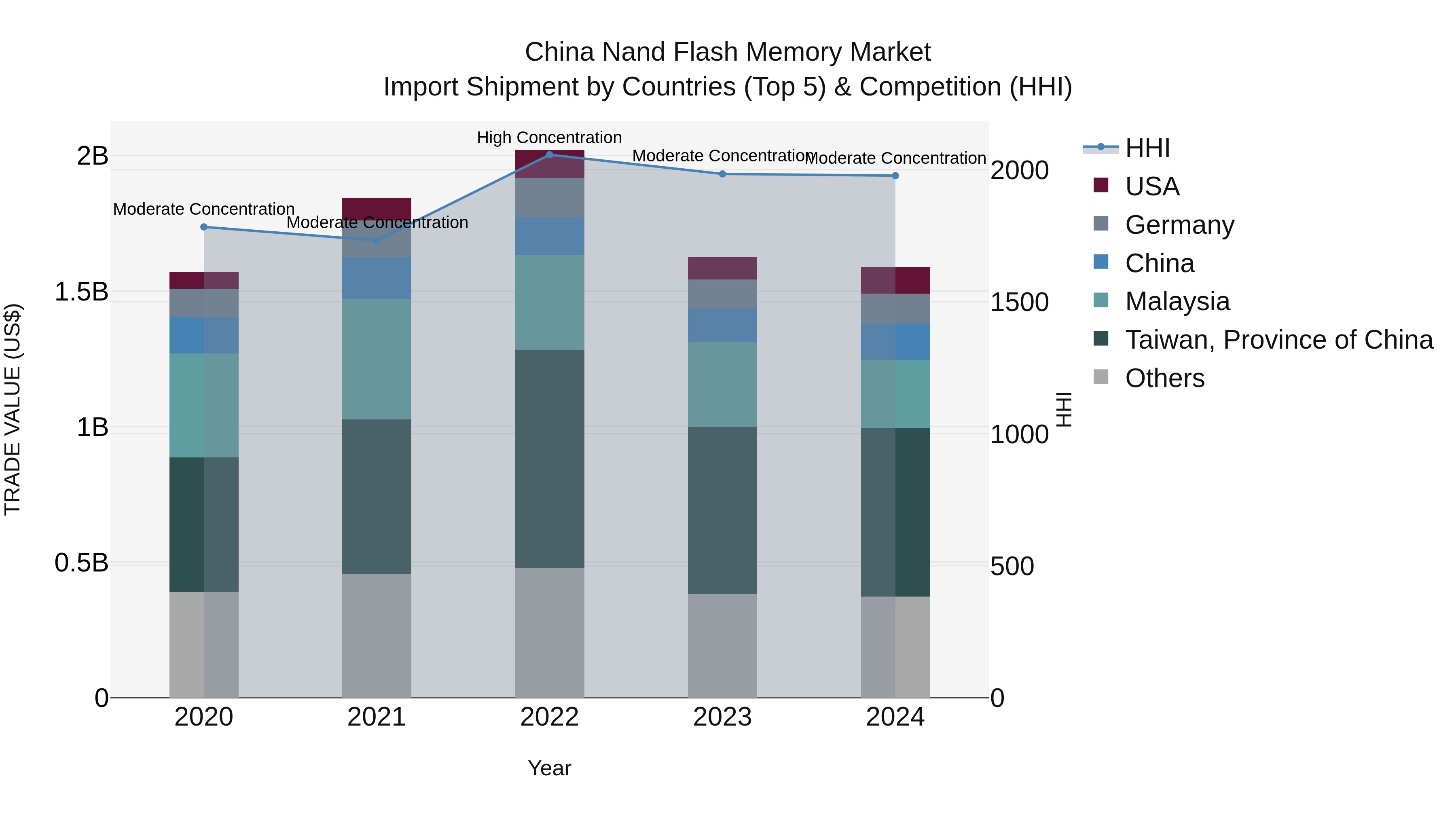
China Nand Flash Memory Market Overview
The China NAND flash memory market is experiencing significant growth driven by the increasing demand for storage solutions in various industries including consumer electronics, automotive, and data centers. The market is dominated by key players such as Samsung, SK Hynix, and Micron, who are investing in research and development to enhance product offerings and expand market presence. The adoption of NAND flash memory in smartphones, tablets, and solid-state drives (SSDs) is a major factor fueling the market growth. The proliferation of 5G technology, artificial intelligence, and Internet of Things (IoT) devices is also contributing to the expanding market size. Government initiatives to promote domestic production of NAND flash memory chips are further boosting the market in China, making it a key player in the global NAND flash memory industry.
China Nand Flash Memory Market Trends
The China NAND flash memory market is experiencing several key trends. Firstly, there is a growing demand for NAND flash memory in consumer electronics such as smartphones, tablets, and laptops due to the increasing storage requirements of users. Additionally, the market is witnessing a shift towards 3D NAND technology, which offers higher storage capacities and faster data transfer speeds compared to traditional 2D NAND. Another trend is the rising adoption of NAND flash memory in automotive applications for infotainment systems, advanced driver-assistance systems (ADAS), and in-vehicle entertainment. Furthermore, the market is also seeing a focus on developing more reliable and durable NAND flash memory solutions to meet the stringent requirements of data centers and enterprise storage applications. Overall, these trends indicate a positive growth trajectory for the China NAND flash memory market.
China Nand Flash Memory Market Challenges
The China NAND flash memory market faces several challenges, including intense competition among domestic and international players leading to pricing pressures and margin erosion. Additionally, intellectual property rights issues and concerns about data security have created barriers to entry for some companies. China`s rapidly evolving regulatory environment and government policies regarding technology and trade also pose uncertainties for market participants. Furthermore, the market is characterized by rapid technological advancements and shifting consumer preferences, necessitating continuous innovation and investment in research and development to stay competitive. Overall, navigating these challenges requires a deep understanding of the market dynamics and a strategic approach to adapt to the changing landscape while maintaining profitability and sustainability.
China Nand Flash Memory Market Investment Opportunities
The China NAND flash memory market presents promising investment opportunities due to the increasing demand for data storage across various industries such as consumer electronics, automotive, and enterprise storage solutions. With the rapid growth of technologies like 5G, artificial intelligence, and Internet of Things (IoT), there is a rising need for high-performance and reliable NAND flash memory products. Investing in Chinese NAND flash memory manufacturers or suppliers can be lucrative as they benefit from the expanding market and government support for domestic semiconductor production. Additionally, partnerships with Chinese tech giants and collaborations with international companies can further strengthen the position of investors in this dynamic market. However, it is crucial to stay informed about regulatory developments, market competition, and technological advancements to make informed investment decisions in the China NAND flash memory sector.
China Nand Flash Memory Market Government Policy
The Chinese government has implemented various policies to support the development of the NAND flash memory market in the country. These policies include financial incentives and subsidies for NAND flash memory manufacturers, tax breaks for companies investing in NAND flash memory production facilities, and support for research and development efforts in the industry. Additionally, the government has encouraged partnerships and collaborations between domestic and international companies to enhance technological capabilities and promote innovation in the NAND flash memory market. Overall, the government`s policies aim to boost the competitiveness of Chinese NAND flash memory manufacturers, reduce reliance on foreign suppliers, and strengthen the country`s position in the global semiconductor industry.
China Nand Flash Memory Market Future Outlook
The future outlook for the China NAND flash memory market appears promising, driven by increasing demand for data storage in various industries such as consumer electronics, automotive, and data centers. The adoption of technologies like 5G, IoT, and artificial intelligence is further fueling the need for higher storage capacities and faster data processing speeds, driving the growth of NAND flash memory market in China. Additionally, the development of advanced NAND flash technologies like 3D NAND and QLC NAND is expected to enhance the performance and efficiency of storage solutions, attracting more investments and driving innovation in the market. Overall, with the continuous technological advancements and growing demand for data storage solutions, the China NAND flash memory market is poised for steady growth in the coming years.
Key Highlights of the Report:
- China NAND Flash Memory Market Outlook
- Market Size of China NAND Flash Memory Market,2024
- Forecast of China NAND Flash Memory Market, 2031
- Historical Data and Forecast of China NAND Flash Memory Revenues & Volume for the Period 2021-2031
- China NAND Flash Memory Market Trend Evolution
- China NAND Flash Memory Market Drivers and Challenges
- China NAND Flash Memory Price Trends
- China NAND Flash Memory Porter's Five Forces
- China NAND Flash Memory Industry Life Cycle
- Historical Data and Forecast of China NAND Flash Memory Market Revenues & Volume By Type for the Period 2021-2031
- Historical Data and Forecast of China NAND Flash Memory Market Revenues & Volume By SLC NAND for the Period 2021-2031
- Historical Data and Forecast of China NAND Flash Memory Market Revenues & Volume By MLC NAND for the Period 2021-2031
- Historical Data and Forecast of China NAND Flash Memory Market Revenues & Volume By TLC NAND for the Period 2021-2031
- Historical Data and Forecast of China NAND Flash Memory Market Revenues & Volume By QLC NAND for the Period 2021-2031
- Historical Data and Forecast of China NAND Flash Memory Market Revenues & Volume By 3D NAND for the Period 2021 - 2029
- Historical Data and Forecast of China NAND Flash Memory Market Revenues & Volume By Form Factor for the Period 2021-2031
- Historical Data and Forecast of China NAND Flash Memory Market Revenues & Volume By SSD for the Period 2021-2031
- Historical Data and Forecast of China NAND Flash Memory Market Revenues & Volume By USB Drive for the Period 2021-2031
- Historical Data and Forecast of China NAND Flash Memory Market Revenues & Volume By Memory Card for the Period 2021-2031
- Historical Data and Forecast of China NAND Flash Memory Market Revenues & Volume By Embedded Memory for the Period 2021-2031
- Historical Data and Forecast of China NAND Flash Memory Market Revenues & Volume By eMMC for the Period 2021 - 2029
- Historical Data and Forecast of China NAND Flash Memory Market Revenues & Volume By Application for the Period 2021-2031
- Historical Data and Forecast of China NAND Flash Memory Market Revenues & Volume By Consumer Electronics for the Period 2021-2031
- Historical Data and Forecast of China NAND Flash Memory Market Revenues & Volume By Automotive for the Period 2021-2031
- Historical Data and Forecast of China NAND Flash Memory Market Revenues & Volume By Industrial for the Period 2021-2031
- Historical Data and Forecast of China NAND Flash Memory Market Revenues & Volume By IoT Devices for the Period 2021-2031
- Historical Data and Forecast of China NAND Flash Memory Market Revenues & Volume By Servers for the Period 2021 - 2029
- Historical Data and Forecast of China NAND Flash Memory Market Revenues & Volume By Capacity for the Period 2021-2031
- Historical Data and Forecast of China NAND Flash Memory Market Revenues & Volume By 64GB - 512GB for the Period 2021-2031
- Historical Data and Forecast of China NAND Flash Memory Market Revenues & Volume By 512GB - 1TB for the Period 2021-2031
- Historical Data and Forecast of China NAND Flash Memory Market Revenues & Volume By 1TB - 2TB for the Period 2021-2031
- Historical Data and Forecast of China NAND Flash Memory Market Revenues & Volume By Above 2TB for the Period 2021-2031
- Historical Data and Forecast of China NAND Flash Memory Market Revenues & Volume By Custom Capacity for the Period 2021 - 2029
- Historical Data and Forecast of China NAND Flash Memory Market Revenues & Volume By Interface for the Period 2021-2031
- Historical Data and Forecast of China NAND Flash Memory Market Revenues & Volume By PCIe for the Period 2021-2031
- Historical Data and Forecast of China NAND Flash Memory Market Revenues & Volume By NVMe for the Period 2021-2031
- Historical Data and Forecast of China NAND Flash Memory Market Revenues & Volume By SATA for the Period 2021-2031
- Historical Data and Forecast of China NAND Flash Memory Market Revenues & Volume By UFS for the Period 2021 - 2029
- Historical Data and Forecast of China NAND Flash Memory Market Revenues & Volume By SPI for the Period 2021 - 2029
- China NAND Flash Memory Import Export Trade Statistics
- Market Opportunity Assessment By Type
- Market Opportunity Assessment By Form Factor
- Market Opportunity Assessment By Application
- Market Opportunity Assessment By Capacity
- Market Opportunity Assessment By Interface
- China NAND Flash Memory Top Companies Market Share
- China NAND Flash Memory Competitive Benchmarking By Technical and Operational Parameters
- China NAND Flash Memory Company Profiles
- China NAND Flash Memory Key Strategic Recommendations






































