China Over the Top Market Size & Growth Rate (2026-2032)
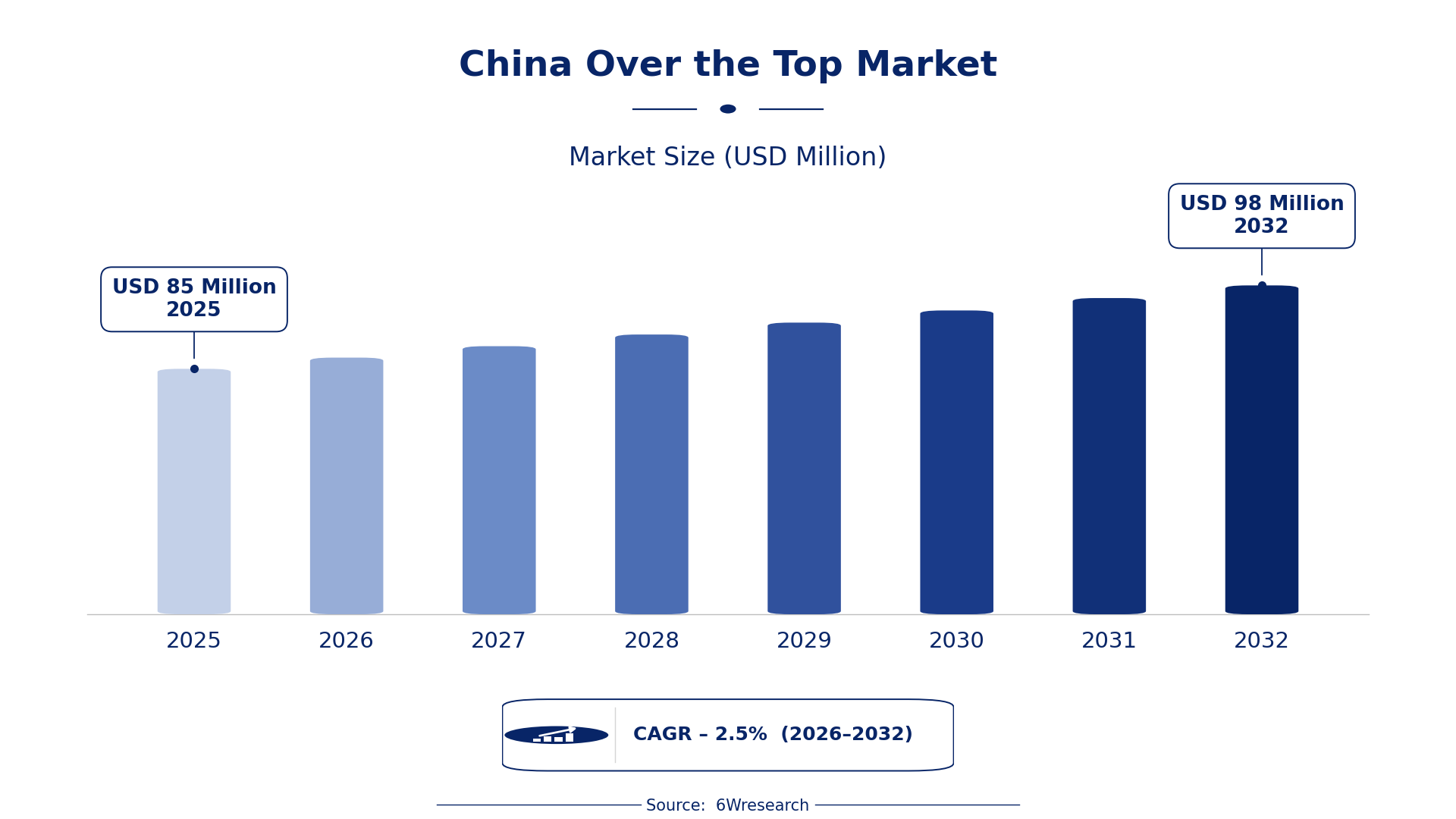
The China Over the Top Market was estimated at USD 85 Million in 2025 and is projected to reach USD 98 Million by 2032, growing at a CAGR of 2.5% from 2026 to 2032.
China Over the Top Market Synopsis
The Over the Top (OTT) market in China is on an accelerated path, benefiting from rising internet connectivity and a surge in mobile device usage. Domestic demand for streaming content is high, yet the competitive atmosphere is becoming denser as both local and international players vie for viewer attention and subscription dollars.
Looking ahead, companies must focus on localized content and innovative partnerships to maintain relevance. As preferences shift towards personalized viewing experiences, strategic investment in technology and user engagement will be crucial to staying ahead in this dynamic market.
China Over the Top Market Year-wise Growth Rate and Key Drivers
This graph illustrates the annual growth rates of the China Over the Top Market from 2021 to 2032, highlighting a steady upward trajectory and projected expansion over the forecast period.
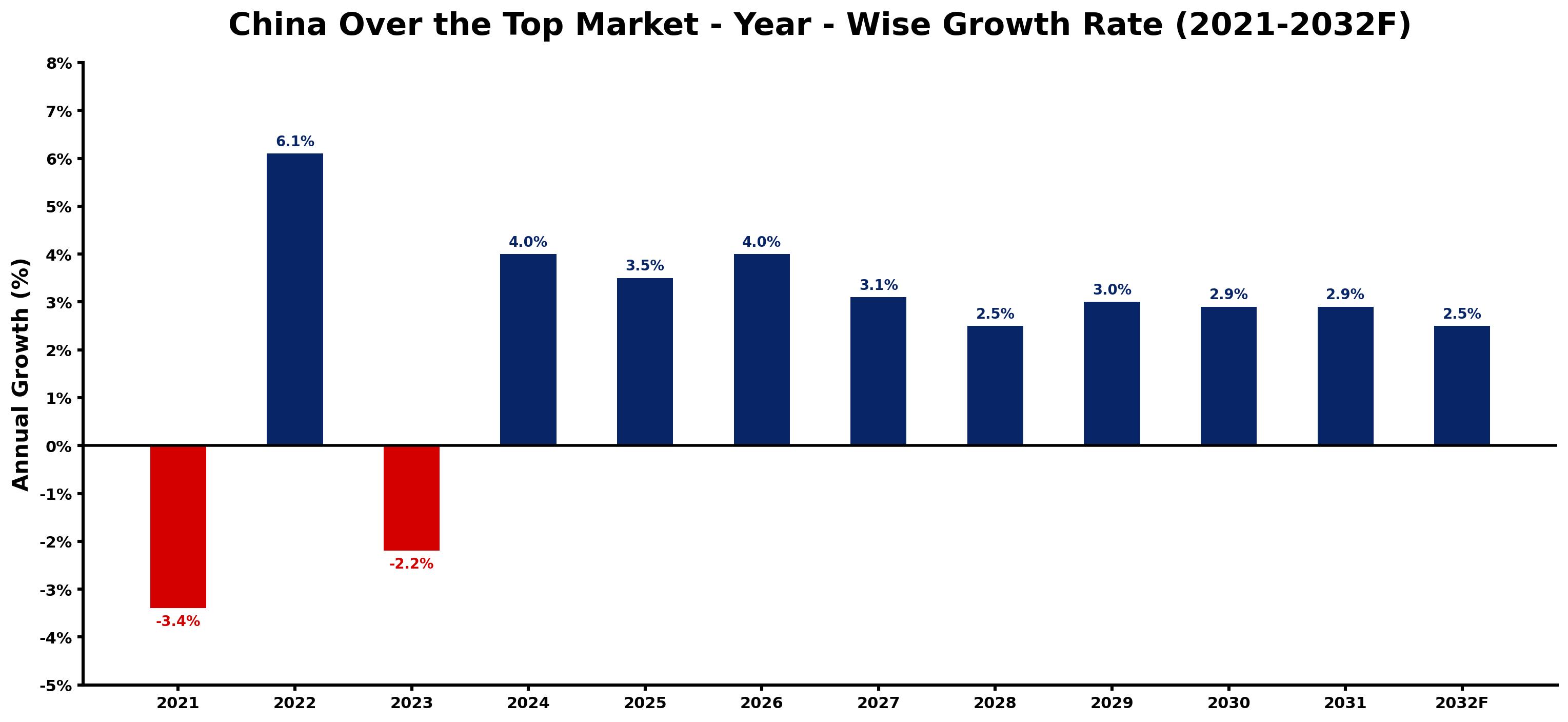
The table below presents the year‑wise growth rates along with the key drivers influencing the market
| Year | Growth Rate | Major Drivers |
| 2021 | -3.4% | Tencent faced stringent regulations on game licenses. |
| 2022 | 6.1% | Rise of younger audiences favoring digital entertainment platforms |
| 2023 | -2.2% | Subscription fatigue among consumers increased significantly. |
| 2024 | 4.0% | Increased smartphone penetration boosting OTT service subscriptions |
| 2025 | 3.5% | Regulatory support for content production and distribution innovations |
| 2026 | 4.0% | Government initiatives promoting digital economy growth and accessibility |
| 2027 | 3.1% | Enhanced internet infrastructure improving streaming quality nationwide |
| 2028 | 2.5% | Corporate investments in local content creation and partnerships |
| 2029 | 3.0% | National campaigns boosting awareness of digital entertainment options |
| 2030 | 2.9% | Emerging AI technologies improving personalized content recommendations |
| 2031 | 2.9% | E-commerce integration with OTT services driving user engagement |
| 2032 | 2.5% | Promotion of digital literacy increasing OTT platform usage |
Note: Market size estimations and growth projections presented in this report are based on 6Wresearch's proprietary forecasting methodology, utilizing the latest available industry data, government publications, and primary research inputs.
China Over the Top Market Key Takeaways
Below are some of the specific key takeaways from the market, including:
- The OTT market in China is witnessing a surge in demand for localized content tailored to regional preferences.
- Smartphone penetration and affordable data plans are primary factors driving OTT consumption.
- Strategic partnerships between international and domestic providers are enhancing market access and user engagement.
- Regulatory frameworks continue to evolve, impacting how OTT services operate in the market.
- Emerging technologies, such as AI, are being adopted to refine user experience and content delivery.
Evaluation of Restraints in China Over the Top Market
The OTT market in China faces notable constraints that can hinder growth. Intense competition forces providers to continuously innovate, placing pressure on profit margins. Stringent government regulations surrounding content censorship and licensing requirements pose additional hurdles, particularly for foreign entities looking to enter the market. Furthermore, the presence of piracy and unauthorized streaming platforms complicates the landscape, challenging legitimate OTT services to safeguard their revenue. As consumer expectations escalate, providers must also ensure a diverse and high-quality content offering to remain appealing.
China Over the Top Market Trends
Several trends are currently shaping the China OTT market. The rise of original content production is critical, as consumers increasingly gravitate toward shows and movies that resonate with their cultural and social contexts. Additionally, international OTT platforms are making headway through localized strategies, offering services tailored to the unique demands of Chinese audiences. The blend of traditional TV with OTT services is also becoming prevalent, as providers seek to capture a wider audience. Enhanced data analytics and AI technology are being utilized to deliver personalized recommendations, improving user retention and satisfaction.
China Over the Top Market Opportunities
There are ample growth opportunities within the China OTT market. Investors can capitalize on rising demand for original content, including series and films specifically catering to local tastes. Subscription-based models are gaining traction, and businesses that provide innovative advertising solutions for OTT platforms are likely to see significant returns. Infrastructure investment, particularly in broadband and mobile networks, offers another avenue for growth. As the landscape evolves, new partnerships and collaborations are also expected to emerge, driving value for stakeholders in the sector.
Government Initiatives in the China Over the Top Market
Government policy plays a decisive role in shaping the China OTT market, influencing everything from content distribution to compliance requirements. With the rise of digital media consumption, the government is keen to ensure that the market remains competitive while also protecting local industry interests. Regulations surrounding content licensing and data privacy continue to adapt, and this evolving framework is vital for all players in the market.
- A regulatory framework introduced in 2025 mandates that foreign OTT service providers partner with local companies to operate within China.
- Ongoing initiatives focusing on enhancing digital infrastructure aim to improve streaming quality and accessibility nationwide.
- A content censorship policy recently updated in early 2026 reinforces the requirements for local firms to adhere to government guidelines on media.
- The government plans to roll out an awareness campaign on digital piracy, expected to launch in Q1 2027, aimed at protecting legitimate service providers.
- A national data security regulation currently in development seeks to standardize data management practices for all digital platforms.
Future Insights of the China Over the Top Market
The outlook for the China OTT market from 2026 to 2032 is promising. Continued growth in internet penetration and the rising disposable incomes of consumers will propel demand for OTT services. The trend of increased investments in original content is expected to persist, as local providers strive to differentiate themselves. As technological advancements improve user experiences, providers will likely harness analytics and AI tools to refine their offerings. With these dynamics at play, the market is set for robust expansion, establishing China as a key player in the global OTT arena.
China Over the Top Market Latest Developments
In the past year, the China OTT market has experienced significant changes. Providers have been actively enhancing their content libraries and user engagement strategies in response to competitive pressures and consumer preferences. The integration of advanced technology has been a focal point, with companies exploring various partnerships to bolster their service offerings.
- A major technology vendor launched a new AI-driven recommendation engine in mid-2026 aimed at improving user engagement on its streaming platform.
- A leading regional operator completed a collaboration with local content creators in early 2026, resulting in a series of original programs targeted at niche audiences.
- An ongoing initiative to upgrade streaming infrastructure began in late 2025, expected to enhance service quality across multiple provinces.
- A rollout of a subscription-based model expected to start in Q3 2027 aims to attract price-sensitive consumers to premium content.
- A comprehensive user feedback program was launched in early 2026 to gather insights on viewer preferences and improve content offerings.
China Over the Top Market - Key Attractiveness of the Report
- 10 Years of Market Numbers
- Historical Data Starting from 2022 to 2025
- Base Year: 2025
- Forecast Data until 2032
- Key Performance Indicators Impacting the Market
- Major Upcoming Developments and Projects
Key Highlights of the Report:
- China Over the Top Market Outlook
- Market Size of China Over the Top Market, 2025
- Forecast of China Over the Top Market, 2032
- Historical Data and Forecast of China Over the Top Revenues & Volume for the Period 2022-2032F
- China Over the Top Market Trend Evolution
- China Over the Top Market Drivers and Challenges
- China Over the Top Price Trends
- China Over the Top Porter's Five Forces
- China Over the Top Industry Life Cycle
- Historical Data and Forecast of China Over the Top Market Revenues & Volume By Type for the Period 2022-2032F
- Historical Data and Forecast of China Over the Top Market Revenues & Volume By Game Streaming for the Period 2022-2032F
- Historical Data and Forecast of China Over the Top Market Revenues & Volume By Audio Streaming for the Period 2022-2032F
- Historical Data and Forecast of China Over the Top Market Revenues & Volume By Video Streaming for the Period 2022-2032F
- Historical Data and Forecast of China Over the Top Market Revenues & Volume By Communication for the Period 2022-2032F
- Historical Data and Forecast of China Over the Top Market Revenues & Volume By Monetization Model for the Period 2022-2032F
- Historical Data and Forecast of China Over the Top Market Revenues & Volume By Subscription-based for the Period 2022-2032F
- Historical Data and Forecast of China Over the Top Market Revenues & Volume By Advertising-based for the Period 2022-2032F
- Historical Data and Forecast of China Over the Top Market Revenues & Volume By Transaction-based for the Period 2022-2032F
- Historical Data and Forecast of China Over the Top Market Revenues & Volume By Streaming Device for the Period 2022-2032F
- Historical Data and Forecast of China Over the Top Market Revenues & Volume By Smartphones and Tablets for the Period 2022-2032F
- Historical Data and Forecast of China Over the Top Market Revenues & Volume By Desktops and Laptops for the Period 2022-2032F
- Historical Data and Forecast of China Over the Top Market Revenues & Volume By IPTV and Consoles for the Period 2022-2032F
- Historical Data and Forecast of China Over the Top Market Revenues & Volume By Vertical for the Period 2022-2032F
- Historical Data and Forecast of China Over the Top Market Revenues & Volume By Media and Entertainment for the Period 2022-2032F
- Historical Data and Forecast of China Over the Top Market Revenues & Volume By Education and Learning for the Period 2022-2032F
- Historical Data and Forecast of China Over the Top Market Revenues & Volume By Gaming for the Period 2022-2032F
- Historical Data and Forecast of China Over the Top Market Revenues & Volume By Service Utilities for the Period 2022-2032F
- China Over the Top Import Export Trade Statistics
- Market Opportunity Assessment By Type
- Market Opportunity Assessment By Monetization Model
- Market Opportunity Assessment By Streaming Device
- Market Opportunity Assessment By Vertical
- China Over the Top Top Companies Market Share
- China Over the Top Competitive Benchmarking By Technical and Operational Parameters
- China Over the Top Company Profiles
- China Over the Top Key Strategic Recommendations






































