China Particle Board Market Growth Rate Analysis (2021 - 2031)
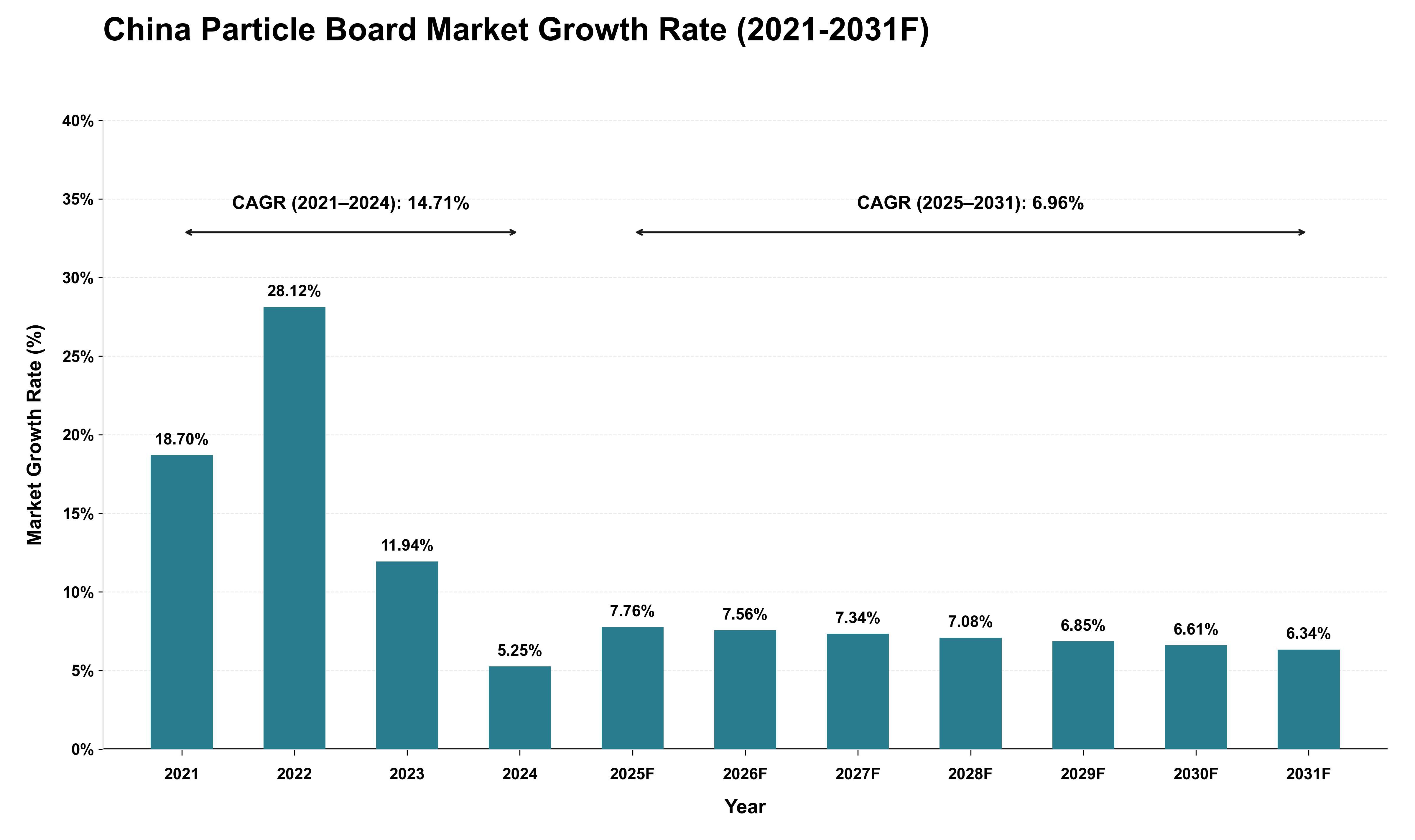
The China particle board market experienced a robust historical CAGR of 14.71% from 2021 to 2024, driven by post-pandemic recovery in construction and furniture sectors, alongside global supply chain disruptions that heightened demand for alternative materials. The significant growth rates in 2021 (18.70%) and 2022 (28.12%) reflected a surge in domestic consumption and export opportunities as international markets reopened. However, by 2023 and into 2024, growth decelerated to 11.94% and 5.25%, respectively, as supply chain normalization began to stabilize prices and availability of raw materials. Looking ahead to the forecast period (2025-2031), the CAGR is projected at a more moderate 6.96%, indicating a shift towards steady demand patterns influenced by global economic conditions, evolving import reliance on sustainable materials, and potential regulatory changes impacting production practices within the industry.
Key Highlights of the Report:
- China Particle Board Market Outlook
- Market Size of China Particle Board Market, 2025
- Forecast of China Particle Board Market, 2032
- Historical Data and Forecast of China Particle Board Revenues & Volume for the Period 2022 - 2032F
- China Particle Board Market Trend Evolution
- China Particle Board Market Drivers and Challenges
- China Particle Board Price Trends
- China Particle Board Porter's Five Forces
- China Particle Board Industry Life Cycle
- Historical Data and Forecast of China Particle Board Market Revenues & Volume By Type for the Period 2022 - 2032F
- Historical Data and Forecast of China Particle Board Market Revenues & Volume By Standard Chipboard for the Period 2022 - 2032F
- Historical Data and Forecast of China Particle Board Market Revenues & Volume By Melamine Veneered Chipboard for the Period 2022 - 2032F
- Historical Data and Forecast of China Particle Board Market Revenues & Volume By Flooring Grade Chipboard for the Period 2022 - 2032F
- Historical Data and Forecast of China Particle Board Market Revenues & Volume By Wood Veneered Chipboard for the Period 2022 - 2032F
- Historical Data and Forecast of China Particle Board Market Revenues & Volume By Plastic Veneered Chipboard for the Period 2022 - 2032F
- Historical Data and Forecast of China Particle Board Market Revenues & Volume By Other for the Period 2022 - 2032F
- Historical Data and Forecast of China Particle Board Market Revenues & Volume By Application for the Period 2022 - 2032F
- Historical Data and Forecast of China Particle Board Market Revenues & Volume By Construction for the Period 2022 - 2032F
- Historical Data and Forecast of China Particle Board Market Revenues & Volume By Furniture for the Period 2022 - 2032F
- Historical Data and Forecast of China Particle Board Market Revenues & Volume By Infrastructure for the Period 2022 - 2032F
- Historical Data and Forecast of China Particle Board Market Revenues & Volume By Other for the Period 2022 - 2032F
- China Particle Board Import Export Trade Statistics
- Market Opportunity Assessment By Type
- Market Opportunity Assessment By Application
- China Particle Board Top Companies Market Share
- China Particle Board Competitive Benchmarking By Technical and Operational Parameters
- China Particle Board Company Profiles
- China Particle Board Key Strategic Recommendations






































