China Propane Market Top 5 Importing Countries and Market Competition (HHI) Analysis
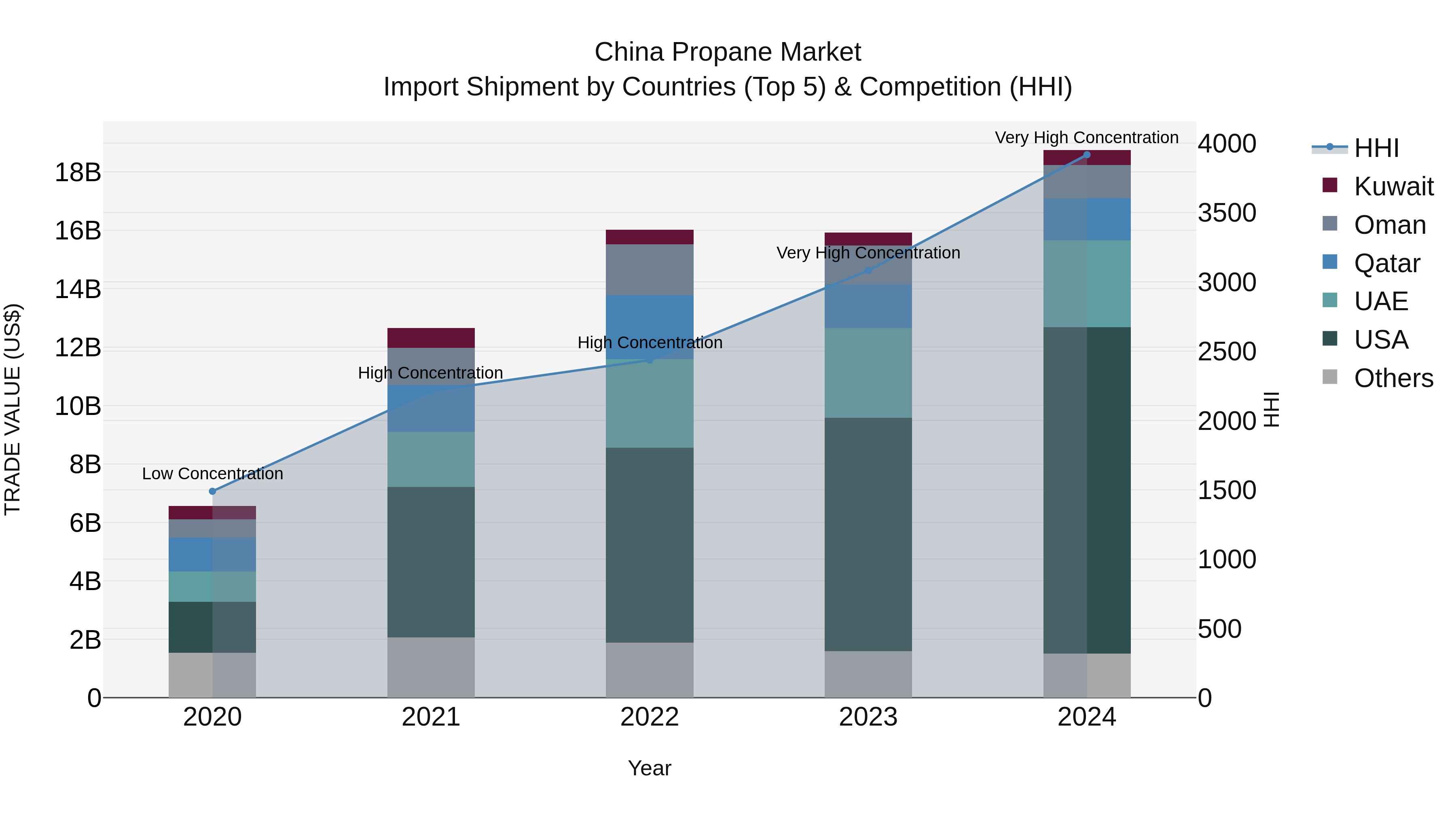
China propane import market remains robust in 2024, with the USA, UAE, Qatar, Oman, and Kuwait emerging as the top exporting countries. The high Herfindahl-Hirschman Index (HHI) indicates a concentrated market structure. A remarkable compound annual growth rate (CAGR) of 30.03% from 2020 to 2024 demonstrates sustained expansion. Moreover, the growth rate spiked at 17.74% from 2023 to 2024, showcasing the increasing demand for propane in China. These trends underscore the significant role of these key exporting nations in meeting China propane needs and shaping the market dynamics.
China Propane Market Overview
The Propane market in China is expanding due to the increasing use of propane as a clean and efficient energy source. Propane is widely used for heating, cooking, and industrial applications. The market growth is driven by the rising demand for alternative fuels, advancements in propane storage and distribution technologies, and government initiatives promoting cleaner energy sources. Chinese producers are focusing on enhancing propane infrastructure and ensuring a reliable supply to meet growing energy needs.
Drivers of the market
The Propane market in China is influenced by the demand for propane used as a fuel for heating, cooking, and industrial applications. Propane offers benefits such as high energy content, low emissions, and versatility. Market growth is driven by increasing demand for clean energy solutions, expanding industrial applications, and advancements in propane distribution and storage technologies.
Challenges of the market
The propane market in China encounters challenges related to fluctuating raw material prices and regulatory constraints. The cost of propane production and distribution is influenced by the volatility of crude oil and natural gas prices. Additionally, the market must navigate complex regulations concerning safety standards and environmental impact. Competition from alternative energy sources and the need to enhance distribution infrastructure also influence market dynamics.
Government Policy of the market
The propane market in China is shaped by government policies focusing on energy safety and environmental standards. The government establishes performance and safety standards for propane production and usage to ensure they meet industry requirements. Policies support the development and adoption of advanced propane technologies, addressing concerns related to safety, efficiency, and environmental impact. These measures aim to enhance the reliability and sustainability of propane as an energy source.
Key Highlights of the Report:
- China Propane Market Outlook
- Market Size of China Propane Market, 2024
- Forecast of China Propane Market, 2031
- Historical Data and Forecast of China Propane Revenues & Volume for the Period 2018 - 2031
- China Propane Market Trend Evolution
- China Propane Market Drivers and Challenges
- China Propane Price Trends
- China Propane Porter's Five Forces
- China Propane Industry Life Cycle
- Historical Data and Forecast of China Propane Market Revenues & Volume By Applications for the Period 2018 - 2031
- Historical Data and Forecast of China Propane Market Revenues & Volume By Industrial for the Period 2018 - 2031
- Historical Data and Forecast of China Propane Market Revenues & Volume By Commercial for the Period 2018 - 2031
- Historical Data and Forecast of China Propane Market Revenues & Volume By Residential for the Period 2018 - 2031
- Historical Data and Forecast of China Propane Market Revenues & Volume By Transportation for the Period 2018 - 2031
- Historical Data and Forecast of China Propane Market Revenues & Volume By Agriculture for the Period 2018 - 2031
- Historical Data and Forecast of China Propane Market Revenues & Volume By Chemicals and Refineries for the Period 2018 - 2031
- China Propane Import Export Trade Statistics
- Market Opportunity Assessment By Applications
- China Propane Top Companies Market Share
- China Propane Competitive Benchmarking By Technical and Operational Parameters
- China Propane Company Profiles
- China Propane Key Strategic Recommendations






































