China PVC Market Summary
The china pvc market was estimated at USD 129 Million in 2025 and is projected to reach USD 148 Million by 2032, growing at a CAGR of 4.6% from 2026 to 2032.
China PVC Market Year-wise Growth Rate and Key Drivers
This graph highlights how the China PVC Market has steadily grown over the past five years, supported by major growth factors.
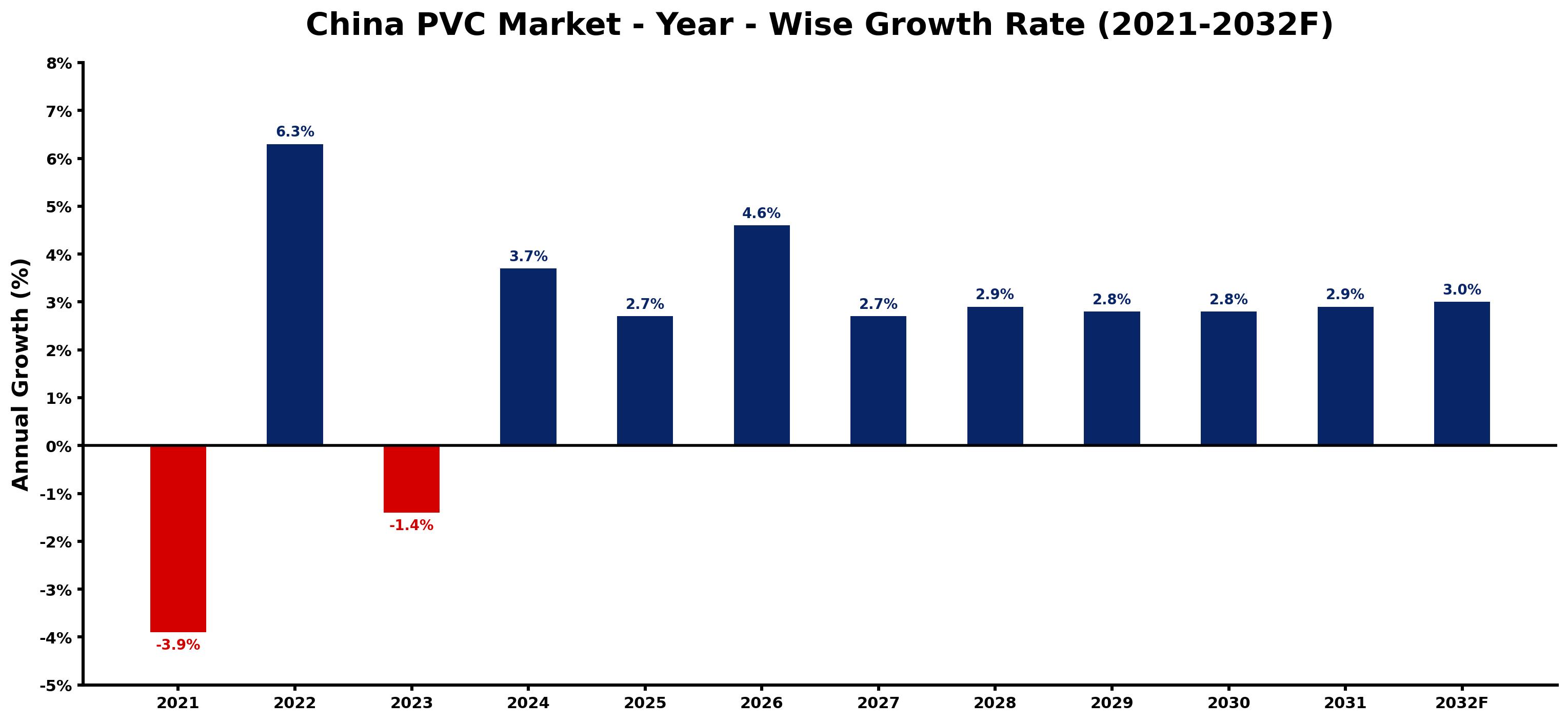
The table below presents the year wise growth rates along with the key drivers influencing the market
| Year | Growth Rate | Major Drivers |
| 2021 | -3.9% | Environmental regulations imposed tighter restrictions on PVC production, hampering supply and affecting market stability. |
| 2022 | 6.3% | Local manufacturers are expanding their PVC production capabilities to meet rising needs. |
| 2023 | -1.4% | Stringent environmental regulations imposed on PVC manufacturing processes increased operational costs, leading to reduced market competitiveness. |
| 2024 | 3.7% | Innovative PVC applications emerge in eco-friendly packaging and consumer products markets. |
| 2025 | 2.7% | Infrastructure upgrades necessitate increased PVC usage in plumbing and electrical sectors. |
| 2026 | 4.6% | The construction industry increasingly adopts PVC due to its cost-effective properties. |
| 2027 | 2.7% | Sustainability trends invigorate PVC recycling initiatives, enhancing industry attractiveness. |
| 2028 | 2.9% | Technological improvements in production elevate PVC quality and durability standards. |
| 2029 | 2.8% | Collaborations between manufacturers streamline supply chains, boosting market efficiency. |
| 2030 | 2.8% | Global economic recovery stimulates demand, propelling growth in PVC-related sectors. |
| 2031 | 2.9% | Emerging startups introduce innovative PVC solutions, attracting investment and interest. |
| 2032 | 3.0% | Market consolidation occurs as key players aim for sustainable and scalable operations. |
Note - Market size estimations and growth projections presented in this report are based on 6Wresearch's advanced forecasting approach, validated with industry datasets as of June 2026.
China PVC Market Synopsis
The China PVC Market is projected to reach 4.6% and witness significant growth during the forecast period (2026-2032). This anticipated expansion is underpinned by robust urbanization trends, escalating infrastructure projects, and an increasing demand for PVC in the packaging and electrical sectors. As a versatile and durable material, polyvinyl chloride (PVC) is becoming increasingly favored for its cost-effectiveness and resistance to various environmental factors.
China PVC Market Growth Drivers
A multitude of factors fuels the growth of the China PVC Market, creating a favorable landscape for stakeholders. The primary drivers include:
- Rapid Urbanization: The relentless pace of urban development has accelerated demand for PVC in construction applications, including piping, windows, and flooring. This sector's growth is crucial as cities expand and require adequate infrastructure.
- Expansion in the Packaging Industry: The shift towards e-commerce and the demand for safe food packaging are driving the need for flexible PVC films and sheets. This segment is expected to flourish given the increasing focus on convenience in packaging solutions.
- Technological Advancements in Electronics: Growing requirements for lightweight and flame-retardant materials in electronics are propelling the adoption of PVC. Electrical applications benefit from PVC's characteristics, which enhance product safety and efficiency.
- Government Support for Green Initiatives: Legislative measures aimed at promoting environmentally-friendly construction practices and sustainable packaging are stimulating innovation in low-emission PVC products.
- Increasing Adoption in the Automotive Sector: The automotive industry's focus on lightweight materials for components and insulation is driving demand for durable PVC, aligning with the push for fuel efficiency.
China PVC Market Challenges and Restraints
While the growth outlook for the China PVC Market appears promising, several restraints may pose challenges. Key challenges include:
- Environmental Concerns: Stricter regulations concerning hazardous substances in PVC production are pressuring manufacturers to adapt. Compliance with these regulations may elevate production costs.
- Raw Material Price Fluctuations: The volatility of prices for essential raw materials, including chlorine and ethylene, can affect the overall cost structure of PVC production, creating uncertainty in profit margins.
- Competition from Alternative Materials: Rising trends favoring bio-based plastics and polyethylene alternatives challenge the market share of PVC in specific applications, particularly in packaging.
- Energy Consumption: The high energy requirements associated with PVC production raise sustainability concerns, pushing manufacturers to invest in greener technologies.
- Supply Chain Interruptions: Global supply chain disruptions can impact the timely availability of raw materials, affecting production schedules and operational efficiency.
China PVC Market Trends and Opportunities
Emerging trends within the China PVC Market present significant opportunities for innovation and growth. Notable trends include:
- Development of Hybrid PVC Formulations: Manufacturers are increasingly exploring blends of rigid and flexible PVC to enhance performance characteristics for specific applications.
- Advanced Manufacturing Technologies: The integration of automation and IoT in PVC production processes aims to improve operational efficiency and ensure consistent quality control.
- Focus on Lightweight, Low-smoke Products: There is a growing emphasis on creating low-smoke PVC for use in construction and transportation, enhancing safety standards and compliance.
- Investment in PVC Recycling: The shift towards sustainable practices is encouraging investments in recycling technologies to support a circular economy and minimize environmental impact.
- Expansion of Flexible PVC Solutions: Increasing demand for innovative flexible PVC in the food and pharmaceutical packaging sectors indicates a shift towards versatile and adaptable solutions.
China PVC Market Government Investment and Initiatives
The Chinese government has introduced several initiatives to bolster the PVC market while prioritizing environmental sustainability and economic growth. Key strategies include:
- The "Plastic Pollution Control Action Plan" aims to reduce the use of hazardous chemicals in the production of PVC, promoting environmental safety and enhancing recycling efforts.
- The "Green Building Action Plan" encourages the use of low-emission and fire-resistant PVC materials in the construction sector for improved safety and indoor air quality.
- Fiscal incentives and subsidies are being extended to manufacturers who invest in eco-friendly production technologies, fostering the development of sustainable PVC solutions.
- Investment in infrastructure improvements supports the recycling of PVC, aligning with national goals for waste reduction and sustainability.
- Government-backed research and development initiatives focus on enhancing PVC's safety profile and improving its recyclability, driving innovation in the industry.
China PVC Market Latest Developments (May 2025 - June 2026)
Recent developments in the China PVC Market reflect a strategic pivot towards sustainability and innovation. Industry players are increasingly adopting advanced processing technologies and hybrid formulations to enhance product performance. The government actions encouraging the use of environmentally friendly materials are gaining traction, with manufacturers adapting to stricter regulatory standards. Growing investment in recycling infrastructure is enabling a circular economy approach, while demand for low-smoke and fire-retardant PVC products continues to rise in construction and transportation sectors. The dynamics of competition are shifting, with alternative materials making inroads into the market.
China PVC Market - Key Attractiveness of the Report
- 10 Years of Market Numbers
- Historical Data Starting from 2022 to 2025
- Base Year: 2025
- Forecast Data until 2032
- Key Performance Indicators Impacting the Market
- Major Upcoming Developments and Projects
Key Highlights of the Report:
- China PVC Market Outlook
- Market Size of China PVC Market, 2025
- Forecast of China PVC Market, 2032
- Historical Data and Forecast of China PVC Revenues & Volume for the Period 2022-2032F
- China PVC Market Trend Evolution
- China PVC Market Drivers and Challenges
- China PVC Price Trends
- China PVC Porter's Five Forces
- China PVC Industry Life Cycle
- Historical Data and Forecast of China PVC Market Revenues & Volume By Product Types for the Period 2022-2032F
- Historical Data and Forecast of China PVC Market Revenues & Volume By Rigid PVC for the Period 2022-2032F
- Historical Data and Forecast of China PVC Market Revenues & Volume By Flexible PVC for the Period 2022-2032F
- Historical Data and Forecast of China PVC Market Revenues & Volume By Low-smoke PVC for the Period 2022-2032F
- Historical Data and Forecast of China PVC Market Revenues & Volume By Chlorinated PVC for the Period 2022-2032F
- Historical Data and Forecast of China PVC Market Revenues & Volume By Stabilizer Type for the Period 2022-2032F
- Historical Data and Forecast of China PVC Market Revenues & Volume By Calcium-based Stabilizers for the Period 2022-2032F
- Historical Data and Forecast of China PVC Market Revenues & Volume By Lead-based Stabilizers for the Period 2022-2032F
- Historical Data and Forecast of China PVC Market Revenues & Volume By Tin and Organotin-based for the Period 2022-2032F
- Historical Data and Forecast of China PVC Market Revenues & Volume By Barium-based and Others for the Period 2022-2032F
- Historical Data and Forecast of China PVC Market Revenues & Volume By Applications for the Period 2022-2032F
- Historical Data and Forecast of China PVC Market Revenues & Volume By Construction for the Period 2022-2032F
- Historical Data and Forecast of China PVC Market Revenues & Volume By Consumer for the Period 2022-2032F
- Historical Data and Forecast of China PVC Market Revenues & Volume By Packaging for the Period 2022-2032F
- Historical Data and Forecast of China PVC Market Revenues & Volume By Electrical & Electronics for the Period 2022-2032F
- Historical Data and Forecast of China PVC Market Revenues & Volume By Transportation for the Period 2022-2032F
- China PVC Import Export Trade Statistics
- Market Opportunity Assessment By Product Types
- Market Opportunity Assessment By Stabilizer Type
- Market Opportunity Assessment By Applications
- China PVC Top Companies Market Share
- China PVC Competitive Benchmarking By Technical and Operational Parameters
- China PVC Company Profiles
- China PVC Key Strategic Recommendations
Market Covered
The report offers a comprehensive study of the subsequent market segments:
By Product Types
- Rigid PVC
- Flexible PVC
- Low-smoke PVC
- Chlorinated PVC
By Stabilizer Type
- Calcium-based Stabilizers
- Lead-based Stabilizers
- Tin and Organotin-based
- Barium-based and Others
By Applications
- Construction
- Consumer
- Packaging
- Electrical & Electronics
- Transportation






































