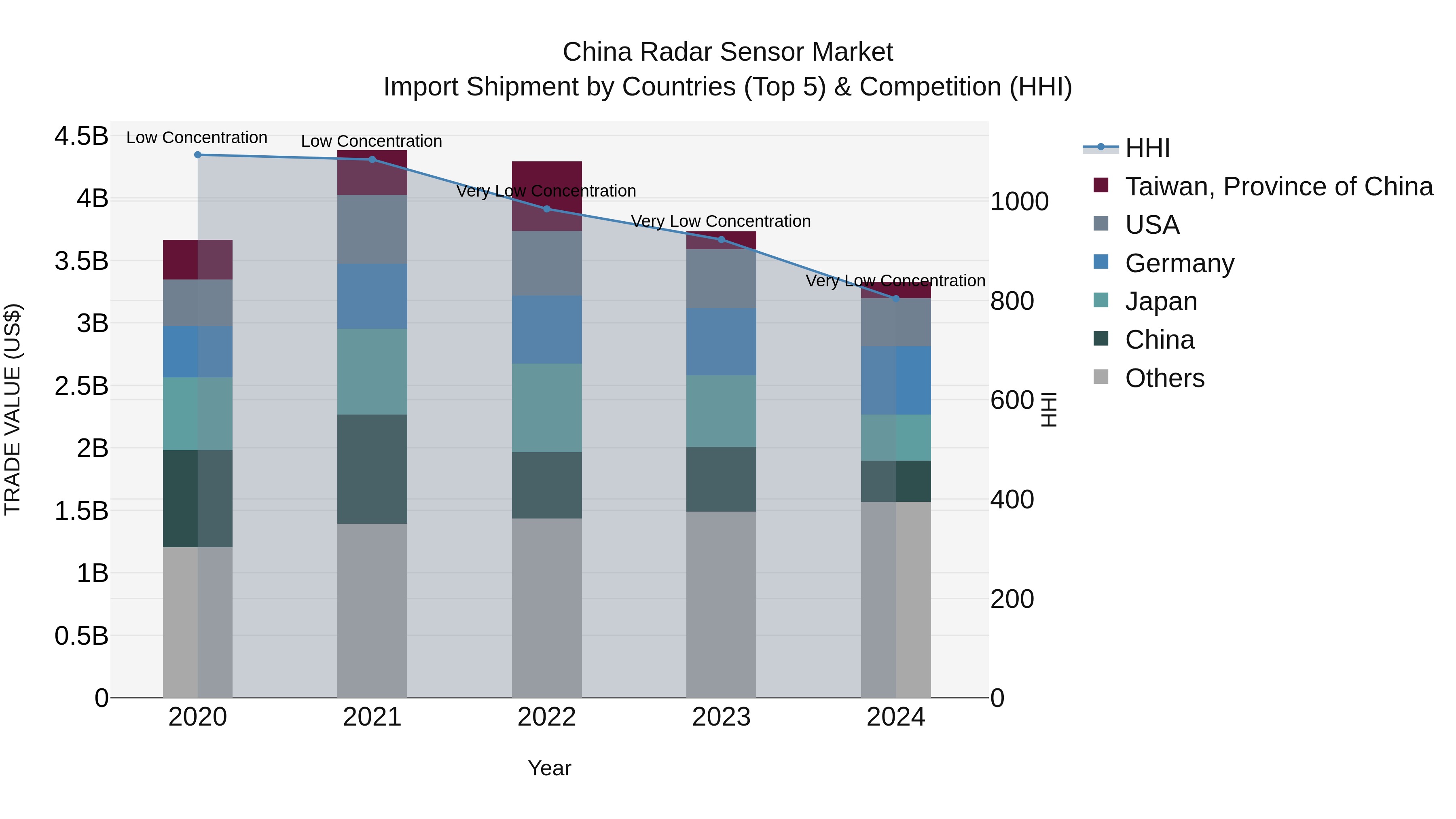
China Radar Sensor Market Top 5 Importing Countries and Market Competition (HHI) Analysis
Despite the low concentration indicated by the Herfindahl-Hirschman Index (HHI), the radar sensor import market in China is experiencing a decline, with a negative Compound Annual Growth Rate (CAGR) of -2.37% from 2020 to 2024. The growth rate for 2023-2024 is also negative at -10.79%. Germany, USA, Japan, China, and Hungary are the top countries exporting radar sensors to China in 2024, showcasing a diverse range of sources for these crucial components in the Chinese market.
China Radar Sensor Market Overview
The China Radar Sensor Market is experiencing significant growth driven by increasing demand in various sectors such as automotive, aerospace, defense, and industrial applications. Radar sensors are being widely adopted for applications like collision avoidance systems, autonomous driving, and surveillance systems due to their ability to provide accurate detection and tracking capabilities. The market is also benefiting from government initiatives to promote advanced technologies and the development of smart cities. Key players in the China Radar Sensor Market include companies like Huawei Technologies Co., Ltd., Hikvision Digital Technology Co., Ltd., and DJI Innovation Technology Co., Ltd. With ongoing technological advancements and increasing investments in research and development, the China Radar Sensor Market is expected to continue its growth trajectory in the coming years.
China Radar Sensor Market Trends and Opportunities
The China Radar Sensor Market is experiencing significant growth driven by the increasing adoption of advanced driver-assistance systems (ADAS) in vehicles for improved safety and autonomous driving capabilities. With the Chinese government`s focus on promoting electric vehicles and smart transportation infrastructure, there is a growing demand for radar sensors in applications such as collision avoidance, parking assistance, and traffic monitoring. Additionally, the expansion of smart cities and the Internet of Things (IoT) ecosystem in China present opportunities for radar sensor integration in various sectors like industrial automation, healthcare, and retail. Key trends in the market include the development of high-frequency radar sensors for enhanced accuracy and the integration of artificial intelligence for more intelligent and efficient sensor systems. Overall, the China Radar Sensor Market is poised for continued growth and innovation in the coming years.
China Radar Sensor Market Challenges
The China Radar Sensor Market faces several challenges, including intense competition from domestic and international players driving price pressures, rapidly evolving technologies requiring continuous innovation to stay competitive, and regulatory hurdles related to data privacy and security. Additionally, the market is impacted by the complex geopolitical landscape and trade tensions, which can disrupt supply chains and influence market dynamics. Ensuring product quality and reliability while navigating these challenges is crucial for companies operating in the China Radar Sensor Market to maintain market share and drive growth. Furthermore, adapting to changing consumer preferences and demands while maintaining compliance with industry standards adds another layer of complexity for market players in China.
China Radar Sensor Market Drivers
The China Radar Sensor Market is primarily driven by the increasing demand for advanced driver assistance systems (ADAS) in automotive vehicles to enhance safety and driving experience. The growth of autonomous vehicles and smart transportation systems is also fueling the adoption of radar sensors for applications such as collision avoidance, adaptive cruise control, and parking assistance. Additionally, the expansion of smart city initiatives and the rise in infrastructure development projects are creating opportunities for radar sensors in traffic management, surveillance, and security applications. Technological advancements in radar sensor technology, such as higher accuracy and longer detection ranges, are further driving market growth in China. Overall, the increasing focus on improving road safety, traffic efficiency, and overall transportation infrastructure is propelling the demand for radar sensors in the country.
China Radar Sensor Market Government Policies
The Chinese government has been actively promoting the development and adoption of radar sensor technology in various industries such as automotive, aerospace, and defense. Policies such as the "Made in China 2025" initiative and the "New Energy Vehicle Development Plan" prioritize the use of radar sensors for advanced driver assistance systems and autonomous driving applications. Additionally, the government has implemented regulations and standards to ensure the safety and reliability of radar sensors in vehicles and other applications. In terms of defense and security, China has been investing in radar sensor technology for military applications to enhance national security and surveillance capabilities. Overall, government policies in China are supportive of the radar sensor market, driving innovation and growth in the industry.
China Radar Sensor Market Future Outlook
The future outlook for the China Radar Sensor Market appears promising, driven by the increasing adoption of advanced driver-assistance systems (ADAS) in vehicles, the growth of smart cities, and the rising demand for security and surveillance applications. The market is expected to witness significant growth due to the continuous development of autonomous vehicles and the integration of radar sensors in various industries such as automotive, aerospace, and defense. With the Chinese government`s focus on promoting technological advancements and innovation, coupled with the expanding industrial and commercial sectors, the radar sensor market in China is projected to experience steady growth in the coming years, offering lucrative opportunities for market players to invest in research and development to cater to the evolving market demands.
Key Highlights of the Report:
- China Radar Sensor Market Outlook
- Market Size of China Radar Sensor Market, 2024
- Forecast of China Radar Sensor Market, 2031
- Historical Data and Forecast of China Radar Sensor Revenues & Volume for the Period 2021 - 2031
- China Radar Sensor Market Trend Evolution
- China Radar Sensor Market Drivers and Challenges
- China Radar Sensor Price Trends
- China Radar Sensor Porter's Five Forces
- China Radar Sensor Industry Life Cycle
- Historical Data and Forecast of China Radar Sensor Market Revenues & Volume By Technology for the Period 2021 - 2031
- Historical Data and Forecast of China Radar Sensor Market Revenues & Volume By Manufacturing technologies for the Period 2021 - 2031
- Historical Data and Forecast of China Radar Sensor Market Revenues & Volume By Gallium-nitride for the Period 2021 - 2031
- Historical Data and Forecast of China Radar Sensor Market Revenues & Volume By Silicon-germanium for the Period 2021 - 2031
- Historical Data and Forecast of China Radar Sensor Market Revenues & Volume By Metal-oxide semiconductor for the Period 2021 - 2031
- Historical Data and Forecast of China Radar Sensor Market Revenues & Volume By Brake lining for the Period 2021 - 2031
- Historical Data and Forecast of China Radar Sensor Market Revenues & Volume By Time domain reflectometry for the Period 2021 - 2031
- Historical Data and Forecast of China Radar Sensor Market Revenues & Volume By Ultra-wideband for the Period 2021 - 2031
- Historical Data and Forecast of China Manufacturing technologies Radar Sensor Market Revenues & Volume By Others for the Period 2021 - 2031
- Historical Data and Forecast of China Radar Sensor Market Revenues & Volume By Components for the Period 2021 - 2031
- Historical Data and Forecast of China Radar Sensor Market Revenues & Volume By Transmitter for the Period 2021 - 2031
- Historical Data and Forecast of China Radar Sensor Market Revenues & Volume By Duplexer for the Period 2021 - 2031
- Historical Data and Forecast of China Radar Sensor Market Revenues & Volume By Antenna for the Period 2021 - 2031
- Historical Data and Forecast of China Radar Sensor Market Revenues & Volume By Receiver for the Period 2021 - 2031
- Historical Data and Forecast of China Radar Sensor Market Revenues & Volume By Video amplifier for the Period 2021 - 2031
- Historical Data and Forecast of China Radar Sensor Market Revenues & Volume By Processing for the Period 2021 - 2031
- Historical Data and Forecast of China Radar Sensor Market Revenues & Volume By Type for the Period 2021 - 2031
- Historical Data and Forecast of China Radar Sensor Market Revenues & Volume By Imaging radar (primary type) for the Period 2021 - 2031
- Historical Data and Forecast of China Radar Sensor Market Revenues & Volume By Continuous wave (CW) radar for the Period 2021 - 2031
- Historical Data and Forecast of China Radar Sensor Market Revenues & Volume By Pulse radar for the Period 2021 - 2031
- Historical Data and Forecast of China Radar Sensor Market Revenues & Volume By Non-imaging radar (secondary type) for the Period 2021 - 2031
- Historical Data and Forecast of China Radar Sensor Market Revenues & Volume By Speed gauge for the Period 2021 - 2031
- Historical Data and Forecast of China Radar Sensor Market Revenues & Volume By Radar altimeter for the Period 2021 - 2031
- Historical Data and Forecast of China Radar Sensor Market Revenues & Volume By Band for the Period 2021 - 2031
- Historical Data and Forecast of China Radar Sensor Market Revenues & Volume By HF, VHF, and UHF bands for the Period 2021 - 2031
- Historical Data and Forecast of China Radar Sensor Market Revenues & Volume By HF and VHF band for the Period 2021 - 2031
- Historical Data and Forecast of China Radar Sensor Market Revenues & Volume By UHF-band for the Period 2021 - 2031
- Historical Data and Forecast of China Radar Sensor Market Revenues & Volume By L, S, C, and X bands for the Period 2021 - 2031
- Historical Data and Forecast of China Radar Sensor Market Revenues & Volume By L-band for the Period 2021 - 2031
- Historical Data and Forecast of China Radar Sensor Market Revenues & Volume By S-band for the Period 2021 - 2031
- Historical Data and Forecast of China Radar Sensor Market Revenues & Volume By C-band for the Period 2021 - 2031
- Historical Data and Forecast of China Radar Sensor Market Revenues & Volume By X-band for the Period 2021 - 2031
- Historical Data and Forecast of China Radar Sensor Market Revenues & Volume By Range for the Period 2021 - 2031
- Historical Data and Forecast of China Radar Sensor Market Revenues & Volume By Industry wise range specifications for the Period 2021 - 2031
- Historical Data and Forecast of China Radar Sensor Market Revenues & Volume By Automotive industry for the Period 2021 - 2031
- Historical Data and Forecast of China Radar Sensor Market Revenues & Volume By LRR1 and LRR2 for the Period 2021 - 2031
- Historical Data and Forecast of China Radar Sensor Market Revenues & Volume By LRR3 for the Period 2021 - 2031
- Historical Data and Forecast of China Radar Sensor Market Revenues & Volume By LRR4 for the Period 2021 - 2031
- Historical Data and Forecast of China Radar Sensor Market Revenues & Volume By Aerospace and defense industry for the Period 2021 - 2031
- Historical Data and Forecast of China Radar Sensor Market Revenues & Volume By Application for the Period 2021 - 2031
- Historical Data and Forecast of China Radar Sensor Market Revenues & Volume By Automotive for the Period 2021 - 2031
- Historical Data and Forecast of China Radar Sensor Market Revenues & Volume By Collision avoidance system for the Period 2021 - 2031
- Historical Data and Forecast of China Radar Sensor Market Revenues & Volume By Blind spot detection for the Period 2021 - 2031
- Historical Data and Forecast of China Radar Sensor Market Revenues & Volume By Adaptive cruise control for the Period 2021 - 2031
- Historical Data and Forecast of China Radar Sensor Market Revenues & Volume By Lane departure warning system for the Period 2021 - 2031
- Historical Data and Forecast of China Radar Sensor Market Revenues & Volume By Object detection system for the Period 2021 - 2031
- Historical Data and Forecast of China Radar Sensor Market Revenues & Volume By Stop-&-go functionality for the Period 2021 - 2031
- Historical Data and Forecast of China Radar Sensor Market Revenues & Volume By Aerospace & defense for the Period 2021 - 2031
- Historical Data and Forecast of China Radar Sensor Market Revenues & Volume By Vertical for the Period 2021 - 2031
- Historical Data and Forecast of China Radar Sensor Market Revenues & Volume By Commercial for the Period 2021 - 2031
- Historical Data and Forecast of China Radar Sensor Market Revenues & Volume By Government for the Period 2021 - 2031
- Historical Data and Forecast of China Radar Sensor Market Revenues & Volume By Industrial for the Period 2021 - 2031
- China Radar Sensor Import Export Trade Statistics
- Market Opportunity Assessment By Technology
- Market Opportunity Assessment By Components
- Market Opportunity Assessment By Type
- Market Opportunity Assessment By Band
- Market Opportunity Assessment By Range
- Market Opportunity Assessment By Application
- Market Opportunity Assessment By Vertical
- China Radar Sensor Top Companies Market Share
- China Radar Sensor Competitive Benchmarking By Technical and Operational Parameters
- China Radar Sensor Company Profiles
- China Radar Sensor Key Strategic Recommendations






































