China Spaghetti Market Top 5 Importing Countries and Market Competition (HHI) Analysis
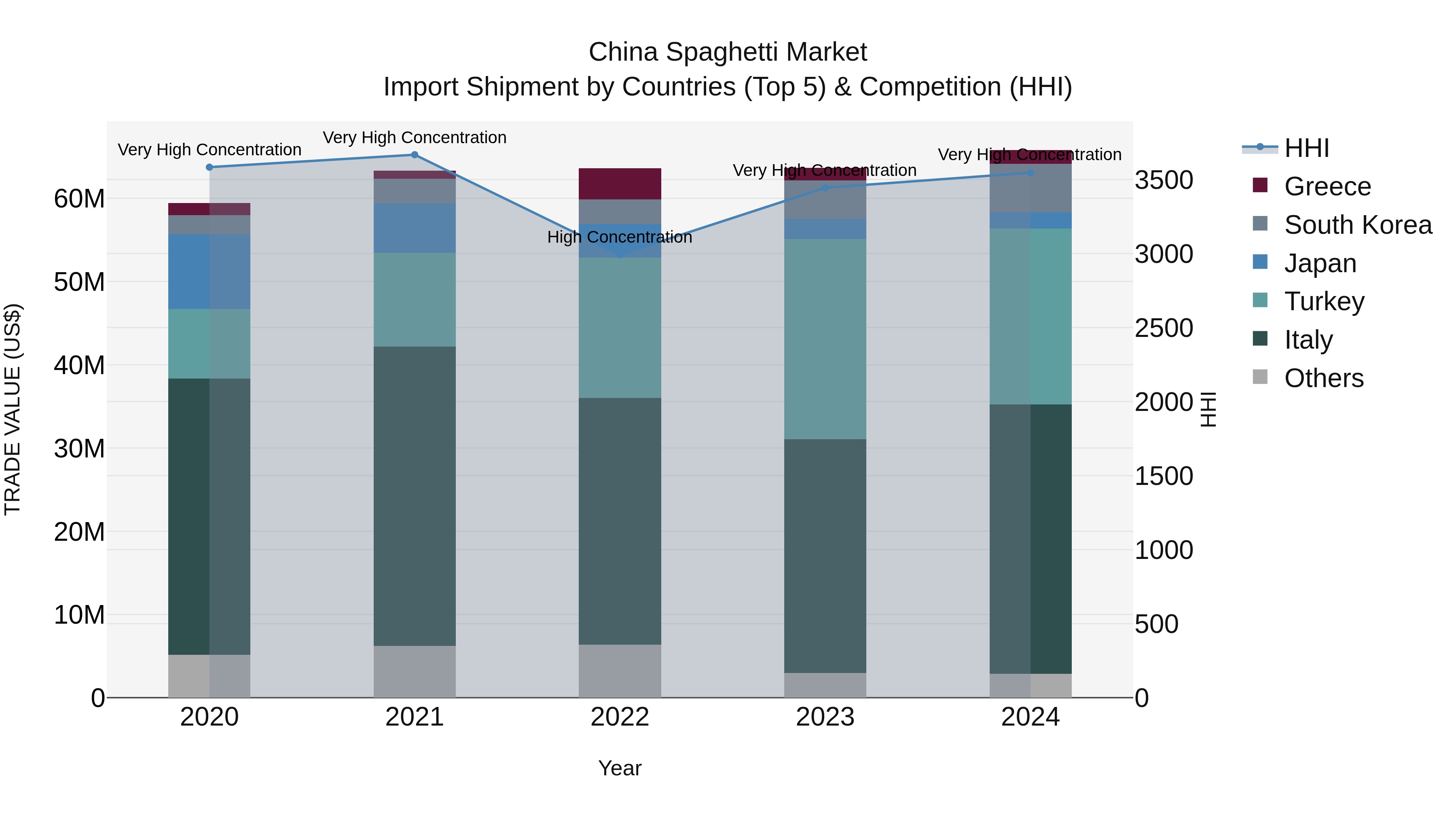
China spaghetti import market continued to see significant concentration in 2024, with top exporting countries being Italy, Turkey, South Korea, Japan, and Greece. The high Herfindahl-Hirschman Index (HHI) indicates a concentrated market structure. The compound annual growth rate (CAGR) from 2020 to 2024 stood at 2.58%, showing steady growth. Moreover, the growth rate in 2024 alone was 3.34%, suggesting a positive momentum in spaghetti imports to China. Italy, known for its quality pasta, remains a key player in supplying spaghetti to the Chinese market.
China Spaghetti Market Overview
The China spaghetti market is witnessing steady growth due to the increasing popularity of Italian cuisine and changing consumer preferences towards convenient and easy-to-cook meal options. Spaghetti, being a versatile pasta type, is widely consumed in China, both in households and in restaurants. The market is characterized by a wide variety of spaghetti products available, including different shapes, sizes, and flavors to cater to diverse consumer needs. Major players in the market are focusing on product innovation, marketing strategies, and distribution channels to gain a competitive edge. The market is expected to continue growing as more consumers adopt Western eating habits and seek out convenient meal solutions, presenting opportunities for both domestic and international spaghetti brands to expand their presence in China.
China Spaghetti Market Trends
The China spaghetti market is experiencing several key trends. Firstly, there is a growing demand for healthier and higher quality spaghetti options, leading to an increase in whole wheat and organic spaghetti products. Consumers are also showing a preference for innovative and convenient packaging formats, such as single-serve portions and resealable bags. Additionally, there is a rising interest in flavored and specialty spaghetti varieties, including options like spinach-infused spaghetti or gluten-free alternatives. E-commerce platforms are playing a significant role in driving sales growth, with more consumers opting to purchase spaghetti online for its convenience and wider product selection. Overall, the China spaghetti market is evolving to meet the changing preferences and needs of consumers, with a focus on health, convenience, and variety.
China Spaghetti Market Challenges
In the China spaghetti market, some challenges include fierce competition from both domestic and international brands, varying consumer preferences and tastes, supply chain disruptions, and changing regulations and trade policies. Domestic brands often struggle to compete with well-established international brands, leading to price wars and pressure on profit margins. Additionally, consumer preferences for different types of pasta shapes and flavors can be unpredictable, requiring companies to constantly innovate and adapt their product offerings. Supply chain disruptions, such as those caused by the COVID-19 pandemic, can impact production and distribution capabilities. Moreover, changing regulations and trade policies, both domestically and internationally, can create uncertainties and affect import/export activities in the market. Successfully navigating these challenges requires market players to stay agile, innovative, and responsive to changing market dynamics.
China Spaghetti Market Investment Opportunities
The China spaghetti market offers promising investment opportunities due to the growing popularity of Western cuisine and changing dietary preferences among Chinese consumers. With the increasing urbanization and rising disposable income levels in China, the demand for convenient and ready-to-cook pasta products like spaghetti is on the rise. Investors can explore opportunities in manufacturing and distributing high-quality spaghetti products tailored to the local taste preferences, as well as investing in marketing and branding strategies to differentiate their products in a competitive market. Additionally, investing in innovative packaging technologies and expanding distribution networks to reach a wider consumer base can further capitalize on the growth potential of the China spaghetti market.
China Spaghetti Market Government Policy
Government policies related to the China Spaghetti Market primarily focus on trade regulations, food safety standards, and agricultural subsidies. The Chinese government has implemented measures to ensure the quality and safety of imported and domestically produced spaghetti, including strict inspections and certifications. Tariffs and import quotas are also in place to regulate the flow of spaghetti into the country and protect domestic producers. Additionally, agricultural subsidies are provided to support local pasta manufacturers and encourage self-sufficiency in producing staple foods. Overall, the government`s policies aim to maintain food security, promote fair competition, and uphold quality standards in the China Spaghetti Market.
China Spaghetti Market Future Outlook
The future outlook for the China Spaghetti Market appears promising, driven by the increasing adoption of Western food culture, rising disposable incomes, and changing dietary preferences among Chinese consumers. The market is expected to witness steady growth as more consumers incorporate spaghetti into their regular dining habits, both at home and in restaurants. Additionally, the convenience and versatility of spaghetti as a meal option make it popular among busy urban populations. With a growing number of international food chains expanding in China and the availability of diverse pasta products in supermarkets, the demand for spaghetti is likely to continue rising. Manufacturers and retailers in the China Spaghetti Market should focus on product innovation, marketing strategies, and catering to evolving consumer tastes to capitalize on the market potential.
Key Highlights of the Report:
- China Spaghetti Market Outlook
- Market Size of China Spaghetti Market, 2021
- Forecast of China Spaghetti Market, 2031
- Historical Data and Forecast of China Spaghetti Revenues & Volume for the Period 2018 - 2031
- China Spaghetti Market Trend Evolution
- China Spaghetti Market Drivers and Challenges
- China Spaghetti Price Trends
- China Spaghetti Porter's Five Forces
- China Spaghetti Industry Life Cycle
- Historical Data and Forecast of China Spaghetti Market Revenues & Volume By Product for the Period 2018 - 2031
- Historical Data and Forecast of China Spaghetti Market Revenues & Volume By Fresh for the Period 2018 - 2031
- Historical Data and Forecast of China Spaghetti Market Revenues & Volume By Dried for the Period 2018 - 2031
- Historical Data and Forecast of China Spaghetti Market Revenues & Volume By End Use for the Period 2018 - 2031
- Historical Data and Forecast of China Spaghetti Market Revenues & Volume By Mass Market Retail for the Period 2018 - 2031
- Historical Data and Forecast of China Spaghetti Market Revenues & Volume By Horeca for the Period 2018 - 2031
- Historical Data and Forecast of China Spaghetti Market Revenues & Volume By Distribution Channel for the Period 2018 - 2031
- Historical Data and Forecast of China Spaghetti Market Revenues & Volume By Supermarket and Hypermarket for the Period 2018 - 2031
- Historical Data and Forecast of China Spaghetti Market Revenues & Volume By Convenience Store for the Period 2018 - 2031
- Historical Data and Forecast of China Spaghetti Market Revenues & Volume By Online for the Period 2018 - 2031
- Historical Data and Forecast of China Spaghetti Market Revenues & Volume By Others for the Period 2018 - 2031
- China Spaghetti Import Export Trade Statistics
- Market Opportunity Assessment By Product
- Market Opportunity Assessment By End Use
- Market Opportunity Assessment By Distribution Channel
- China Spaghetti Top Companies Market Share
- China Spaghetti Competitive Benchmarking By Technical and Operational Parameters
- China Spaghetti Company Profiles
- China Spaghetti Key Strategic Recommendations






































