China Sustainable Palm Oil Market Top 5 Importing Countries and Market Competition (HHI) Analysis
In 2024, China continued to import sustainable palm oil predominantly from Malaysia, Thailand, Indonesia, Taiwan, and Sweden, reflecting a commitment towards sustainable sourcing. Despite a significant decline in the Compound Annual Growth Rate (CAGR) from 2020 to 2024, the High Herfindahl-Hirschman Index (HHI) indicates a highly concentrated market. The sharp decrease in growth rate from 2023 to 2024 suggests a challenging environment for palm oil imports in China, emphasizing the need for strategic adaptation and sustainable practices in the industry.
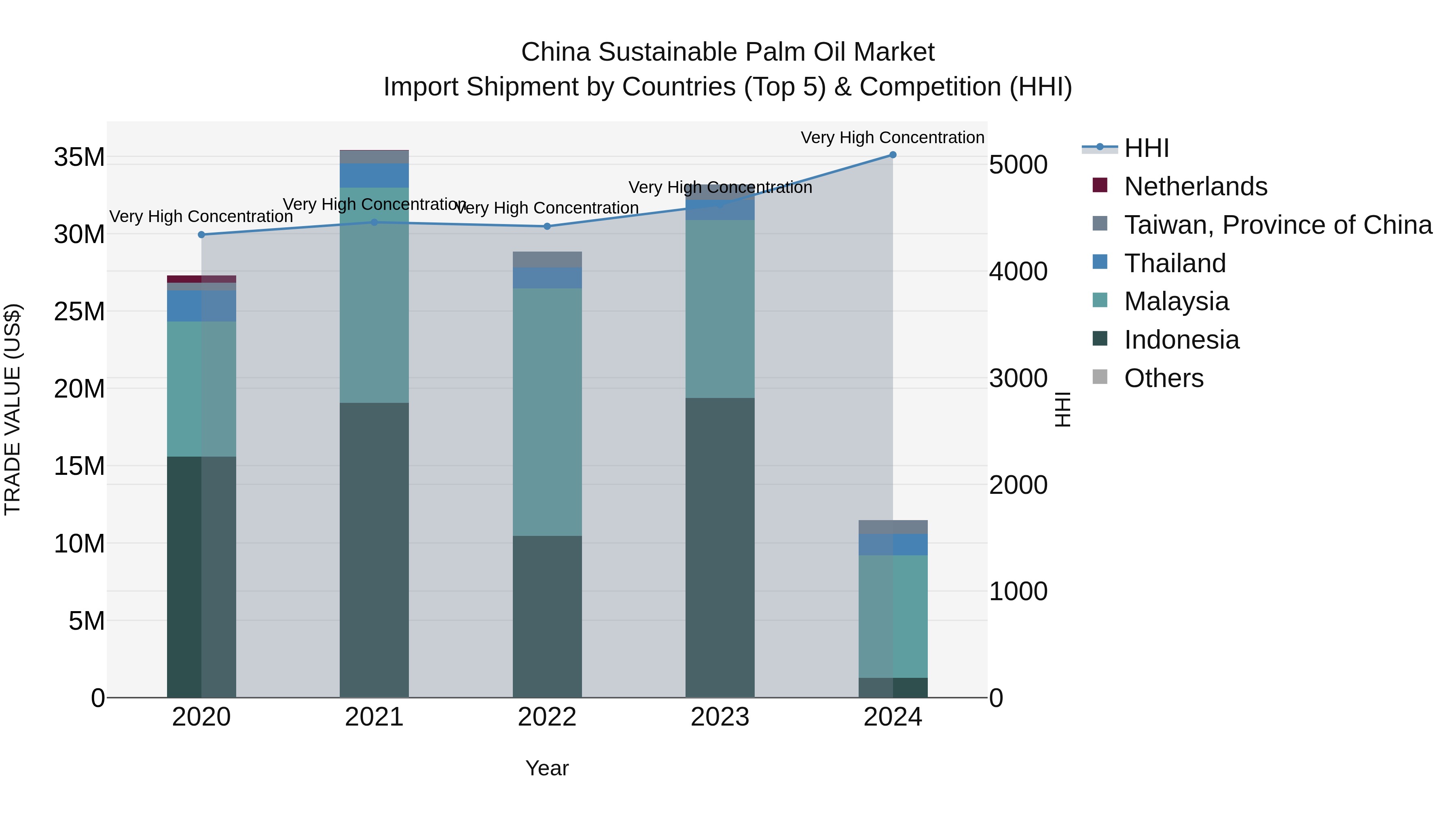
China Sustainable Palm Oil Market Overview
The China Sustainable Palm Oil Market is witnessing significant growth due to increasing awareness about sustainability and environmental concerns. The market is driven by a shift towards sustainable sourcing practices by key industry players, as well as government initiatives promoting the use of sustainable palm oil. Consumer demand for ethically sourced products is also fueling market growth, leading to greater adoption of sustainable palm oil in various industries such as food, cosmetics, and biofuels. Key challenges include ensuring transparency in the supply chain and addressing issues related to deforestation and labor practices. Overall, the China Sustainable Palm Oil Market is poised for continued expansion as stakeholders work towards achieving a more sustainable palm oil industry in the country.
Trends of the Market
The China Sustainable Palm Oil Market is witnessing a growing shift towards sustainable sourcing practices, driven by increasing consumer awareness of environmental issues and demand for ethically produced products. Key trends include the rising adoption of certification programs such as RSPO (Roundtable on Sustainable Palm Oil), which promote responsible palm oil cultivation. Companies in China are also investing in traceability measures to ensure transparency in their supply chains and guarantee sustainable sourcing practices. Furthermore, there is a growing emphasis on promoting deforestation-free palm oil production in line with national and international sustainability goals. Overall, the China Sustainable Palm Oil Market is moving towards greater sustainability practices to meet the evolving preferences of consumers and address environmental concerns.
Challenges of the Market
In the China Sustainable Palm Oil Market, challenges arise from the lack of awareness and education among consumers and businesses regarding the importance of sustainable palm oil production. Many stakeholders in the industry are still not fully informed about the environmental and social impacts of unsustainable palm oil cultivation, leading to a slow adoption of sustainable practices. Additionally, the complexity of supply chains and difficulties in tracing the sources of palm oil pose challenges in ensuring that only sustainable palm oil is being utilized in products. There is also a need for greater collaboration among government bodies, industry players, and non-governmental organizations to create and enforce regulations that promote sustainable palm oil production and consumption in China.
Investment Opportunities of the market
The China Sustainable Palm Oil Market presents promising investment opportunities due to the increasing consumer demand for sustainable and eco-friendly products. With the Chinese government`s emphasis on environmental protection and sustainability, there is a growing trend towards sustainable palm oil production and consumption in the country. Investors can consider opportunities in sustainable palm oil plantations, processing facilities, and trading companies that adhere to strict environmental and social standards. Additionally, investing in technology and innovation for sustainable palm oil production methods can also be a lucrative option in the Chinese market. Overall, the China Sustainable Palm Oil Market offers potential for long-term growth and profitability for investors looking to capitalize on the sustainable consumption trend in the country.
Government Policy of the market
The Chinese government has implemented various policies aimed at promoting sustainability in the palm oil market. These include the Sustainable Palm Oil Sourcing Policy issued by the State Forestry Administration, which encourages companies to source certified sustainable palm oil. Additionally, China has signed agreements with producing countries to promote sustainable practices in the palm oil industry and reduce deforestation. The government has also introduced regulations to monitor and control the import and use of palm oil to ensure it meets environmental and social standards. Overall, these policies reflect China`s commitment to promoting sustainable palm oil production and consumption to mitigate the environmental and social impacts associated with palm oil cultivation.
Future Outlook of the market
The future outlook for the China Sustainable Palm Oil Market looks promising as the country continues to prioritize sustainability and environmental conservation in its development strategies. With increasing awareness among consumers regarding the negative impacts of conventional palm oil production, there is a growing demand for sustainable palm oil products in China. Government regulations and initiatives to promote sustainable sourcing practices are also expected to drive the market growth. Collaboration between industry stakeholders, NGOs, and government bodies to promote sustainable palm oil production and certification is likely to further boost market expansion. As Chinese consumers become more conscious of their environmental footprint, the demand for sustainable palm oil is anticipated to rise, presenting opportunities for companies to capitalize on this trend and establish a stronger presence in the market.
Key Highlights of the Report:
- China Sustainable Palm Oil Market Outlook
- Market Size of China Sustainable Palm Oil Market,2024
- Forecast of China Sustainable Palm Oil Market, 2031
- Historical Data and Forecast of China Sustainable Palm Oil Revenues & Volume for the Period 2022-2031
- China Sustainable Palm Oil Market Trend Evolution
- China Sustainable Palm Oil Market Drivers and Challenges
- China Sustainable Palm Oil Price Trends
- China Sustainable Palm Oil Porter's Five Forces
- China Sustainable Palm Oil Industry Life Cycle
- Historical Data and Forecast of China Sustainable Palm Oil Market Revenues & Volume By Product Type for the Period 2022-2031
- Historical Data and Forecast of China Sustainable Palm Oil Market Revenues & Volume By Certified Palm Oil for the Period 2022-2031
- Historical Data and Forecast of China Sustainable Palm Oil Market Revenues & Volume By Sustainable Palm Oil for the Period 2022-2031
- Historical Data and Forecast of China Sustainable Palm Oil Market Revenues & Volume By Palm Oil Derivatives for the Period 2022-2031
- Historical Data and Forecast of China Sustainable Palm Oil Market Revenues & Volume By Application for the Period 2022-2031
- Historical Data and Forecast of China Sustainable Palm Oil Market Revenues & Volume By Food Production for the Period 2022-2031
- Historical Data and Forecast of China Sustainable Palm Oil Market Revenues & Volume By Cosmetics for the Period 2022-2031
- Historical Data and Forecast of China Sustainable Palm Oil Market Revenues & Volume By Biofuels for the Period 2022-2031
- Historical Data and Forecast of China Sustainable Palm Oil Market Revenues & Volume By Certification for the Period 2022-2031
- Historical Data and Forecast of China Sustainable Palm Oil Market Revenues & Volume By RSPO for the Period 2022-2031
- Historical Data and Forecast of China Sustainable Palm Oil Market Revenues & Volume By Organic for the Period 2022-2031
- Historical Data and Forecast of China Sustainable Palm Oil Market Revenues & Volume By Fair Trade for the Period 2022-2031
- Historical Data and Forecast of China Sustainable Palm Oil Market Revenues & Volume By End User for the Period 2022-2031
- Historical Data and Forecast of China Sustainable Palm Oil Market Revenues & Volume By Food Manufacturers for the Period 2022-2031
- Historical Data and Forecast of China Sustainable Palm Oil Market Revenues & Volume By Personal Care Brands for the Period 2022-2031
- Historical Data and Forecast of China Sustainable Palm Oil Market Revenues & Volume By Energy Companies for the Period 2022-2031
- China Sustainable Palm Oil Import Export Trade Statistics
- Market Opportunity Assessment By Product Type
- Market Opportunity Assessment By Application
- Market Opportunity Assessment By Certification
- Market Opportunity Assessment By End User
- China Sustainable Palm Oil Top Companies Market Share
- China Sustainable Palm Oil Competitive Benchmarking By Technical and Operational Parameters
- China Sustainable Palm Oil Company Profiles
- China Sustainable Palm Oil Key Strategic Recommendations






































