China Tapioca Market Top 5 Importing Countries and Market Competition (HHI) Analysis
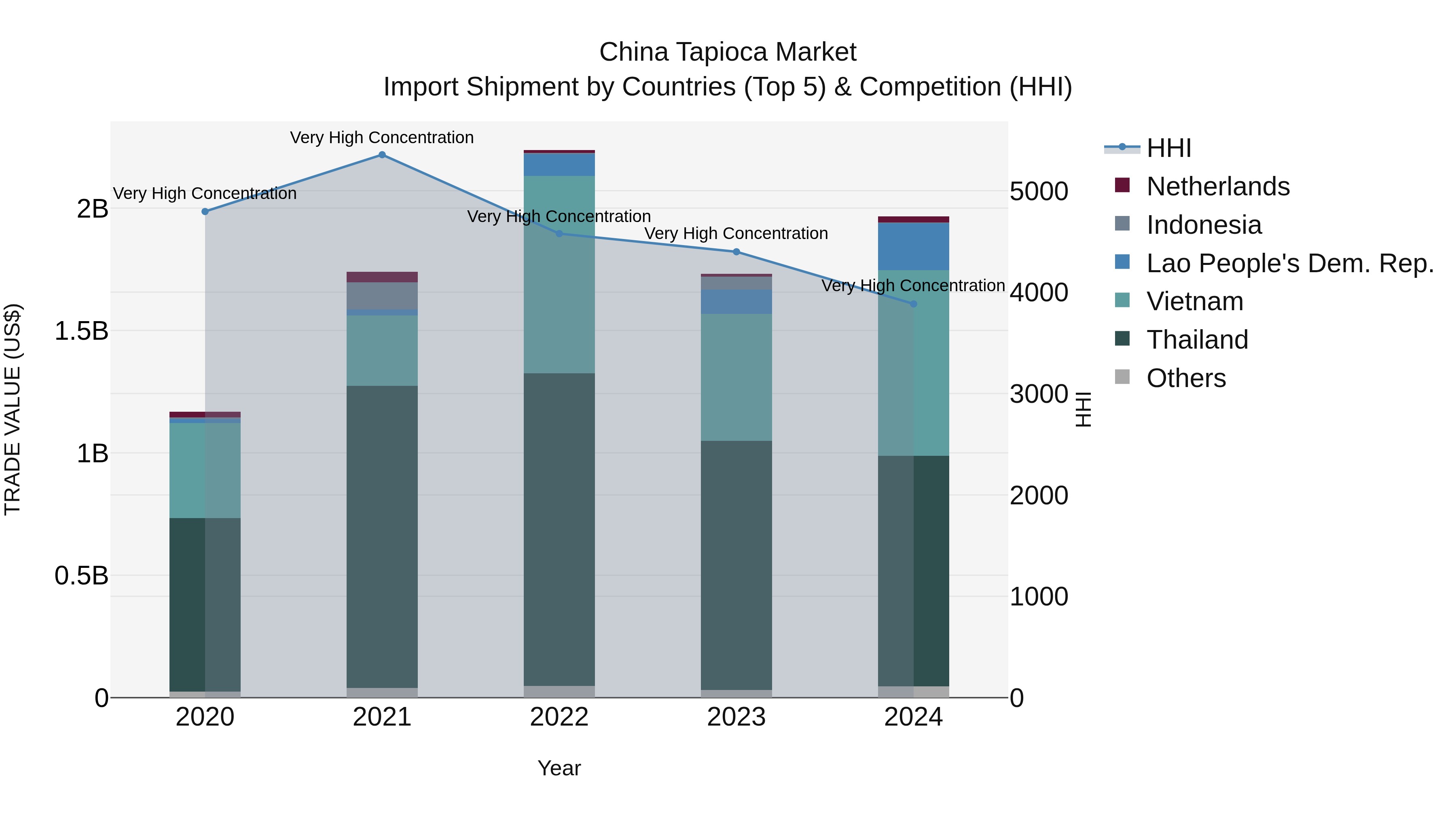
China tapioca import shipments in 2024 continued to be dominated by key suppliers including Thailand, Vietnam, Lao People`s Dem. Rep., Cambodia, and Netherlands. The market maintained a high Herfindahl-Hirschman Index (HHI) concentration, indicating strong supplier control. With a Compound Annual Growth Rate (CAGR) of 13.9% from 2020 to 2024 and a growth rate of 13.58% from 2023 to 2024, the tapioca import market in China shows consistent growth and importance of these key exporting countries in meeting the demand for tapioca in the Chinese market.
China Tapioca Market Overview
The China tapioca market is experiencing steady growth due to the increasing demand for tapioca products in various industries such as food and beverage, textile, and pharmaceuticals. Tapioca is a versatile ingredient used in the production of food items like noodles, snacks, and desserts. The rising disposable income of the Chinese population, coupled with the growing awareness of the health benefits of tapioca, is driving the market`s expansion. Additionally, tapioca starch is widely used in the textile industry for its binding and stiffening properties. The market is witnessing innovations in tapioca-based products and increasing investments in tapioca processing facilities to meet the growing demand. Overall, the China tapioca market is projected to continue its growth trajectory in the coming years as consumer preferences shift towards healthier and more sustainable food options.
China Tapioca Market Trends
The China tapioca market is currently experiencing growth due to the increasing demand for tapioca-based products in various industries such as food and beverage, textile, and pharmaceuticals. Tapioca is being used as a key ingredient in food products like bubble tea, tapioca pearls, and gluten-free alternatives. The market is also benefiting from the rising popularity of plant-based and gluten-free diets among Chinese consumers. Additionally, the versatility of tapioca in different applications, its natural and healthy image, and its affordability compared to other ingredients are driving its demand in the market. Manufacturers are focusing on product innovation, quality improvement, and sustainable sourcing practices to meet the evolving consumer preferences and regulatory standards in China. Overall, the China tapioca market is expected to continue growing in the coming years.
China Tapioca Market Challenges
In the China tapioca market, some of the key challenges faced include fluctuating raw material prices, supply chain disruptions, and increasing competition from alternative starch sources. Tapioca is heavily dependent on cassava as its raw material, and any fluctuations in cassava prices can directly impact the overall production costs. Additionally, disruptions in the supply chain, whether due to natural disasters or logistical issues, can lead to delays in production and distribution. Moreover, the market faces competition from other starch sources such as corn and potato starch, which offer similar functionalities and may be more cost-effective in certain situations. Navigating these challenges requires market players to stay agile, closely monitor market dynamics, and invest in strategies to enhance efficiency and competitiveness.
China Tapioca Market Investment Opportunities
Investment opportunities in the China Tapioca Market include the growing demand for tapioca products such as starch, pearls, and flour due to changing consumer preferences and increasing awareness of gluten-free and natural food products. With China being the largest producer of tapioca globally, investing in tapioca processing facilities or agricultural land for tapioca cultivation could be lucrative. Additionally, the expansion of tapioca-based industries such as food and beverage, textile, and pharmaceutical sectors in China provides opportunities for investors to tap into diverse market segments. Collaborating with local farmers to improve tapioca cultivation practices or investing in research and development for innovative tapioca-based products could also yield long-term returns in this dynamic market.
China Tapioca Market Government Policy
Government policies related to the China Tapioca Market primarily focus on promoting sustainable production practices, ensuring food safety standards, and enhancing international trade. The Chinese government has implemented regulations to monitor and control the quality and safety of tapioca products, including inspections of production facilities and certification processes. Additionally, there are subsidies and incentives provided to farmers and processors to encourage the adoption of environmentally friendly farming techniques and to improve overall productivity. In terms of international trade, China follows tariff regulations and import/export policies to maintain a balance in the tapioca market. Overall, the government`s policies aim to support the growth of the tapioca industry while safeguarding consumer health and fostering competitiveness in the global market.
China Tapioca Market Future Outlook
The future outlook for the China Tapioca Market appears promising, driven by factors such as increasing consumer demand for natural and gluten-free products, as well as the versatile applications of tapioca in various industries including food and beverage, pharmaceuticals, and textiles. Additionally, the growing awareness of tapioca`s health benefits and its use as a sustainable ingredient are expected to further fuel market growth. With China being a major tapioca producer and consumer globally, the market is likely to witness steady expansion, supported by investments in research and development, as well as technological advancements in processing and distribution. However, challenges such as fluctuating raw material prices and competition from alternative starch sources may impact market dynamics, requiring industry players to innovate and adapt to changing market conditions.
Key Highlights of the Report:
- China Tapioca Market Outlook
- Market Size of China Tapioca Market, 2021
- Forecast of China Tapioca Market, 2031
- Historical Data and Forecast of China Tapioca Revenues & Volume for the Period 2018 - 2031
- China Tapioca Market Trend Evolution
- China Tapioca Market Drivers and Challenges
- China Tapioca Price Trends
- China Tapioca Porter's Five Forces
- China Tapioca Industry Life Cycle
- Historical Data and Forecast of China Tapioca Market Revenues & Volume By Product Type for the Period 2018 - 2031
- Historical Data and Forecast of China Tapioca Market Revenues & Volume By Tapioca Starch for the Period 2018 - 2031
- Historical Data and Forecast of China Tapioca Market Revenues & Volume By Tapioca Thippi for the Period 2018 - 2031
- Historical Data and Forecast of China Tapioca Market Revenues & Volume By Tapioca milk residue for the Period 2018 - 2031
- Historical Data and Forecast of China Tapioca Market Revenues & Volume By Tapioca Pearl / Sabudana for the Period 2018 - 2031
- Historical Data and Forecast of China Tapioca Market Revenues & Volume By Tapioca Flour for the Period 2018 - 2031
- Historical Data and Forecast of China Tapioca Market Revenues & Volume By Black Tapioca Pearl for the Period 2018 - 2031
- Historical Data and Forecast of China Tapioca Market Revenues & Volume By Function for the Period 2018 - 2031
- Historical Data and Forecast of China Tapioca Market Revenues & Volume By Bodying for the Period 2018 - 2031
- Historical Data and Forecast of China Tapioca Market Revenues & Volume By Thickening for the Period 2018 - 2031
- Historical Data and Forecast of China Tapioca Market Revenues & Volume By Binding for the Period 2018 - 2031
- Historical Data and Forecast of China Tapioca Market Revenues & Volume By Stabilizer for the Period 2018 - 2031
- Historical Data and Forecast of China Tapioca Market Revenues & Volume By Form for the Period 2018 - 2031
- Historical Data and Forecast of China Tapioca Market Revenues & Volume By Fresh for the Period 2018 - 2031
- Historical Data and Forecast of China Tapioca Market Revenues & Volume By Dried for the Period 2018 - 2031
- Historical Data and Forecast of China Tapioca Market Revenues & Volume By End-use for the Period 2018 - 2031
- Historical Data and Forecast of China Tapioca Market Revenues & Volume By Food & beverages for the Period 2018 - 2031
- Historical Data and Forecast of China Tapioca Market Revenues & Volume By Pharmaceutical for the Period 2018 - 2031
- Historical Data and Forecast of China Tapioca Market Revenues & Volume By Animal Feed for the Period 2018 - 2031
- Historical Data and Forecast of China Tapioca Market Revenues & Volume By Textiles Industry for the Period 2018 - 2031
- Historical Data and Forecast of China Tapioca Market Revenues & Volume By Industrial for the Period 2018 - 2031
- China Tapioca Import Export Trade Statistics
- Market Opportunity Assessment By Product Type
- Market Opportunity Assessment By Function
- Market Opportunity Assessment By Form
- Market Opportunity Assessment By End-use
- China Tapioca Top Companies Market Share
- China Tapioca Competitive Benchmarking By Technical and Operational Parameters
- China Tapioca Company Profiles
- China Tapioca Key Strategic Recommendations






































