China Three Wheeler Market Size, Share & Growth Rate
The China Three Wheeler Market was estimated at USD 85 Million in 2025 and is projected to reach USD 98 Million by 2032, growing at a CAGR of 2.1% from 2026 to 2032. This growth is largely driven by an increasing demand for efficient and cost-effective transportation solutions, particularly in rural areas where traditional vehicles may be less accessible. The rising popularity of electric three-wheelers, fueled by government incentives for sustainable transport, is also playing a pivotal role in shaping the market's future.
China Three Wheeler Market Year-wise Growth Rate and Key Drivers
This graph highlights how the China Three Wheeler Market has steadily grown over the years, supported by major growth factors.
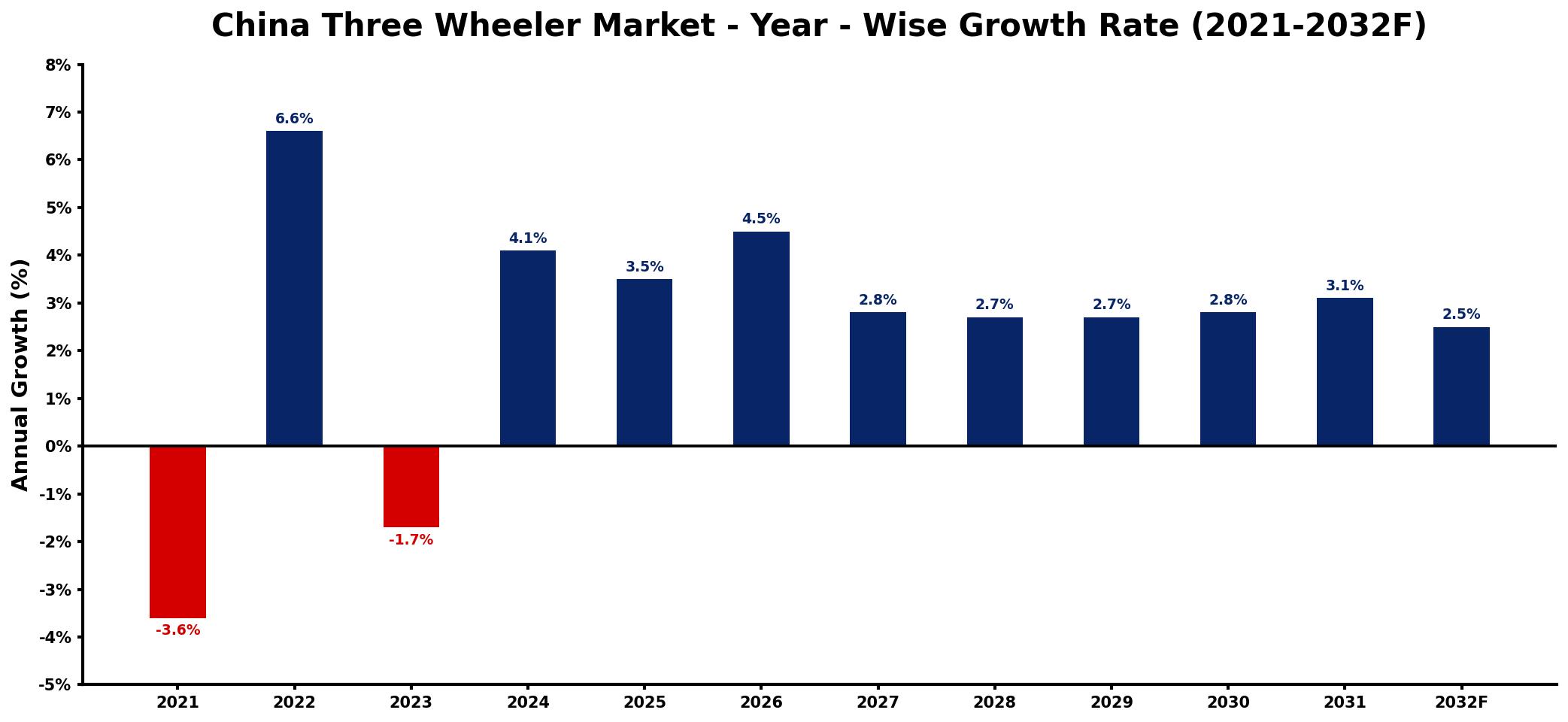
The table below presents the year‑wise growth rates along with the key drivers influencing the market
| Year | Growth Rate | Major Drivers |
| 2021 | -3.6% | decrease in urban transportation demand |
| 2022 | 6.6% | growth in logistics sector investments |
| 2023 | -1.7% | fall in consumer purchasing power |
| 2024 | 4.1% | rise in e-commerce delivery needs |
| 2025 | 3.5% | expansion of ride-sharing services |
| 2026 | 4.5% | increase in last-mile delivery solutions |
| 2027 | 2.8% | expanding industrial usage applications |
| 2028 | 2.7% | strengthening international trade flows |
| 2029 | 2.7% | increased production capacity utilization |
| 2030 | 2.8% | improved processing technologies adoption |
| 2031 | 3.1% | increased pharmaceutical industry usage |
| 2032 | 2.5% | expanding manufacturing base activity |
Note: Market size estimations and growth projections presented in this report are based on 6Wresearch's proprietary forecasting methodology, utilizing the latest available industry data, government publications, and primary research inputs.
China Three Wheeler Market Synopsis
In recent years, the China Three Wheeler Market has gained significant traction, particularly due to the surging demand for versatile transportation options. These vehicles are particularly favored for their fuel efficiency and ability to navigate congested urban settings.
As consumer preferences shift towards eco-friendly options, electric three-wheelers are increasingly becoming the norm, driven by both public interest and regulatory support. The intersection of these factors signals a transformative phase for the industry, as manufacturers adapt to meet the evolving demands.
China Three Wheeler Market Key Takeaways
- The market is experiencing a notable shift towards electric three-wheelers, fueled by government policies favoring sustainable transportation.
- Last-mile delivery services are becoming a significant growth area, leveraging the maneuverability of three-wheelers in urban environments.
- Technological innovations are enhancing safety, comfort, and efficiency, making three-wheelers more appealing to consumers.
- Regulatory challenges and infrastructure limitations present obstacles but also opportunities for innovation and growth.
- The market offers diverse investment prospects, particularly in electric vehicle manufacturing and logistics services.
Evaluation of Restraints in China Three Wheeler Market
While the China Three Wheeler Market shows promising potential, various restraints impede its growth. Regulatory hurdles can complicate the production and sale of traditional three-wheelers, particularly as regions impose stricter emission standards. Furthermore, competition from electric bicycles and motorcycles poses a challenge, as consumers increasingly view these alternatives as modern and safe options. Perceptions around the safety of three-wheelers compared to four-wheeled vehicles also continue to be a concern that manufacturers must address to enhance consumer confidence. Infrastructure challenges, particularly the lack of adequate charging stations for electric models, further complicate the landscape, requiring strategic planning from stakeholders.
China Three Wheeler Market Trends
The trend towards electric three-wheelers has taken center stage, driven by a collective push for sustainable transportation solutions. Government incentives and subsidies are encouraging manufacturers to innovate and invest in electric vehicle technology. Concurrently, there's a rising demand for three-wheelers in the logistics sector, particularly for last-mile delivery, as urbanization increases and online shopping surges. Additionally, manufacturers are focusing on enhancing vehicle design and features to cater to consumer preferences for safety, comfort, and connectivity.
China Three Wheeler Market Opportunities
Investors will find ample opportunities in the electric three-wheeler segment, particularly as consumer preferences shift towards greener alternatives. The demand for last-mile delivery solutions in urban areas presents a fertile ground for companies willing to harness three-wheelers for logistics applications. Furthermore, opportunities abound for technology firms specializing in enhancing vehicle safety, connectivity, and performance—key factors that can significantly boost market appeal and consumer trust. As the landscape evolves, innovative partnerships and strategic investments will be vital for stakeholders looking to capitalize on this dynamic market.
Government Initiatives in the China Three Wheeler Market
The Chinese government has been proactive in regulating the Three Wheeler Market through various initiatives aimed at promoting sustainability. These include emission standards that set limits on pollution and enhance vehicle safety protocols. Incentives for manufacturers producing electric three-wheelers are also a core focus, as the government seeks to align industry growth with its broader environmental goals. In regions facing significant pollution issues, restrictions on traditional gasoline-powered three-wheelers are implemented to encourage a transition toward greener technologies.
Future Insights of the China Three Wheeler Market
Looking ahead to 2026-2032, the China Three Wheeler Market is poised for steady growth driven by the dual forces of urbanization and environmental responsibility. The push for electric vehicles is expected to gain momentum as consumers increasingly seek cost-effective and sustainable transport options. Furthermore, ongoing advancements in technology will likely enhance vehicle safety and connectivity features, appealing to a broader consumer base. Overall, the market is set to evolve, presenting both challenges and significant opportunities for innovation and investment.
China Three Wheeler Market Latest Developments (2025 - 2026)
In the recent months, the China Three Wheeler Market has seen an uptick in initiatives focused on electric vehicle adoption, driven by both consumer demand and government incentives. Many manufacturers are ramping up efforts to improve their electric three-wheeler offerings, enhancing safety features and performance capabilities. Additionally, several companies are exploring partnerships with technology firms to integrate advanced connectivity solutions into their vehicles. The ongoing urbanization trend continues to spotlight the utility of three-wheelers in logistics, particularly for last-mile delivery services, underscoring their potential in an evolving transportation landscape.
China Three Wheeler Market - Key Attractiveness of the Report
- 10 Years of Market Numbers
- Historical Data Starting from 2022 to 2025
- Base Year: 2025
- Forecast Data until 2032
- Key Performance Indicators Impacting the Market
- Major Upcoming Developments and Projects
Key Highlights of the Report:
- China Three Wheeler Market Outlook
- Market Size of China Three Wheeler Market, 2025
- Forecast of China Three Wheeler Market, 2032
- Historical Data and Forecast of China Three Wheeler Revenues & Volume for the Period 2022-2032F
- China Three Wheeler Market Trend Evolution
- China Three Wheeler Market Drivers and Challenges
- China Three Wheeler Price Trends
- China Three Wheeler Porter's Five Forces
- China Three Wheeler Industry Life Cycle
- Historical Data and Forecast of China Three Wheeler Market Revenues & Volume By Fuel Type for the Period 2022-2032F
- Historical Data and Forecast of China Three Wheeler Market Revenues & Volume By Petrol/CNG for the Period 2022-2032F
- Historical Data and Forecast of China Three Wheeler Market Revenues & Volume By Diesel for the Period 2022-2032F
- Historical Data and Forecast of China Three Wheeler Market Revenues & Volume By Electric for the Period 2022-2032F
- Historical Data and Forecast of China Three Wheeler Market Revenues & Volume By Vehicle Type for the Period 2022-2032F
- Historical Data and Forecast of China Three Wheeler Market Revenues & Volume By Passenger Carrier for the Period 2022-2032F
- Historical Data and Forecast of China Three Wheeler Market Revenues & Volume By Load Carrier for the Period 2022-2032F
- China Three Wheeler Import Export Trade Statistics
- Market Opportunity Assessment By Fuel Type
- Market Opportunity Assessment By Vehicle Type
- China Three Wheeler Top Companies Market Share
- China Three Wheeler Competitive Benchmarking By Technical and Operational Parameters
- China Three Wheeler Company Profiles
- China Three Wheeler Key Strategic Recommendations






































