Congo Canned Tuna Market: Top 5 Importing Countries and Market Competition (HHI) Analysis
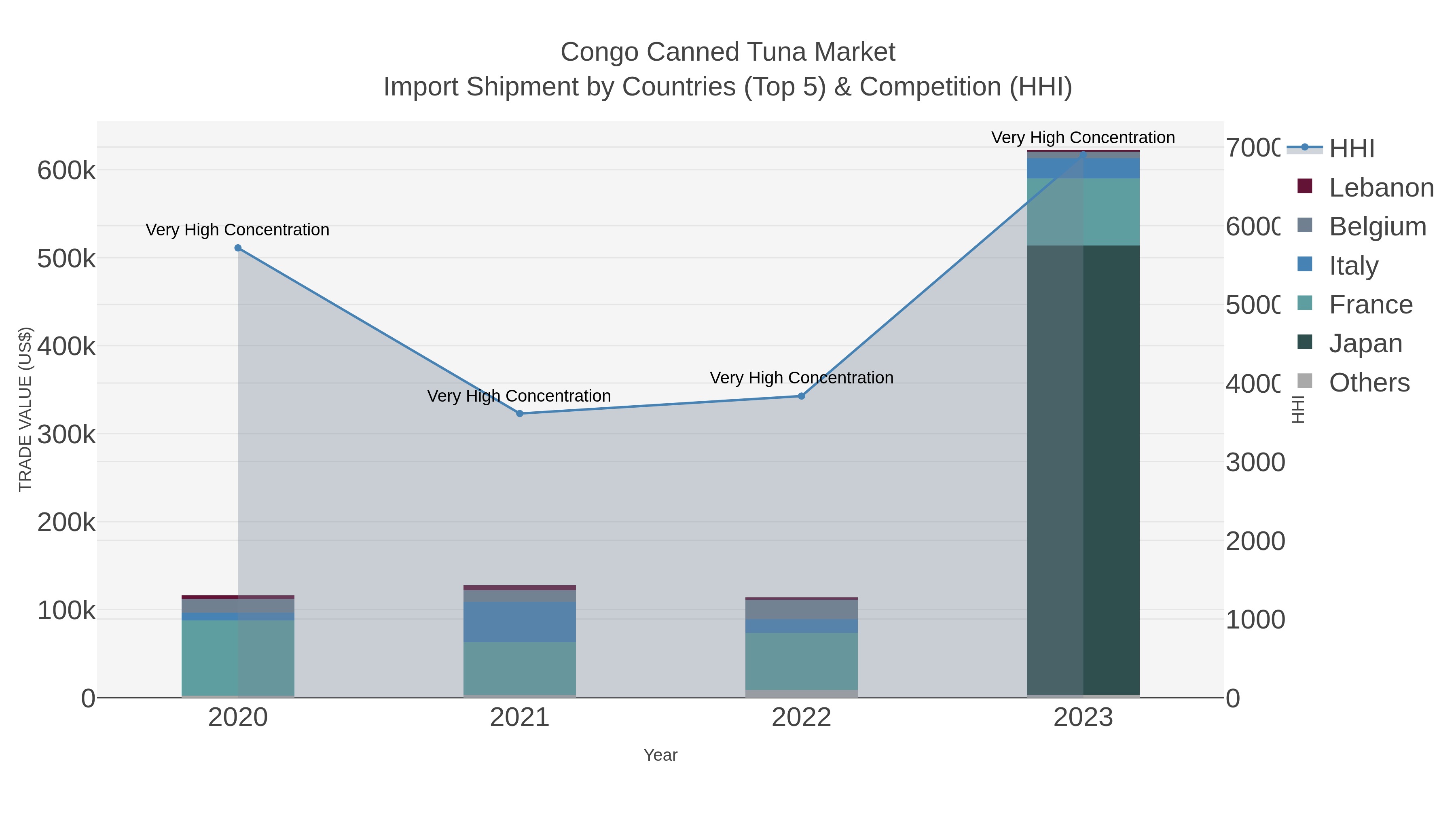
Congo canned tuna import market saw significant growth in 2023, with top exporters including Japan, France, Italy, Belgium, and Lebanon. The high Herfindahl-Hirschman Index (HHI) indicates a concentrated market, while the impressive Compound Annual Growth Rate (CAGR) of 75.02% and growth rate of 445.12% highlight the rapid expansion of this sector. This data suggests a strong demand for canned tuna in Congo, with key players vying for a share of this lucrative market.
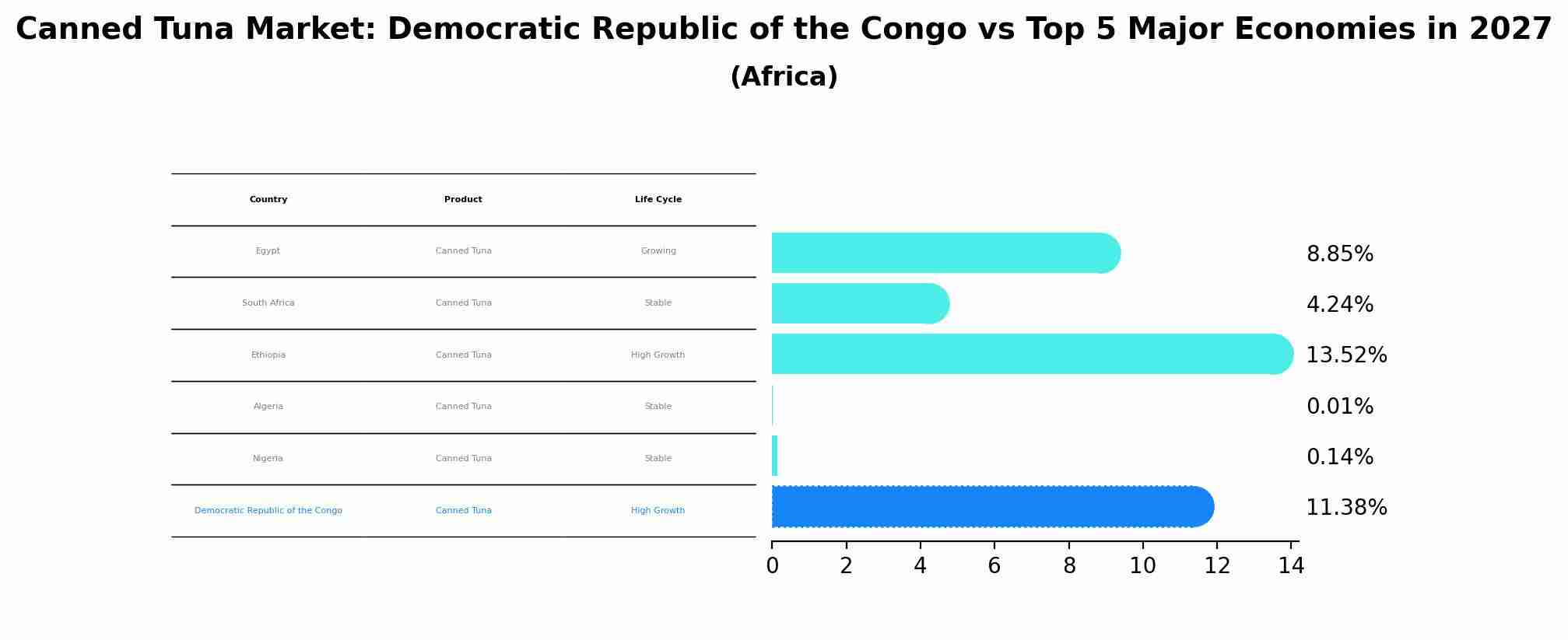
Canned Tuna Market: Democratic Republic of the Congo vs Top 5 Major Economies in 2027 (Africa)
Democratic Republic of the Congo's Canned Tuna market is anticipated to experience a high growth rate of 11.38% by 2027, reflecting trends observed in the largest economy Egypt, followed by South Africa, Ethiopia, Algeria and Nigeria.
Congo Canned Tuna Market Overview
Canned Tuna is one of the most popular canned seafood products in Congo, driven by its high protein content, convenience, and versatility in meal preparation. The market benefits from the growing demand for easy-to-store and nutritious food options, especially among urban consumers. However, the Congo Canned Tuna Market struggles with issues like limited local processing capacity, dependency on imports, and environmental concerns regarding overfishing. Developing local production capabilities and ensuring sustainable fishing practices are critical for the market`s long-term growth.
Drivers of the market
The Congo Canned Tuna Market is witnessing growth due to the rising awareness of the nutritional benefits of tuna, such as its high protein and omega-3 content. Tuna`s versatility in meal preparation and its convenience as a ready-to-eat product make it a staple in many households. The growing demand for affordable and shelf-stable protein sources further drives the market.
Challenges of the market
The canned tuna market in Congo faces challenges stemming from the high cost of tuna imports, as local fish stocks are insufficient to meet demand. Environmental concerns around sustainable fishing practices also lead to stricter regulations, affecting supply chains. Additionally, rising prices for packaging materials, combined with increasing competition from alternative protein sources, such as plant-based options, create hurdles for the market. There is also the issue of consumer preference for fresh over canned tuna, which limits demand.
Government Policy of the market
The Congo Canned Tuna Market is shaped by government policies on fisheries management, trade regulations, and food safety. The governments policies promote sustainable fishing practices, with quotas and restrictions aimed at preventing overfishing and ensuring long-term resource availability. Food safety regulations are enforced to maintain high standards in canned tuna products, affecting both local and imported goods. Tariffs on imported canned tuna help protect local producers from foreign competition, and the governments support for local food processing industries, including tax incentives and subsidies, aids in market development.
Key Highlights of the Report:
- Congo Canned Tuna Market Outlook
- Market Size of Congo Canned Tuna Market, 2024
- Forecast of Congo Canned Tuna Market, 2031
- Historical Data and Forecast of Congo Canned Tuna Revenues & Volume for the Period 2021-2031
- Congo Canned Tuna Market Trend Evolution
- Congo Canned Tuna Market Drivers and Challenges
- Congo Canned Tuna Price Trends
- Congo Canned Tuna Porter`s Five Forces
- Congo Canned Tuna Industry Life Cycle
- Historical Data and Forecast of Congo Canned Tuna Market Revenues & Volume By Product for the Period 2021-2031
- Historical Data and Forecast of Congo Canned Tuna Market Revenues & Volume By Skipjack for the Period 2021-2031
- Historical Data and Forecast of Congo Canned Tuna Market Revenues & Volume By Yellowfin for the Period 2021-2031
- Historical Data and Forecast of Congo Canned Tuna Market Revenues & Volume By Others for the Period 2021-2031
- Historical Data and Forecast of Congo Canned Tuna Market Revenues & Volume By Distribution Channel for the Period 2021-2031
- Historical Data and Forecast of Congo Canned Tuna Market Revenues & Volume By Hypermarket & Supermarket for the Period 2021-2031
- Historical Data and Forecast of Congo Canned Tuna Market Revenues & Volume By Specialty Stores for the Period 2021-2031
- Historical Data and Forecast of Congo Canned Tuna Market Revenues & Volume By Online for the Period 2021-2031
- Congo Canned Tuna Import Export Trade Statistics
- Market Opportunity Assessment By Product
- Market Opportunity Assessment By Distribution Channel
- Congo Canned Tuna Top Companies Market Share
- Congo Canned Tuna Competitive Benchmarking By Technical and Operational Parameters
- Congo Canned Tuna Company Profiles
- Congo Canned Tuna Key Strategic Recommendations






































