Congo Glycerin Market: Top 5 Importing Countries and Market Competition (HHI) Analysis
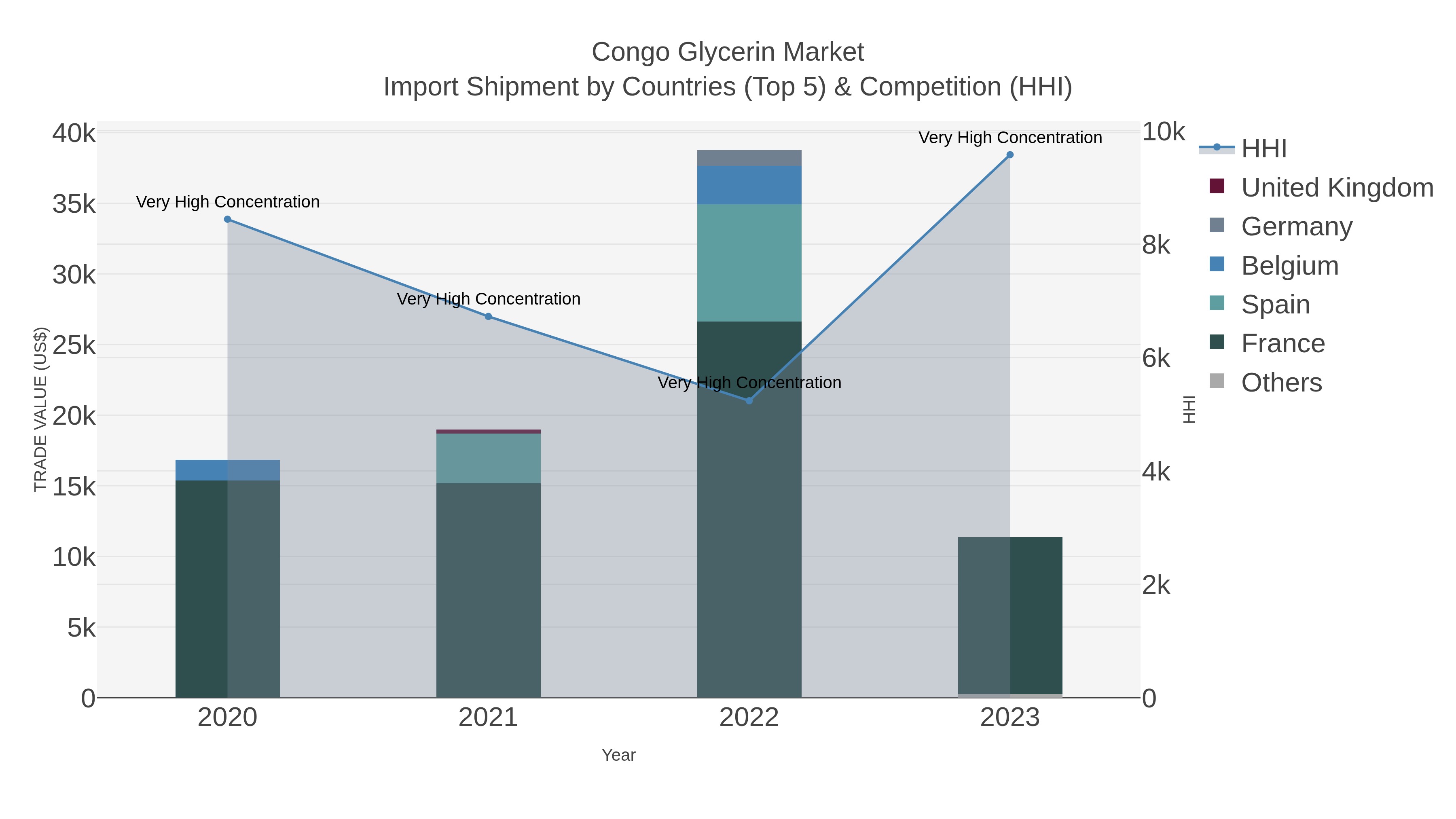
Despite the high concentration in Congo glycerin import market, top exporters like France, UAE, and Brazil continue to dominate in 2023. The negative CAGR of -12.26 and growth rate of -70.68 indicate significant challenges and potential disruptions in the market. It will be crucial for both existing and new players to adapt to the changing dynamics and market conditions to maintain their competitiveness in the Congo glycerin import sector.
Congo Glycerin Market Overview
The glycerin market in Congo is seeing growth due to its wide applications in the cosmetics, pharmaceutical, and food industries. Glycerin is valued for its moisturizing properties and as a solvent in various formulations. The increasing demand for natural and organic products is driving the market, along with the rise in personal care and hygiene products. Challenges include the fluctuating prices of raw materials and competition from synthetic alternatives.
Drivers of the market
The Congo glycerin market is primarily driven by the growth in the personal care and cosmetics industry. Glycerin, known for its moisturizing properties, is a key ingredient in skincare products, soaps, and shampoos. The rising awareness of personal hygiene and the increasing demand for natural and organic cosmetic products boost the market. Additionally, glycerin`s applications in pharmaceuticals and food processing sectors further drive its demand.
Challenges of the market
The glycerin market in Congo faces several obstacles, including a limited production base and high dependency on imports. This dependence can lead to fluctuating prices and supply shortages. There is also a lack of infrastructure for proper storage and distribution, which affects the stability of supply. Additionally, the absence of stringent quality regulations can lead to issues with product purity and safety.
Government Policy of the market
The Congolese government supports the glycerin market through policies that promote the production of biodiesel, from which glycerin is a byproduct. Policies are focused on increasing the use of renewable energy sources and supporting industries that contribute to this goal. There are also specific regulations regarding the quality of glycerin, particularly for use in cosmetics and pharmaceuticals, to ensure safety and compliance with international standards.
Key Highlights of the Report:
- Congo Glycerin Market Outlook
- Market Size of Congo Glycerin Market, 2024
- Forecast of Congo Glycerin Market, 2031
- Historical Data and Forecast of Congo Glycerin Revenues & Volume for the Period 2021-2031
- Congo Glycerin Market Trend Evolution
- Congo Glycerin Market Drivers and Challenges
- Congo Glycerin Price Trends
- Congo Glycerin Porter`s Five Forces
- Congo Glycerin Industry Life Cycle
- Historical Data and Forecast of Congo Glycerin Market Revenues & Volume By Process for the Period 2021-2031
- Historical Data and Forecast of Congo Glycerin Market Revenues & Volume By Transesterification for the Period 2021-2031
- Historical Data and Forecast of Congo Glycerin Market Revenues & Volume By Saponification for the Period 2021-2031
- Historical Data and Forecast of Congo Glycerin Market Revenues & Volume By Fat Splitting for the Period 2021-2031
- Historical Data and Forecast of Congo Glycerin Market Revenues & Volume By Source for the Period 2021-2031
- Historical Data and Forecast of Congo Glycerin Market Revenues & Volume By Vegetable Oils for the Period 2021-2031
- Historical Data and Forecast of Congo Glycerin Market Revenues & Volume By Biodiesel for the Period 2021-2031
- Historical Data and Forecast of Congo Glycerin Market Revenues & Volume By Soaps for the Period 2021-2031
- Historical Data and Forecast of Congo Glycerin Market Revenues & Volume By Synthetic for the Period 2021-2031
- Historical Data and Forecast of Congo Glycerin Market Revenues & Volume By Application for the Period 2021-2031
- Historical Data and Forecast of Congo Glycerin Market Revenues & Volume By Industrial for the Period 2021-2031
- Historical Data and Forecast of Congo Glycerin Market Revenues & Volume By Chemical intermediates for the Period 2021-2031
- Historical Data and Forecast of Congo Glycerin Market Revenues & Volume By Grade for the Period 2021-2031
- Historical Data and Forecast of Congo Glycerin Market Revenues & Volume By Technical grade for the Period 2021-2031
- Historical Data and Forecast of Congo Glycerin Market Revenues & Volume By Pharmaceutical grade for the Period 2021-2031
- Congo Glycerin Import Export Trade Statistics
- Market Opportunity Assessment By Process
- Market Opportunity Assessment By Source
- Market Opportunity Assessment By Application
- Market Opportunity Assessment By Grade
- Congo Glycerin Top Companies Market Share
- Congo Glycerin Competitive Benchmarking By Technical and Operational Parameters
- Congo Glycerin Company Profiles
- Congo Glycerin Key Strategic Recommendations






































