Congo Kegs Market: Top 5 Importing Countries and Market Competition (HHI) Analysis
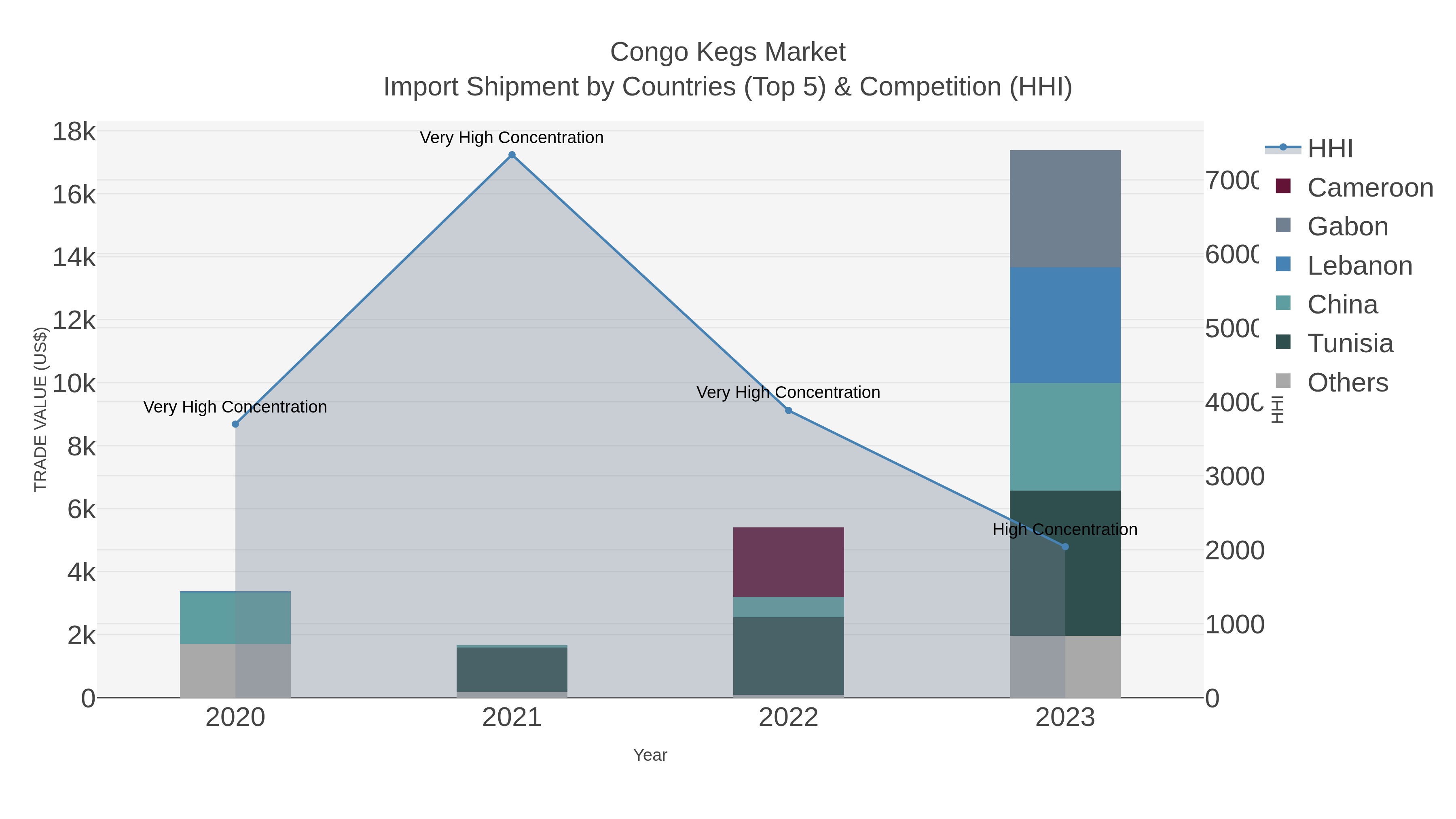
The import shipments of Congo kegs in 2023 saw a notable shift in the market landscape, with top exporters being Tunisia, Gabon, Lebanon, China, and Hong Kong. The Herfindahl-Hirschman Index (HHI) indicated a change from very high concentration in 2022 to high concentration in 2023, reflecting evolving market dynamics. The impressive Compound Annual Growth Rate (CAGR) of 72.58% and a remarkable growth rate of 221.21% highlight the thriving demand for kegs in Congo, presenting lucrative opportunities for exporters and stakeholders in the industry.
Kegs Market: Democratic Republic of the Congo vs Top 5 Major Economies in 2027 (Africa)
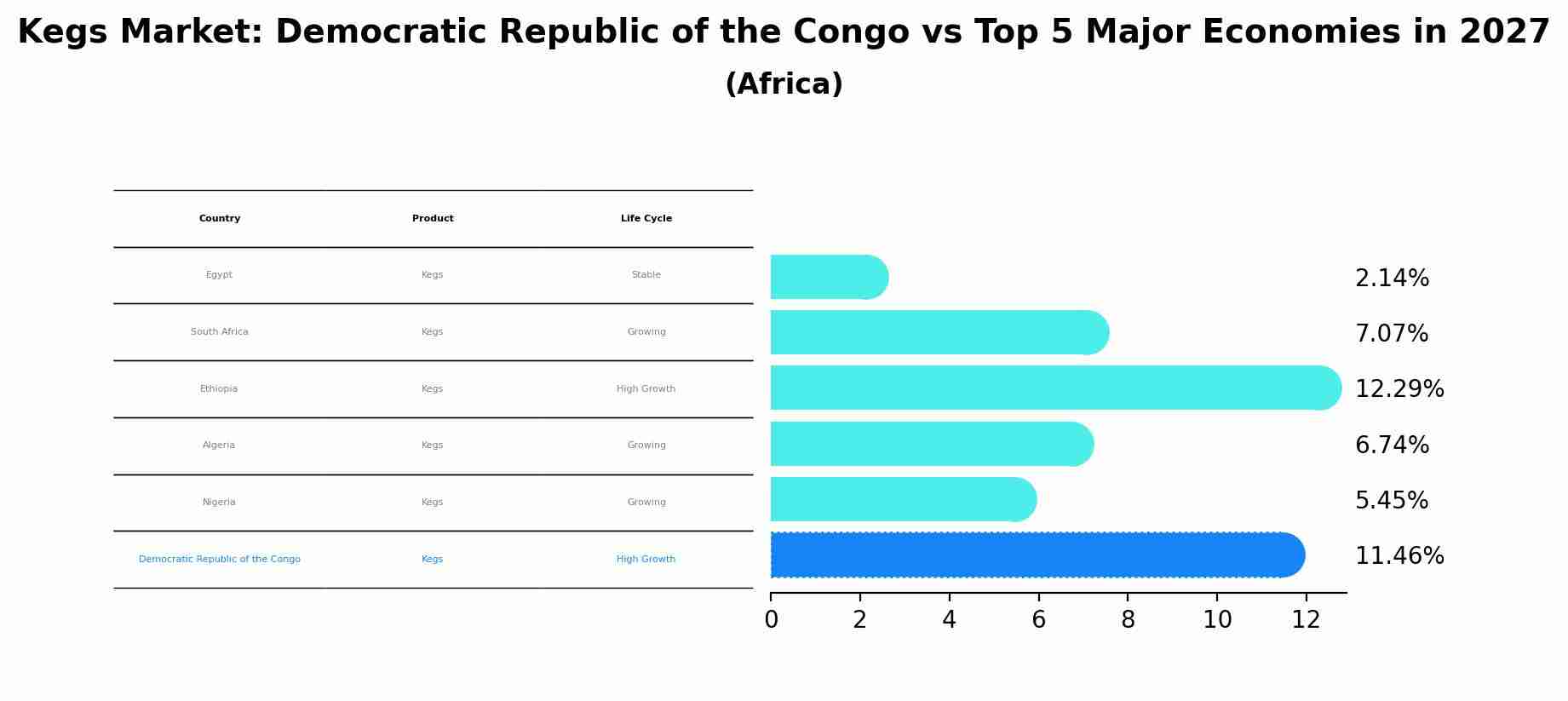
By 2027, Democratic Republic of the Congo's Kegs market is forecasted to achieve a high growth rate of 11.46%, with Egypt leading the Africa region, followed by South Africa, Ethiopia, Algeria and Nigeria.
Congo Kegs Market Overview
The kegs market in Congo is expanding as the demand for beverage packaging solutions grows. Kegs are used for storing and dispensing beverages such as beer, cider, and soft drinks, offering a convenient and efficient packaging option. The market growth is influenced by the increasing consumption of draft beverages, the expansion of the hospitality and beverage industries, and the need for efficient packaging solutions. The adoption of kegs for various beverages supports market development.
Drivers of the market
The kegs market in Congo is influenced by the demand for durable and reusable containers used for storing and dispensing beverages, particularly in the food and beverage industry. Kegs are commonly used for beer, soft drinks, and other liquids, offering convenience and efficiency in distribution and service. The market growth is driven by the increasing consumption of beverages and the need for reliable packaging solutions. As the beverage industry in Congo grows, the demand for kegs and related products continues to rise.
Challenges of the market
The Congo kegs market is constrained by high import costs and limited local manufacturing capabilities. The reliance on imported kegs results in increased expenses and longer lead times for businesses. Additionally, there is a lack of local technical expertise and support services, impacting the effective use and management of kegs. The market also faces challenges related to the absence of standardized regulations and quality control measures, affecting the performance and reliability of these products.
Government Policy of the market
The government supports the kegs market by promoting the use of kegs in beverage distribution and packaging. Policies include incentives for businesses involved in keg production and recycling. The government also focuses on ensuring the quality and safety of kegs used in the beverage industry and encourages environmentally responsible practices.
Key Highlights of the Report:
- Congo Kegs Market Outlook
- Market Size of Congo Kegs Market, 2024
- Forecast of Congo Kegs Market, 2031
- Historical Data and Forecast of Congo Kegs Revenues & Volume for the Period 2021-2031
- Congo Kegs Market Trend Evolution
- Congo Kegs Market Drivers and Challenges
- Congo Kegs Price Trends
- Congo Kegs Porter`s Five Forces
- Congo Kegs Industry Life Cycle
- Historical Data and Forecast of Congo Kegs Market Revenues & Volume By Material for the Period 2021-2031
- Historical Data and Forecast of Congo Kegs Market Revenues & Volume By Plastic for the Period 2021-2031
- Historical Data and Forecast of Congo Kegs Market Revenues & Volume By Tin for the Period 2021-2031
- Historical Data and Forecast of Congo Kegs Market Revenues & Volume By Stainless Steel for the Period 2021-2031
- Historical Data and Forecast of Congo Kegs Market Revenues & Volume By Capacity for the Period 2021-2031
- Historical Data and Forecast of Congo Kegs Market Revenues & Volume By Up to 20 Liter for the Period 2021-2031
- Historical Data and Forecast of Congo Kegs Market Revenues & Volume By 20 Liter to 40 Liter for the Period 2021-2031
- Historical Data and Forecast of Congo Kegs Market Revenues & Volume By 40 Liter to 60 Liter for the Period 2021-2031
- Historical Data and Forecast of Congo Kegs Market Revenues & Volume By Above 60 Liter for the Period 2021-2031
- Historical Data and Forecast of Congo Kegs Market Revenues & Volume By End Use for the Period 2021-2031
- Historical Data and Forecast of Congo Kegs Market Revenues & Volume By Alcoholic Beverages for the Period 2021-2031
- Historical Data and Forecast of Congo Kegs Market Revenues & Volume By Non-Alcoholic Beverages for the Period 2021-2031
- Historical Data and Forecast of Congo Kegs Market Revenues & Volume By Cooking Oil for the Period 2021-2031
- Historical Data and Forecast of Congo Kegs Market Revenues & Volume By Chemicals for the Period 2021-2031
- Historical Data and Forecast of Congo Kegs Market Revenues & Volume By Others for the Period 2021-2031
- Historical Data and Forecast of Congo Kegs Market Revenues & Volume By Distribution Channel for the Period 2021-2031
- Historical Data and Forecast of Congo Kegs Market Revenues & Volume By Supermarket/Hypermarket for the Period 2021-2031
- Historical Data and Forecast of Congo Kegs Market Revenues & Volume By Commercial Liquor Store for the Period 2021-2031
- Historical Data and Forecast of Congo Kegs Market Revenues & Volume By Others for the Period 2021-2031
- Congo Kegs Import Export Trade Statistics
- Market Opportunity Assessment By Material
- Market Opportunity Assessment By Capacity
- Market Opportunity Assessment By End Use
- Market Opportunity Assessment By Distribution Channel
- Congo Kegs Top Companies Market Share
- Congo Kegs Competitive Benchmarking By Technical and Operational Parameters
- Congo Kegs Company Profiles
- Congo Kegs Key Strategic Recommendations






































