Congo Non-alcoholic Wine Market: Top 5 Importing Countries and Market Competition (HHI) Analysis
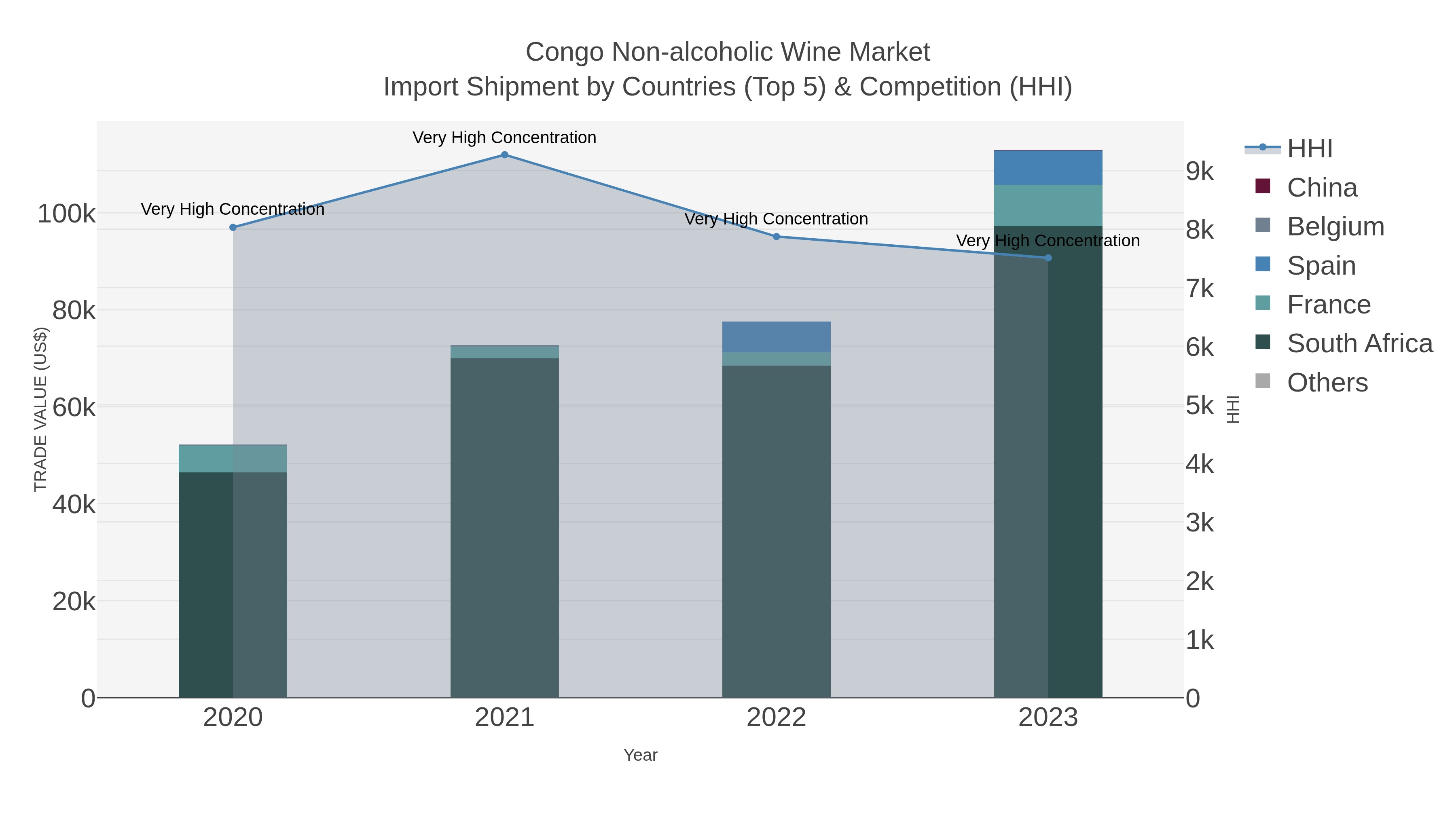
The non-alcoholic wine import market in Congo showed strong growth in 2023, with top exporters being South Africa, France, Spain, China, and Belgium. Despite the high concentration levels indicated by the Herfindahl-Hirschman Index (HHI), the industry continues to expand rapidly with an impressive Compound Annual Growth Rate (CAGR) of 29.34% and a growth rate of 45.54%. This suggests a promising outlook for the non-alcoholic wine market in Congo, driven by a diverse range of suppliers and increasing consumer interest in alcohol-free alternatives.
Key Highlights of the Report:
- Congo Non-Alcoholic Wine Market Outlook
- Market Size of Congo Non-Alcoholic Wine Market, 2025
- Forecast of Congo Non-Alcoholic Wine Market, 2032
- Historical Data and Forecast of Congo Non-Alcoholic Wine Revenues & Volume for the Period 2022 - 2032
- Congo Non-Alcoholic Wine Market Trend Evolution
- Congo Non-Alcoholic Wine Market Drivers and Challenges
- Congo Non-Alcoholic Wine Price Trends
- Congo Non-Alcoholic Wine Porter's Five Forces
- Congo Non-Alcoholic Wine Industry Life Cycle
- Historical Data and Forecast of Congo Non-Alcoholic Wine Market Revenues & Volume By Product Type for the Period 2022 - 2032
- Historical Data and Forecast of Congo Non-Alcoholic Wine Market Revenues & Volume By Alcohol-Free for the Period 2022 - 2032
- Historical Data and Forecast of Congo Non-Alcoholic Wine Market Revenues & Volume By 0.5% Alcohol by Volume for the Period 2022 - 2032
- Historical Data and Forecast of Congo Non-Alcoholic Wine Market Revenues & Volume By Category for the Period 2022 - 2032
- Historical Data and Forecast of Congo Non-Alcoholic Wine Market Revenues & Volume By Plain for the Period 2022 - 2032
- Historical Data and Forecast of Congo Non-Alcoholic Wine Market Revenues & Volume By Flavored for the Period 2022 - 2032
- Historical Data and Forecast of Congo Non-Alcoholic Wine Market Revenues & Volume By Distribution Channel for the Period 2022 - 2032
- Historical Data and Forecast of Congo Non-Alcoholic Wine Market Revenues & Volume By Store-Based for the Period 2022 - 2032
- Historical Data and Forecast of Congo Non-Alcoholic Wine Market Revenues & Volume By Non-Store-Based for the Period 2022 - 2032
- Congo Non-Alcoholic Wine Import Export Trade Statistics
- Market Opportunity Assessment By Product Type
- Market Opportunity Assessment By Category
- Market Opportunity Assessment By Distribution Channel
- Congo Non-Alcoholic Wine Top Companies Market Share
- Congo Non-Alcoholic Wine Competitive Benchmarking By Technical and Operational Parameters
- Congo Non-Alcoholic Wine Company Profiles
- Congo Non-Alcoholic Wine Key Strategic Recommendations






































