Croatia Emollient Market Top 5 Importing Countries and Market Competition (HHI) Analysis
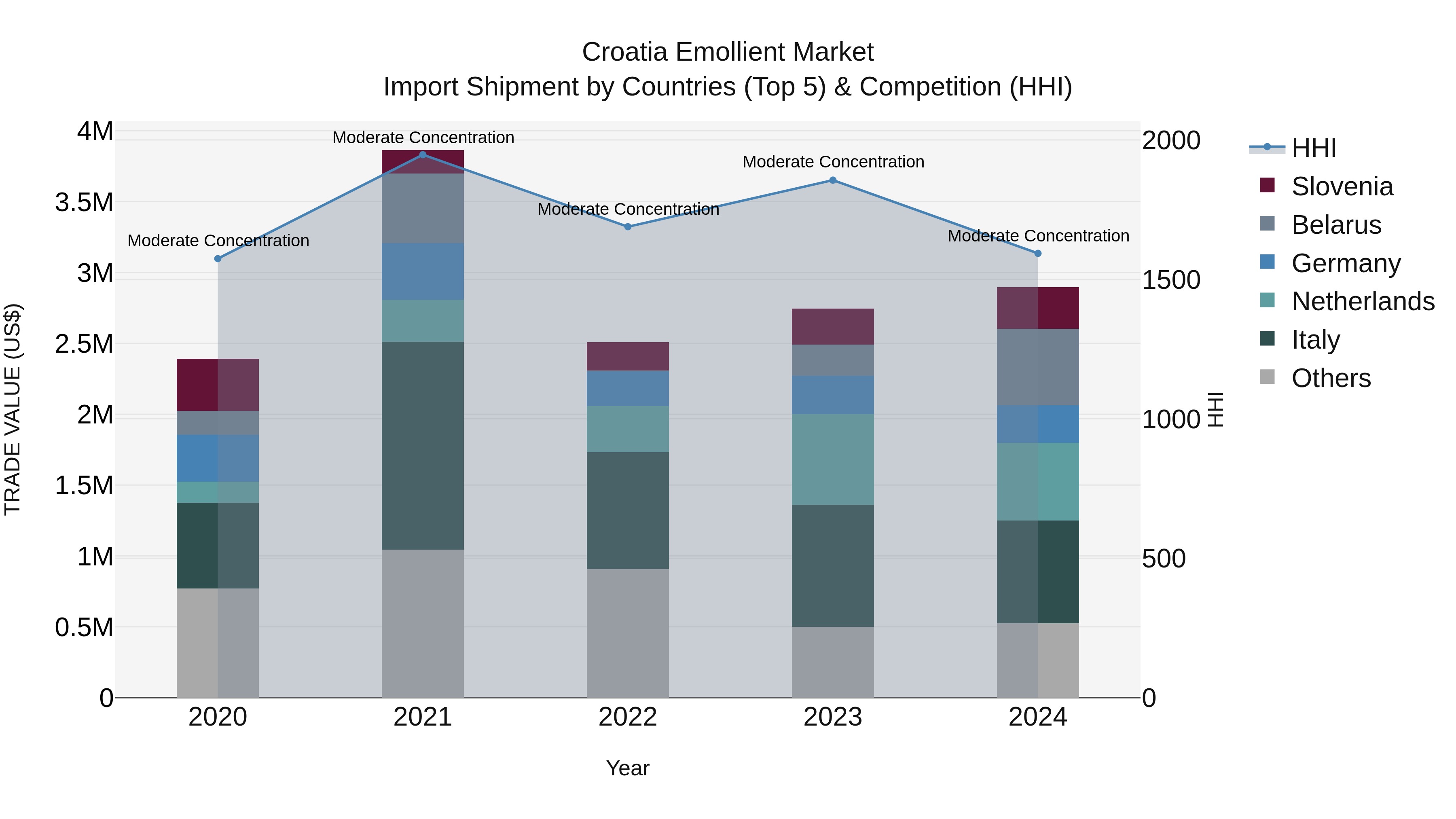
In 2024, Croatia continued to see a steady increase in emollient import shipments, with top exporting countries being Italy, Netherlands, Belarus, Slovenia, and Germany. The market concentration, as measured by the Herfindahl-Hirschman Index (HHI), remained at a moderate level, indicating a competitive landscape. The compound annual growth rate (CAGR) from 2020 to 2024 stood at 4.9%, with a notable growth rate of 5.52% from 2023 to 2024. These trends suggest a resilient market with promising opportunities for both domestic and international players in the emollient sector.
Croatia Emollient Market Overview
The Croatia Emollient Market is witnessing steady growth due to the increasing demand for skincare products and cosmetics. Emollients are essential ingredients in these products as they help improve skin hydration, smoothness, and overall appearance. Key drivers of market growth include the rising awareness about skincare, changing lifestyles, and a growing aging population. Manufacturers are focusing on developing innovative emollient products using natural and organic ingredients to cater to the increasing consumer preference for clean beauty products. The market is also benefiting from the expansion of distribution channels, including online retail platforms, which provide easy access to a wide range of emollient-based products. Overall, the Croatia Emollient Market is expected to continue its growth trajectory in the coming years, driven by evolving consumer preferences and advancements in skincare technology.
Croatia Emollient Market Trends and Opportunities
The Croatia Emollient Market is experiencing steady growth driven by the increasing consumer demand for skincare products with moisturizing benefits. There is a growing interest in natural and organic emollients, as consumers are becoming more conscious about the ingredients they apply on their skin. Key opportunities in the market include the development of innovative emollient formulations targeting specific skin concerns such as anti-aging, sensitive skin, and sun protection. Additionally, the rising popularity of multi-functional emollients that offer both moisturizing and skin conditioning properties presents a promising avenue for market expansion. Manufacturers can capitalize on these trends by investing in research and development to create high-quality emollients that cater to evolving consumer preferences in the skincare industry.
Croatia Emollient Market Challenges
In the Croatia Emollient Market, some challenges faced include increasing competition from international brands, fluctuating raw material prices, and evolving consumer preferences. Local emollient manufacturers may struggle to compete with well-established global brands that have greater resources for marketing and distribution. Additionally, the volatility of raw material prices can impact production costs and profit margins for companies operating in the market. Moreover, as consumers become more conscious about ingredients and sustainability, emollient companies in Croatia may need to invest in research and development to meet changing preferences and regulatory requirements. Overall, navigating these challenges requires strategic planning, innovation, and adaptability to stay competitive in the Croatia Emollient Market.
Croatia Emollient Market Drivers
The Croatia Emollient Market is primarily driven by factors such as the increasing awareness among consumers regarding skincare and the growing demand for natural and organic ingredients in skincare products. Additionally, the rise in disposable income levels and changing lifestyle patterns are fueling the demand for emollient products in the country. The aging population in Croatia is also a significant driver, as older individuals tend to have drier skin and require emollients for hydration and moisturization. Furthermore, the expanding distribution channels, including online retail platforms and specialty stores, are making emollient products more accessible to a wider consumer base, thereby contributing to the market growth in Croatia.
Croatia Emollient Market Government Policy
The Croatian government has implemented various regulations and policies related to the emollient market to ensure consumer safety and product quality. These policies include adherence to EU regulations on cosmetic products, which require emollients to meet specific safety and labeling standards before being placed on the market. Additionally, the government has established guidelines for the registration and approval of emollient products to ensure compliance with national legislation. The regulatory framework also includes monitoring and surveillance activities to oversee the market and address any potential risks or non-compliance issues. Overall, these policies aim to promote transparency, consumer protection, and product quality within the Croatia emollient market.
Croatia Emollient Market Future Outlook
The Croatia Emollient Market is poised for steady growth in the coming years, driven by increasing consumer awareness of the benefits of emollients in skincare and personal care products. The market is expected to witness a rise in demand for natural and organic emollients, as consumers seek products that are sustainable and environmentally friendly. Additionally, the growing trend towards premium and high-quality skincare products is likely to boost the market for emollients in Croatia. Advancements in technology and formulation techniques are also expected to drive innovation in the market, leading to the development of new and more effective emollient products. Overall, the Croatia Emollient Market is projected to experience healthy growth as consumers continue to prioritize skincare and self-care routines.
Key Highlights of the Report:
- Croatia Emollient Market Outlook
- Market Size of Croatia Emollient Market, 2024
- Forecast of Croatia Emollient Market, 2031
- Historical Data and Forecast of Croatia Emollient Revenues & Volume for the Period 2021- 2031
- Croatia Emollient Market Trend Evolution
- Croatia Emollient Market Drivers and Challenges
- Croatia Emollient Price Trends
- Croatia Emollient Porter's Five Forces
- Croatia Emollient Industry Life Cycle
- Historical Data and Forecast of Croatia Emollient Market Revenues & Volume By Type for the Period 2021- 2031
- Historical Data and Forecast of Croatia Emollient Market Revenues & Volume By Esters for the Period 2021- 2031
- Historical Data and Forecast of Croatia Emollient Market Revenues & Volume By Fatty Alcohols for the Period 2021- 2031
- Historical Data and Forecast of Croatia Emollient Market Revenues & Volume By Fatty Acids for the Period 2021- 2031
- Historical Data and Forecast of Croatia Emollient Market Revenues & Volume By Ethers for the Period 2021- 2031
- Historical Data and Forecast of Croatia Emollient Market Revenues & Volume By Silicones for the Period 2021- 2031
- Historical Data and Forecast of Croatia Emollient Market Revenues & Volume By Others for the Period 2021- 2031
- Historical Data and Forecast of Croatia Emollient Market Revenues & Volume By Form for the Period 2021- 2031
- Historical Data and Forecast of Croatia Emollient Market Revenues & Volume By Solid for the Period 2021- 2031
- Historical Data and Forecast of Croatia Emollient Market Revenues & Volume By Liquid for the Period 2021- 2031
- Historical Data and Forecast of Croatia Emollient Market Revenues & Volume By Application for the Period 2021- 2031
- Historical Data and Forecast of Croatia Emollient Market Revenues & Volume By Skin Care for the Period 2021- 2031
- Historical Data and Forecast of Croatia Emollient Market Revenues & Volume By Hair Care for the Period 2021- 2031
- Historical Data and Forecast of Croatia Emollient Market Revenues & Volume By Deodorants for the Period 2021- 2031
- Historical Data and Forecast of Croatia Emollient Market Revenues & Volume By Oral Care for the Period 2021- 2031
- Historical Data and Forecast of Croatia Emollient Market Revenues & Volume By Others for the Period 2021- 2031
- Croatia Emollient Import Export Trade Statistics
- Market Opportunity Assessment By Type
- Market Opportunity Assessment By Form
- Market Opportunity Assessment By Application
- Croatia Emollient Top Companies Market Share
- Croatia Emollient Competitive Benchmarking By Technical and Operational Parameters
- Croatia Emollient Company Profiles
- Croatia Emollient Key Strategic Recommendations






































