Croatia Laminated Glass Market Top 5 Importing Countries and Market Competition (HHI) Analysis
Croatia import shipments of laminated glass in 2024 continued to be primarily sourced from neighboring countries such as Poland, Bosnia Herzegovina, and Hungary, as well as Turkey and Slovenia. The market concentration, as measured by the HHI, significantly increased from 2023 to 2024, indicating a higher level of dominance by key suppliers. Despite a slight decline in growth rate from the previous year, the compound annual growth rate (CAGR) over the 2020-2024 period remained strong at 8.75%, reflecting steady demand for laminated glass in Croatia.

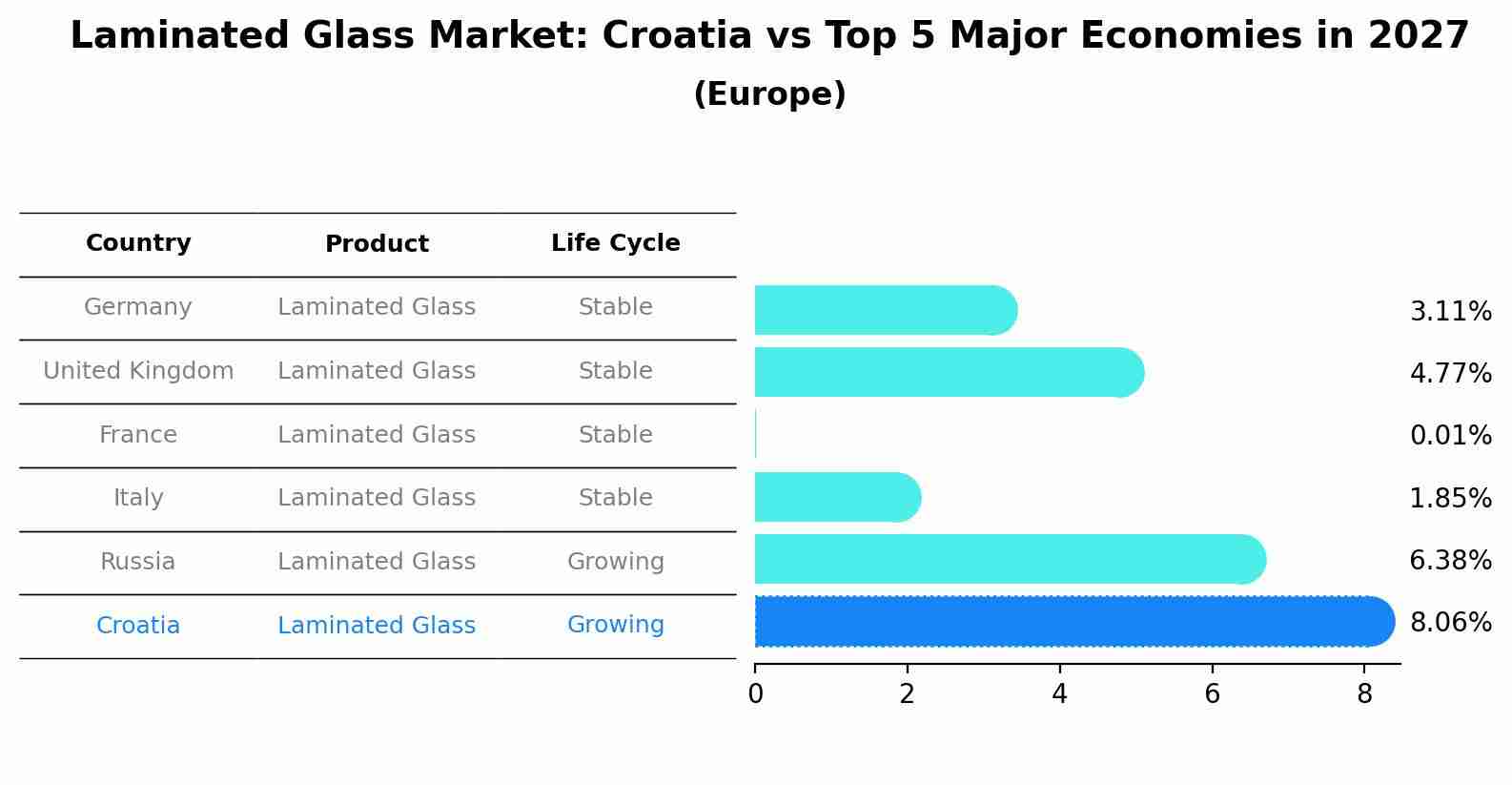
Laminated Glass Market: Croatia vs Top 5 Major Economies in 2027 (Europe)
The Laminated Glass market in Croatia is projected to grow at a growing growth rate of 8.06% by 2027, within the Europe region led by Germany, along with other countries like United Kingdom, France, Italy and Russia, collectively shaping a dynamic and evolving market environment driven by innovation and increasing adoption of emerging technologies.
Croatia Laminated Glass Market Overview
Croatia`s laminated glass market is growing, driven by its use in construction, automotive, and safety applications. Laminated glass, known for its strength and safety features, is widely used in buildings for windows, facades, and in vehicles for windshields. The increasing focus on safety standards and energy efficiency in buildings is boosting the market.
Drivers of the market
The laminated glass market in Croatia is witnessing growth due to its increased application in the construction and automotive industries. The demand for safety and security features in buildings and vehicles, as well as enhanced aesthetic appeal, drives the adoption of laminated glass.
Challenges of the market
Challenges in the Croatia Laminated Glass Market include the high costs of raw materials and the complexity of the manufacturing process. The demand for laminated glass in construction and automotive industries may fluctuate with economic cycles, affecting market stability. Additionally, ensuring the product meets strict safety standards and regulations for impact resistance and durability adds further production costs.
Government Policy of the market
In Croatia, building and automotive safety regulations heavily influence the laminated glass market. The government enforces stringent standards for the use of laminated glass in vehicles and construction, ensuring it meets EU safety and environmental criteria. Policies promoting energy-efficient building solutions also boost demand for laminated glass in construction projects.
Key Highlights of the Report:
- Croatia Laminated Glass Market Outlook
- Market Size of Croatia Laminated Glass Market, 2024
- Forecast of Croatia Laminated Glass Market, 2031
- Historical Data and Forecast of Croatia Laminated Glass Revenues & Volume for the Period 2021-2031
- Croatia Laminated Glass Market Trend Evolution
- Croatia Laminated Glass Market Drivers and Challenges
- Croatia Laminated Glass Price Trends
- Croatia Laminated Glass Porter`s Five Forces
- Croatia Laminated Glass Industry Life Cycle
- Historical Data and Forecast of Croatia Laminated Glass Market Revenues & Volume By Type for the Period 2021-2031
- Historical Data and Forecast of Croatia Laminated Glass Market Revenues & Volume By Polyvinyl Butyral (PVB) for the Period 2021-2031
- Historical Data and Forecast of Croatia Laminated Glass Market Revenues & Volume By Sentryglas Plus (SGP) for the Period 2021-2031
- Historical Data and Forecast of Croatia Laminated Glass Market Revenues & Volume By Ethylene-vinyl Acetate (EVA) for the Period 2021-2031
- Historical Data and Forecast of Croatia Laminated Glass Market Revenues & Volume By Other Types for the Period 2021-2031
- Historical Data and Forecast of Croatia Laminated Glass Market Revenues & Volume By End-user Industry for the Period 2021-2031
- Historical Data and Forecast of Croatia Laminated Glass Market Revenues & Volume By Automotive for the Period 2021-2031
- Historical Data and Forecast of Croatia Laminated Glass Market Revenues & Volume By Building and Construction for the Period 2021-2031
- Historical Data and Forecast of Croatia Laminated Glass Market Revenues & Volume By Electronics for the Period 2021-2031
- Historical Data and Forecast of Croatia Laminated Glass Market Revenues & Volume By Other End-user Industries for the Period 2021-2031
- Croatia Laminated Glass Import Export Trade Statistics
- Market Opportunity Assessment By Type
- Market Opportunity Assessment By End-user Industry
- Croatia Laminated Glass Top Companies Market Share
- Croatia Laminated Glass Competitive Benchmarking By Technical and Operational Parameters
- Croatia Laminated Glass Company Profiles
- Croatia Laminated Glass Key Strategic Recommendations






































