Croatia Mobility Scooter Market Top 5 Importing Countries and Market Competition (HHI) Analysis
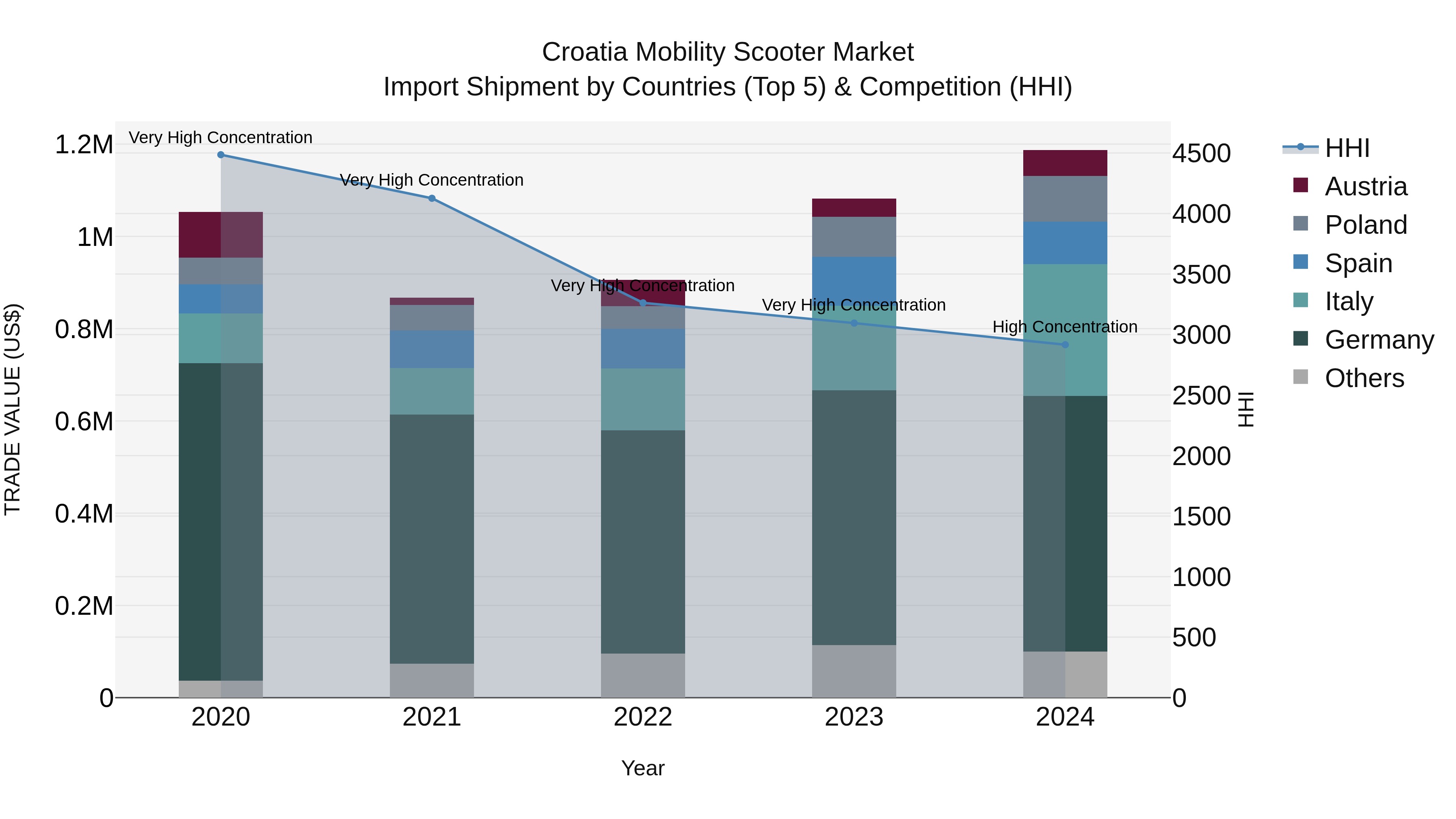
Croatia import shipments of mobility scooters in 2024 continued to be dominated by key exporters such as Germany, Italy, Poland, Spain, and Austria. The market concentration, although slightly decreased from 2023, remained high. The industry showed steady growth with a Compound Annual Growth Rate (CAGR) of 3.03% from 2020 to 2024. The impressive growth rate of 9.75% from 2023 to 2024 indicates a rising demand for mobility scooters in Croatia, presenting opportunities for both domestic retailers and international suppliers to capitalize on this trend.
Croatia Mobility Scooter Market Overview
The Croatia mobility scooter market is experiencing steady growth due to an aging population and increasing awareness about mobility aids. Key drivers include the rise in elderly individuals seeking greater independence and mobility, as well as the government initiatives to improve accessibility for people with disabilities. The market is competitive, with both domestic and international players offering a range of products, from basic models to advanced features such as foldable designs and long-lasting batteries. Retail channels include specialized mobility stores, online platforms, and healthcare equipment providers. In terms of consumer preferences, factors such as price, quality, brand reputation, and after-sales service play a significant role in purchasing decisions. Overall, the Croatia mobility scooter market is poised for further expansion, fueled by demographic trends and technological advancements in the industry.
Croatia Mobility Scooter Market Trends
The Croatia Mobility Scooter Market is experiencing growth driven by an aging population and increasing awareness about mobility aids for individuals with limited mobility. There is a trend towards the development of more advanced and technologically sophisticated mobility scooters that offer enhanced features such as longer battery life, improved maneuverability, and increased comfort. Additionally, there is a rising demand for foldable and portable mobility scooters to cater to the needs of users who require convenient transportation options. The market is also witnessing a shift towards eco-friendly and sustainable mobility solutions, with an emphasis on electric-powered scooters. Overall, the Croatia Mobility Scooter Market is poised for further expansion as the population ages and the demand for mobility assistance solutions continues to grow.
Croatia Mobility Scooter Market Challenges
In the Croatia Mobility Scooter Market, challenges include limited infrastructure support for mobility devices, lack of awareness among the population about the benefits and availability of mobility scooters, and affordability issues for potential buyers. Additionally, regulations and policies regarding the use of mobility scooters in public spaces may not be well-defined or enforced, leading to safety concerns for users. The market may also face competition from alternative mobility solutions and a relatively small target customer base due to the aging population in Croatia. Overcoming these challenges will require increased advocacy for accessibility rights, education campaigns to raise awareness, partnerships with government agencies to improve infrastructure, and innovative pricing strategies to make mobility scooters more accessible to a wider range of consumers.
Croatia Mobility Scooter Market Investment Opportunities
The Croatia Mobility Scooter Market presents promising investment opportunities due to an aging population and increasing demand for mobility solutions. With a growing elderly population, there is a rising need for assistive devices such as mobility scooters to enhance independence and quality of life. Investors can capitalize on this trend by entering the market with innovative and user-friendly mobility scooter offerings tailored to the specific needs of Croatian seniors. Additionally, leveraging digital technologies and online sales channels can help reach a wider customer base and drive sales growth. Moreover, partnerships with healthcare providers and insurance companies can further boost market penetration and create a competitive advantage in this evolving market segment. Overall, investing in the Croatia Mobility Scooter Market holds potential for long-term success and profitability.
Croatia Mobility Scooter Market Government Policy
In Croatia, mobility scooters are regulated under the Law on Road Traffic Safety, which classifies them as vehicles and requires users to follow road traffic regulations. Users must be at least 16 years old and possess a valid driver`s license or a certificate of medical fitness to operate a mobility scooter. Additionally, mobility scooters are not allowed on motorways or roads where the speed limit exceeds 50 km/h. The law also mandates that mobility scooters have proper lighting and reflective elements for nighttime use. Importantly, users are required to have liability insurance coverage when operating a mobility scooter in public spaces to ensure protection for all road users. Compliance with these regulations is essential to ensure safety and proper usage of mobility scooters in Croatia.
Croatia Mobility Scooter Market Future Outlook
The Croatia Mobility Scooter Market is expected to witness steady growth in the coming years due to various factors such as an aging population, increasing awareness about mobility aids, and improved accessibility in public spaces. The market is likely to be driven by technological advancements leading to more advanced and user-friendly mobility scooters, as well as the growing trend towards active and independent living among seniors and individuals with mobility issues. Additionally, the rising healthcare costs and the preference for non-invasive mobility solutions are expected to further boost the demand for mobility scooters in Croatia. Overall, the market is anticipated to expand as the population demographics continue to shift towards an older age group, creating a greater need for mobility assistance devices.
Key Highlights of the Report:
- Croatia Mobility Scooter Market Outlook
- Market Size of Croatia Mobility Scooter Market, 2024
- Forecast of Croatia Mobility Scooter Market, 2031
- Historical Data and Forecast of Croatia Mobility Scooter Revenues & Volume for the Period 2021- 2031
- Croatia Mobility Scooter Market Trend Evolution
- Croatia Mobility Scooter Market Drivers and Challenges
- Croatia Mobility Scooter Price Trends
- Croatia Mobility Scooter Porter's Five Forces
- Croatia Mobility Scooter Industry Life Cycle
- Historical Data and Forecast of Croatia Mobility Scooter Market Revenues & Volume By Type for the Period 2021- 2031
- Historical Data and Forecast of Croatia Mobility Scooter Market Revenues & Volume By Small (Less than 110cm) for the Period 2021- 2031
- Historical Data and Forecast of Croatia Mobility Scooter Market Revenues & Volume By Medium (110-150cm) for the Period 2021- 2031
- Historical Data and Forecast of Croatia Mobility Scooter Market Revenues & Volume By Large (More than 150cm) for the Period 2021- 2031
- Historical Data and Forecast of Croatia Mobility Scooter Market Revenues & Volume By Application for the Period 2021- 2031
- Historical Data and Forecast of Croatia Mobility Scooter Market Revenues & Volume By In-House for the Period 2021- 2031
- Historical Data and Forecast of Croatia Mobility Scooter Market Revenues & Volume By Outdoor for the Period 2021- 2031
- Historical Data and Forecast of Croatia Mobility Scooter Market Revenues & Volume By Off-Road for the Period 2021- 2031
- Historical Data and Forecast of Croatia Mobility Scooter Market Revenues & Volume By Number of Wheels for the Period 2021- 2031
- Historical Data and Forecast of Croatia Mobility Scooter Market Revenues & Volume By Three Wheels for the Period 2021- 2031
- Historical Data and Forecast of Croatia Mobility Scooter Market Revenues & Volume By Four Wheels for the Period 2021- 2031
- Historical Data and Forecast of Croatia Mobility Scooter Market Revenues & Volume By Others for the Period 2021- 2031
- Historical Data and Forecast of Croatia Mobility Scooter Market Revenues & Volume By Battery Range for the Period 2021- 2031
- Historical Data and Forecast of Croatia Mobility Scooter Market Revenues & Volume By Less than 10 Miles for the Period 2021- 2031
- Historical Data and Forecast of Croatia Mobility Scooter Market Revenues & Volume By 10-20 Miles for the Period 2021- 2031
- Historical Data and Forecast of Croatia Mobility Scooter Market Revenues & Volume By More than 20 Miles for the Period 2021- 2031
- Historical Data and Forecast of Croatia Mobility Scooter Market Revenues & Volume By End use for the Period 2021- 2031
- Historical Data and Forecast of Croatia Mobility Scooter Market Revenues & Volume By Personal Use for the Period 2021- 2031
- Historical Data and Forecast of Croatia Mobility Scooter Market Revenues & Volume By Institutional Use for the Period 2021- 2031
- Croatia Mobility Scooter Import Export Trade Statistics
- Market Opportunity Assessment By Type
- Market Opportunity Assessment By Application
- Market Opportunity Assessment By Number of Wheels
- Market Opportunity Assessment By Battery Range
- Market Opportunity Assessment By End use
- Croatia Mobility Scooter Top Companies Market Share
- Croatia Mobility Scooter Competitive Benchmarking By Technical and Operational Parameters
- Croatia Mobility Scooter Company Profiles
- Croatia Mobility Scooter Key Strategic Recommendations






































