Czech Republic Food & Grocery Retail Market Size, Share & Growth Rate
The Czech Republic Food & Grocery Retail Market was estimated at USD 1032 Million in 2025 and is projected to reach USD 1940 Million by 2032, growing at a CAGR of 9.4% from 2026 to 2032. This growth trajectory is being driven by increasing disposable incomes, a shift in consumer preferences towards healthier and organic products, and the expanding reach of e-commerce platforms. These factors are transforming the market landscape, as both traditional and modern retailers adapt to the dynamic demands of Czech consumers.
Czech Republic Food & Grocery Retail Market Year-wise Growth Rate and Key Drivers
This graph highlights how the Czech Republic Food & Grocery Retail Market has steadily grown over the years, supported by major growth factors.
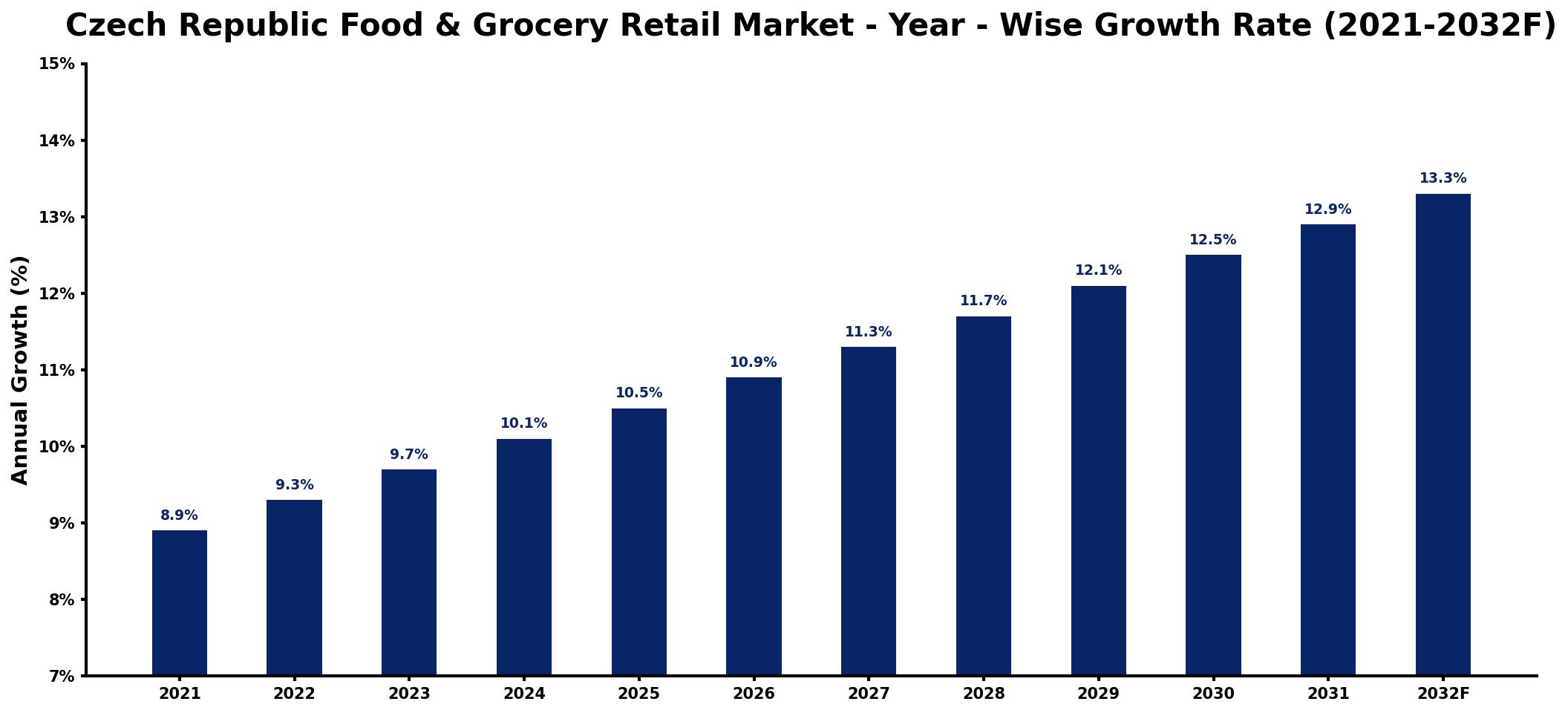
The table below presents the year‑wise growth rates along with the key drivers influencing the market
| Year | Growth Rate | Major Drivers |
| 2021 | 8.9% | Rising consumer health consciousness |
| 2022 | 9.3% | Shift towards online shopping |
| 2023 | 9.7% | Increased demand for convenience |
| 2024 | 10.1% | Expansion of local producers |
| 2025 | 10.5% | Growing popularity of organic options |
| 2026 | 10.9% | Investment in supply chain technology |
| 2027 | 11.3% | Emerging trends in plant-based diets |
| 2028 | 11.7% | Enhanced focus on sustainability practices |
| 2029 | 12.1% | Development of private label products |
| 2030 | 12.5% | Increased international market access |
| 2031 | 12.9% | increased capital investment inflows |
| 2032 | 13.3% | Strengthening of community-supported agriculture |
Note: Market size estimations and growth projections presented in this report are based on 6Wresearch's proprietary forecasting methodology, utilizing the latest available industry data, government publications, and primary research inputs.
Czech Republic Food & Grocery Retail Market Synopsis
In recent years, the Czech Republic Food & Grocery Retail Market has seen robust momentum, characterized by a vibrant mix of traditional and modern retail formats. As consumer preferences evolve, the market is now pivoting towards online shopping and healthier product offerings, setting the stage for significant future growth.
With the increasing importance of sustainability and health consciousness, retailers are compelled to innovate and diversify their product assortments. The current trend signifies a market ripe for opportunities, allowing both local and international players to capitalize on the shifting landscape.
- The market is experiencing a notable shift towards online grocery shopping, especially among younger demographics.
- There is a rising consumer demand for organic, healthy, and locally sourced products, influencing retailer offerings.
- Investment opportunities are expanding due to increasing disposable incomes and a robust e-commerce framework.
- Competition is intensifying, necessitating retailers to enhance customer experience through technology and service innovation.
- Government regulations on food safety and labeling significantly shape market practices and consumer trust.
Despite its promising growth trajectory, the Czech Republic Food & Grocery Retail Market faces notable restraints. Intense competition among traditional and online retailers is pressuring pricing strategies, often leading to narrower profit margins. Retailers must also stay ahead of rapidly changing consumer preferences, particularly as health and sustainability become paramount. Furthermore, navigating regulatory landscapes concerning food safety and labeling can be complex, necessitating significant investments in compliance and operational adjustments.
Several key trends are shaping the Czech Republic Food & Grocery Retail Market. A pronounced inclination towards healthier and organic products is becoming evident as consumers increasingly prioritize nutrition and sustainability. The rise of e-commerce is another significant trend, with online grocery platforms gaining traction due to their convenience and efficiency. Furthermore, there is a growing interest in locally sourced and artisanal products, reflecting a consumer desire for authenticity and support for local businesses. Retailers are responding by enhancing customer experiences through digital innovations like mobile apps and loyalty programs.
The Czech food and grocery retail market presents numerous investment opportunities driven by its robust economic indicators. The growing e-commerce segment is ripe for online grocery retailers to innovate and cater to the increasing demand for home delivery services. Additionally, the burgeoning interest in organic and health-conscious products creates avenues for specialized retailers to thrive. With the market's relative fragmentation, new entrants can find their niche while established players can explore expansion strategies to meet evolving consumer demands.
Government policies in the Czech Republic play a crucial role in shaping the food and grocery retail landscape. Regulations focusing on food safety and labeling standards ensure that consumers receive quality products. Competitive practices are also regulated to foster a fair marketplace, discouraging monopolistic behaviors. Additionally, taxation policies, including VAT rates, influence pricing strategies within the sector, reflecting the governments ongoing commitment to market transparency and consumer protection.
Looking forward to 2026-2032, the Czech Republic Food & Grocery Retail Market is set to experience continued growth, fueled by an unwavering demand for convenience, quality, and health-oriented products. With increasing disposable incomes and a shift towards e-commerce, the landscape will likely evolve further, presenting both challenges and opportunities for market participants. Key players will need to focus on enhancing product offerings and investing in digital transformation to maintain their competitive edge in this rapidly changing environment.
In the most recent months, the Czech food and grocery retail market has been witnessing significant shifts, with various retailers embracing digital transformation strategies. Enhancements in logistics and supply chain management have been prioritized to accommodate the rise in online shopping. Additionally, the focus on sustainability has led to increased partnerships with local producers, offering consumers greater access to organic and locally sourced products. Overall, the market is adapting dynamically to the evolving consumer landscape.
- 10 Years of Market Numbers
- Historical Data Starting from 2022 to 2025
- Base Year: 2025
- Forecast Data until 2032
- Key Performance Indicators Impacting the Market
- Major Upcoming Developments and Projects
Key Highlights of the Report:
- Czech Republic Food & Grocery Retail Market Outlook
- Market Size of Czech Republic Food & Grocery Retail Market, 2025
- Forecast of Czech Republic Food & Grocery Retail Market, 2032
- Historical Data and Forecast of Czech Republic Food & Grocery Retail Revenues & Volume for the Period 2022-2032F
- Czech Republic Food & Grocery Retail Market Trend Evolution
- Czech Republic Food & Grocery Retail Market Drivers and Challenges
- Czech Republic Food & Grocery Retail Price Trends
- Czech Republic Food & Grocery Retail Porter's Five Forces
- Czech Republic Food & Grocery Retail Industry Life Cycle
- Historical Data and Forecast of Czech Republic Food & Grocery Retail Market Revenues & Volume By Product for the Period 2022-2032F
- Historical Data and Forecast of Czech Republic Food & Grocery Retail Market Revenues & Volume By Fresh Food for the Period 2022-2032F
- Historical Data and Forecast of Czech Republic Food & Grocery Retail Market Revenues & Volume By Frozen Food for the Period 2022-2032F
- Historical Data and Forecast of Czech Republic Food & Grocery Retail Market Revenues & Volume By Food Cupboard for the Period 2022-2032F
- Historical Data and Forecast of Czech Republic Food & Grocery Retail Market Revenues & Volume By Beverages for the Period 2022-2032F
- Historical Data and Forecast of Czech Republic Food & Grocery Retail Market Revenues & Volume By Cleaning & Household for the Period 2022-2032F
- Historical Data and Forecast of Czech Republic Food & Grocery Retail Market Revenues & Volume By Others for the Period 2022-2032F
- Historical Data and Forecast of Czech Republic Food & Grocery Retail Market Revenues & Volume By Distribution Channel for the Period 2022-2032F
- Historical Data and Forecast of Czech Republic Food & Grocery Retail Market Revenues & Volume By Supermarkets & Hypermarkets for the Period 2022-2032F
- Historical Data and Forecast of Czech Republic Food & Grocery Retail Market Revenues & Volume By Convenience Stores for the Period 2022-2032F
- Historical Data and Forecast of Czech Republic Food & Grocery Retail Market Revenues & Volume By Departmental Stores & Clubs for the Period 2022-2032F
- Historical Data and Forecast of Czech Republic Food & Grocery Retail Market Revenues & Volume By Online for the Period 2022-2032F
- Czech Republic Food & Grocery Retail Import Export Trade Statistics
- Market Opportunity Assessment By Product
- Market Opportunity Assessment By Distribution Channel
- Czech Republic Food & Grocery Retail Top Companies Market Share
- Czech Republic Food & Grocery Retail Competitive Benchmarking By Technical and Operational Parameters
- Czech Republic Food & Grocery Retail Company Profiles
- Czech Republic Food & Grocery Retail Key Strategic Recommendations






































