Czech Republic Secondhand Apparel Market Size, Share & Growth Rate
The Czech Republic Secondhand Apparel Market was estimated at USD 321 Million in 2025 and is projected to reach USD 469 Million by 2032, growing at a CAGR of 5.6% from 2026 to 2032. This growth trajectory is largely fueled by heightened environmental awareness and an evolving consumer mindset that increasingly values sustainability. As more shoppers gravitate towards unique and affordable fashion, the market is becoming a vibrant space for innovation and creativity.
Czech Republic Secondhand Apparel Market Year-wise Growth Rate and Key Drivers
This graph highlights how the Czech Republic Secondhand Apparel Market has steadily grown over the years, supported by major growth factors.
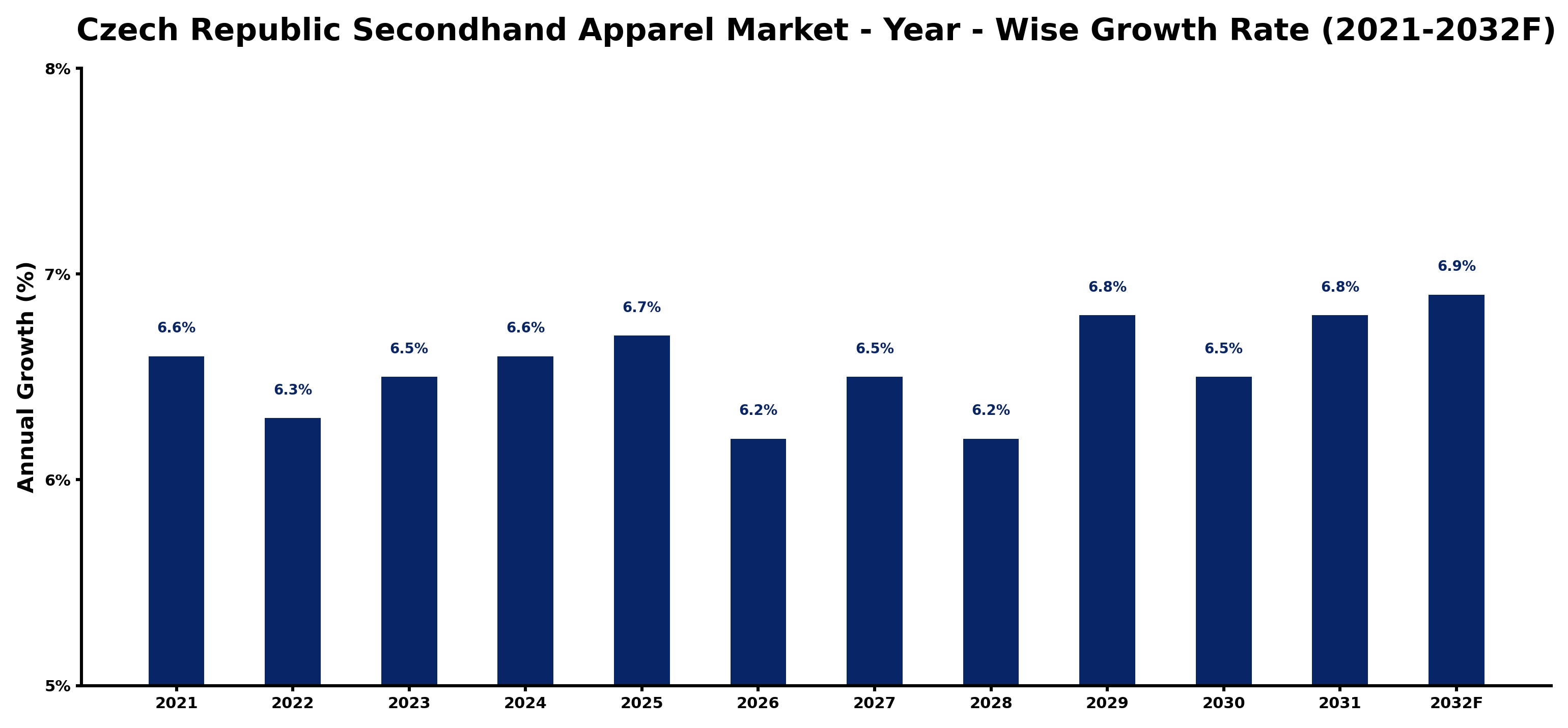
The table below presents the year‑wise growth rates along with the key drivers influencing the market
| Year | Growth Rate | Major Drivers |
| 2021 | 6.6% | Expansion of commercial construction activities |
| 2022 | 6.3% | Expansion of commercial construction activities |
| 2023 | 6.5% | Rapid growth in telecom and data center sectors |
| 2024 | 6.6% | Increasing adoption of advanced technologies |
| 2025 | 6.7% | Increasing adoption of advanced technologies |
| 2026 | 6.2% | Expansion of commercial construction activities |
| 2027 | 6.5% | Increasing industrial automation investments |
| 2028 | 6.2% | Government infrastructure modernization initiatives |
| 2029 | 6.8% | Rising electricity demand across industries |
| 2030 | 6.5% | Rapid growth in telecom and data center sectors |
| 2031 | 6.8% | Growing renewable energy integration projects |
| 2032 | 6.9% | Growing urbanization and commercial development |
Note - Market size estimations and growth projections presented in this report are based on 6Wresearch’s advanced forecasting approach, validated with industry datasets as of June 2026.
Czech Republic Secondhand Apparel Market Synopsis
The Czech Republic is witnessing a remarkable shift in consumer behavior, with an increasing number of individuals opting for secondhand apparel as a viable alternative to new fashion. The growing popularity of vintage styles among younger generations contributes significantly to this trend, reflecting a cultural embrace of unique fashion statements.
In addition to shifting consumer preferences, the market landscape is diversifying, with online platforms, physical thrift stores, and flea markets catering to various demographics. This accessibility encourages shoppers to explore more sustainable options, allowing the secondhand apparel market to flourish.
Czech Republic Secondhand Apparel Market Key Takeaways
- Increasing environmental consciousness is reshaping consumer purchasing behaviors in the Czech Republic.
- There is a notable rise in demand for vintage and retro clothing, particularly among younger demographics.
- The market is diversifying with a blend of online and offline platforms catering to distinct consumer preferences.
- Key players are enhancing their offerings and customer experiences to meet the evolving demands of the market.
- Investment opportunities abound for businesses committed to promoting sustainable and affordable fashion.
Evaluation of Restraints in Czech Republic Secondhand Apparel Market
Despite the promising growth trajectory, the Czech Republic's secondhand apparel market faces several restraints that could hinder its development. A significant barrier is the lingering consumer skepticism about the quality and authenticity of pre-owned clothing. This skepticism can deter potential buyers who may feel uncertain about purchasing items with an unknown history. Additionally, the competition from fast fashion brands, which offer low-cost new items, presents another challenge, making it necessary for secondhand retailers to clearly communicate the benefits of their products.
Moreover, there exists a need for improved infrastructure related to the collection and distribution of secondhand items. Limited logistics capabilities may restrict the growth potential of online platforms, highlighting the necessity for targeted investment in this area. Educating consumers about the value of secondhand shopping and building trust in these marketplaces will be critical for overcoming these hurdles.
Czech Republic Secondhand Apparel Market Trends
A few key trends are shaping the Czech Republic Secondhand Apparel Market. Firstly, there is a significant movement towards conscious consumerism, where shoppers are increasingly aware of the environmental impact of their purchases. Secondly, the rise of social media influencers advocating for sustainable fashion choices is propelling interest in vintage and secondhand clothing. Furthermore, technology is playing a crucial role, with the proliferation of online resale platforms making it easier for consumers to buy and sell pre-loved items. Enhanced shopping experiences, such as curated collections and mobile applications, are also emerging as important differentiators in this competitive market.
Czech Republic Secondhand Apparel Market Opportunities
The Czech Republic Secondhand Apparel Market presents multiple avenues for growth and investment. One of the most promising opportunities lies in developing comprehensive online platforms that cater to the growing digital-savvy population. Partnering with local thrift stores to create a robust supply chain can also foster innovation and facilitate a better customer experience. Moreover, brands focusing on unique collections, sustainability, and ethical sourcing are well-positioned to capture a loyal customer base that values quality and authenticity. Collaborating with influencers or community initiatives aimed at promoting secondhand shopping could further enhance brand visibility and encourage consumer participation.
Government Initiatives in the Czech Republic Secondhand Apparel Market
The Czech government has taken meaningful steps to support the secondhand apparel market as part of a broader initiative to promote sustainability. Policies aimed at reducing textile waste include campaigns encouraging clothing donations and partnerships with local thrift stores to raise awareness about the benefits of secondhand shopping. In addition, regulations ensuring the quality and safety of secondhand clothing sold in the market are in place. The government also offers tax incentives to businesses involved in this sector, encouraging innovation and growth while fostering a more sustainable fashion industry.
Future Insights of the Czech Republic Secondhand Apparel Market
Looking ahead, the Czech Republic Secondhand Apparel Market is expected to experience sustained growth from 2026 to 2032. As consumer awareness of sustainable practices continues to rise, the appeal of vintage and pre-owned clothing will likely expand. Moreover, technological advancements will further streamline buying and selling processes, facilitating market penetration for new entrants. The increasing embrace of circular economy models positions the secondhand market not just as a trend, but as a significant player in the larger fashion landscape.
Czech Republic Secondhand Apparel Market Latest Developments (May 2025 - June 2026)
Recent developments in the Czech Republic's secondhand apparel market indicate a shift towards enhanced digital engagement. Online resale platforms are expanding their functionalities, enabling smoother transactions and personalized shopping experiences for consumers. Additionally, local thrift stores are beginning to collaborate with community organizations to enhance outreach and educational programs on the benefits of secondhand clothing. These initiatives, coupled with increased visibility through social media campaigns, are paving the way for broader acceptance of secondhand fashion among diverse consumer demographics.
Czech Republic Secondhand Apparel Market - Key Attractiveness of the Report
- 10 Years of Market Numbers
- Historical Data Starting from 2022 to 2025
- Base Year: 2025
- Forecast Data until 2032
- Key Performance Indicators Impacting the Market
- Major Upcoming Developments and Projects
Key Highlights of the Report:
- Czech Republic Secondhand Apparel Market Outlook
- Market Size of Czech Republic Secondhand Apparel Market, 2025
- Forecast of Czech Republic Secondhand Apparel Market, 2032
- Historical Data and Forecast of Czech Republic Secondhand Apparel Revenues & Volume for the Period 2022-2032F
- Czech Republic Secondhand Apparel Market Trend Evolution
- Czech Republic Secondhand Apparel Market Drivers and Challenges
- Czech Republic Secondhand Apparel Price Trends
- Czech Republic Secondhand Apparel Porter's Five Forces
- Czech Republic Secondhand Apparel Industry Life Cycle
- Historical Data and Forecast of Czech Republic Secondhand Apparel Market Revenues & Volume By Sector for the Period 2022-2032F
- Historical Data and Forecast of Czech Republic Secondhand Apparel Market Revenues & Volume By Resale for the Period 2022-2032F
- Historical Data and Forecast of Czech Republic Secondhand Apparel Market Revenues & Volume By Traditional Thrift Stores and Donations for the Period 2022-2032F
- Historical Data and Forecast of Czech Republic Secondhand Apparel Market Revenues & Volume By Product Type for the Period 2022-2032F
- Historical Data and Forecast of Czech Republic Secondhand Apparel Market Revenues & Volume By Dresses & Tops for the Period 2022-2032F
- Historical Data and Forecast of Czech Republic Secondhand Apparel Market Revenues & Volume By Shirts & T-shirts for the Period 2022-2032F
- Historical Data and Forecast of Czech Republic Secondhand Apparel Market Revenues & Volume By Sweaters, Coats & Jackets for the Period 2022-2032F
- Historical Data and Forecast of Czech Republic Secondhand Apparel Market Revenues & Volume By Jeans & Pants for the Period 2022-2032F
- Historical Data and Forecast of Czech Republic Secondhand Apparel Market Revenues & Volume By Others for the Period 2022-2032F
- Historical Data and Forecast of Czech Republic Secondhand Apparel Market Revenues & Volume By Target Population for the Period 2022-2032F
- Historical Data and Forecast of Czech Republic Secondhand Apparel Market Revenues & Volume By Men for the Period 2022-2032F
- Historical Data and Forecast of Czech Republic Secondhand Apparel Market Revenues & Volume By Women for the Period 2022-2032F
- Historical Data and Forecast of Czech Republic Secondhand Apparel Market Revenues & Volume By Kids for the Period 2022-2032F
- Historical Data and Forecast of Czech Republic Secondhand Apparel Market Revenues & Volume By Sales Channel for the Period 2022-2032F
- Historical Data and Forecast of Czech Republic Secondhand Apparel Market Revenues & Volume By Wholesalers/Distributors for the Period 2022-2032F
- Historical Data and Forecast of Czech Republic Secondhand Apparel Market Revenues & Volume By Hypermarkets/Supermarkets for the Period 2022-2032F
- Historical Data and Forecast of Czech Republic Secondhand Apparel Market Revenues & Volume By Multi-brand Stores for the Period 2022-2032F
- Historical Data and Forecast of Czech Republic Secondhand Apparel Market Revenues & Volume By Independent Small Stores for the Period 2022-2032F
- Historical Data and Forecast of Czech Republic Secondhand Apparel Market Revenues & Volume By Departmental Stores for the Period 2022-2032F
- Historical Data and Forecast of Czech Republic Secondhand Apparel Market Revenues & Volume By Online Retailers for the Period 2022-2032F
- Historical Data and Forecast of Czech Republic Secondhand Apparel Market Revenues & Volume By Others for the Period 2022-2032F
- Czech Republic Secondhand Apparel Import Export Trade Statistics
- Market Opportunity Assessment By Sector
- Market Opportunity Assessment By Product Type
- Market Opportunity Assessment By Target Population
- Market Opportunity Assessment By Sales Channel
- Czech Republic Secondhand Apparel Top Companies Market Share
- Czech Republic Secondhand Apparel Competitive Benchmarking By Technical and Operational Parameters
- Czech Republic Secondhand Apparel Company Profiles
- Czech Republic Secondhand Apparel Key Strategic Recommendations






































