Czech Republic Smart Weapons Market: Import Trend Analysis
The Czech Republic smart weapons market experienced a substantial increase in imports from 2020 to 2024. The compound annual growth rate (CAGR) for this period was 120.38%. Notably, the year-on-year growth rate for 20232024 stood at 621.58%, indicating a significant surge in imports during that specific year.
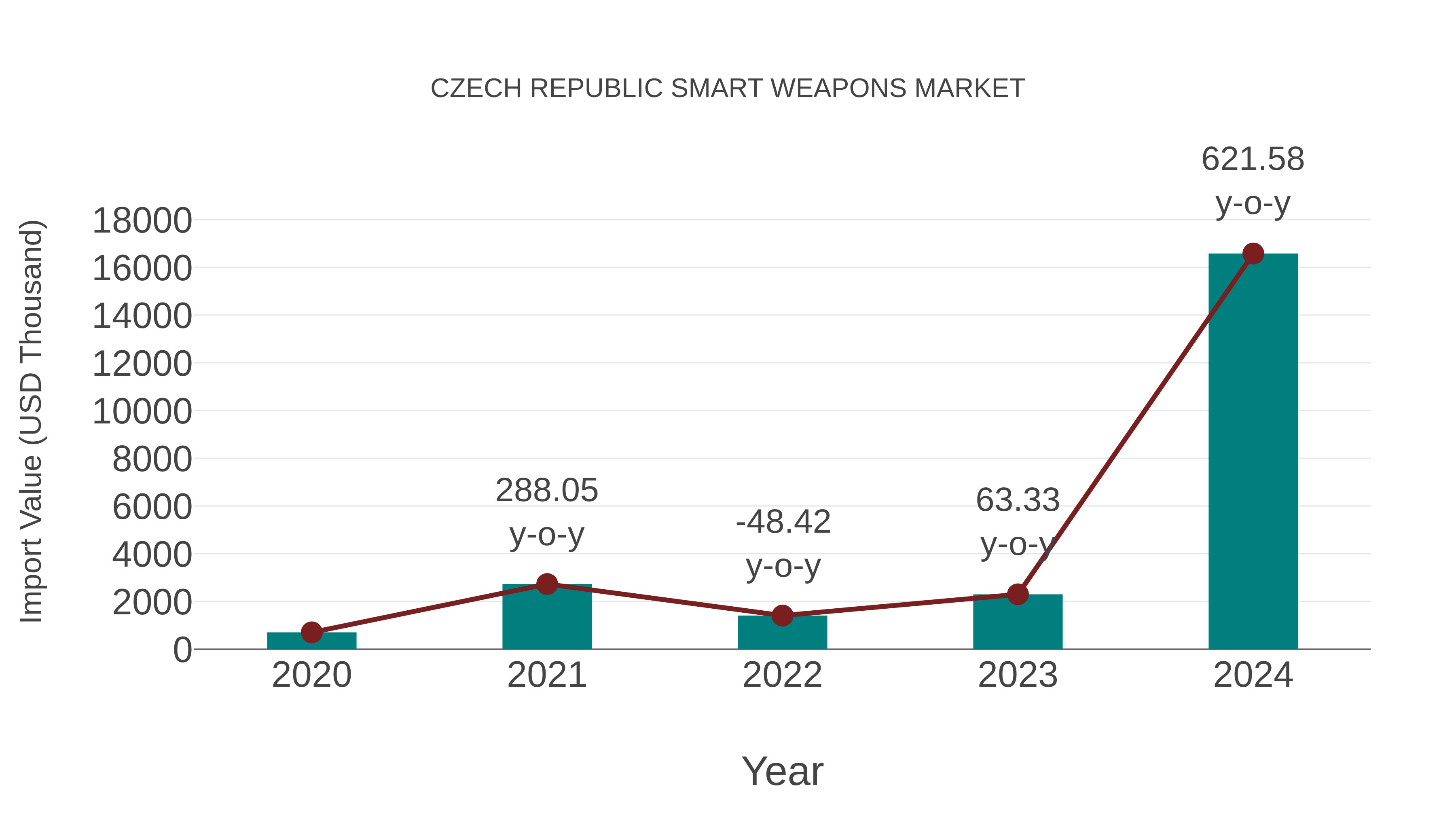
Czech Republic Smart Weapons Market Synopsis
The Czech Republic Smart Weapons Market is witnessing steady growth driven by the country`s focus on modernizing its defense capabilities. Smart weapons, such as precision-guided munitions and advanced missile systems, are increasingly being integrated into the Czech armed forces to enhance operational effectiveness and combat capabilities. The growing threats from regional instability and emerging technologies have propelled the demand for smart weapons in the Czech Republic. Key market players are actively investing in research and development to introduce innovative smart weapon systems tailored to the specific requirements of the Czech defense sector. The market is characterized by collaborations between domestic and international defense companies to leverage technological expertise and strengthen the country`s defense capabilities. Overall, the Czech Republic Smart Weapons Market is expected to continue its growth trajectory in the coming years.
Czech Republic Smart Weapons Market Trends
The Czech Republic Smart Weapons Market is experiencing a growing demand for advanced technologies such as guided missiles, precision-guided munitions, and smart bombs. With increasing investments in modernizing defense capabilities, there is a rising focus on enhancing accuracy, range, and effectiveness of weapons systems. The integration of smart technologies, including sensor fusion, artificial intelligence, and data analytics, is driving innovation in the development of smart weapons. Additionally, the Czech Republic is actively collaborating with international defense contractors and participating in joint research and development projects to leverage expertise and access cutting-edge technologies. Moreover, there is a shift towards the adoption of unmanned systems and autonomous weapons platforms, further shaping the future of the smart weapons market in the Czech Republic.
Czech Republic Smart Weapons Market Challenges
In the Czech Republic Smart Weapons Market, one of the major challenges faced is the strict regulations and export controls imposed on the trade of advanced weapon systems. This can hinder the smooth flow of smart weapon technologies and products into the market, leading to delays in procurement processes and potential limitations in accessing cutting-edge defense capabilities. Additionally, the relatively small size of the Czech defense industry compared to major global players can result in limited resources and capabilities for local companies to develop and manufacture smart weapons independently. This may necessitate collaborations with international partners, which could raise concerns about technology transfer and intellectual property protection. Overall, navigating these regulatory, technological, and resource-related challenges is essential for the growth and competitiveness of the smart weapons market in the Czech Republic.
Czech Republic Smart Weapons Market Investment Opportunities
The Czech Republic Smart Weapons Market presents promising investment opportunities due to increasing defense expenditures and modernization efforts by the country`s armed forces. With a focus on enhancing military capabilities and improving efficiency, there is a growing demand for advanced smart weapons systems such as precision-guided munitions, unmanned aerial vehicles, and missile defense systems. Key players in the global defense industry are actively seeking partnerships and collaborations with Czech defense companies to capitalize on this market potential. Additionally, the Czech government`s commitment to strengthening its defense capabilities through strategic procurement programs creates a favorable environment for investors looking to enter the smart weapons sector in the country. Overall, the Czech Republic Smart Weapons Market offers a competitive landscape and significant growth prospects for investors interested in this niche segment of the defense industry.
Czech Republic Smart Weapons Market Future Outlook
The Czech Republic Smart Weapons Market is expected to witness steady growth in the coming years due to increasing investments in defense modernization programs and the growing focus on enhancing military capabilities. The adoption of advanced technologies such as precision-guided munitions, unmanned aerial vehicles, and integrated command and control systems will drive the demand for smart weapons in the country. Additionally, the rising security concerns and geopolitical tensions in the region will further fuel the market growth. Key players in the industry are likely to focus on developing innovative smart weapon systems to meet the evolving defense requirements of the Czech Republic Armed Forces. Overall, the market outlook for smart weapons in the Czech Republic appears promising, with opportunities for growth and expansion in the foreseeable future.
Key Highlights of the Report:
- Czech Republic Smart Weapons Market Outlook
- Market Size of Czech Republic Smart Weapons Market, 2025
- Forecast of Czech Republic Smart Weapons Market, 2032
- Historical Data and Forecast of Czech Republic Smart Weapons Revenues & Volume for the Period 2022 - 2032F
- Czech Republic Smart Weapons Market Trend Evolution
- Czech Republic Smart Weapons Market Drivers and Challenges
- Czech Republic Smart Weapons Price Trends
- Czech Republic Smart Weapons Porter's Five Forces
- Czech Republic Smart Weapons Industry Life Cycle
- Historical Data and Forecast of Czech Republic Smart Weapons Market Revenues & Volume By Product for the Period 2022 - 2032F
- Historical Data and Forecast of Czech Republic Smart Weapons Market Revenues & Volume By Missiles for the Period 2022 - 2032F
- Historical Data and Forecast of Czech Republic Smart Weapons Market Revenues & Volume By Munitions for the Period 2022 - 2032F
- Historical Data and Forecast of Czech Republic Smart Weapons Market Revenues & Volume By Guided Projectiles for the Period 2022 - 2032F
- Historical Data and Forecast of Czech Republic Smart Weapons Market Revenues & Volume By Guided Rockets for the Period 2022 - 2032F
- Historical Data and Forecast of Czech Republic Smart Weapons Market Revenues & Volume By Guided Firearms for the Period 2022 - 2032F
- Historical Data and Forecast of Czech Republic Smart Weapons Market Revenues & Volume By Directed Energy Weapons for the Period 2022 - 2032F
- Historical Data and Forecast of Czech Republic Smart Weapons Market Revenues & Volume By Technology for the Period 2022 - 2032F
- Historical Data and Forecast of Czech Republic Smart Weapons Market Revenues & Volume By Laser for the Period 2022 - 2032F
- Historical Data and Forecast of Czech Republic Smart Weapons Market Revenues & Volume By Infrared for the Period 2022 - 2032F
- Historical Data and Forecast of Czech Republic Smart Weapons Market Revenues & Volume By Radar for the Period 2022 - 2032F
- Historical Data and Forecast of Czech Republic Smart Weapons Market Revenues & Volume By GPS for the Period 2022 - 2032F
- Historical Data and Forecast of Czech Republic Smart Weapons Market Revenues & Volume By Others for the Period 2022 - 2032F
- Historical Data and Forecast of Czech Republic Smart Weapons Market Revenues & Volume By Platform for the Period 2022 - 2032F
- Historical Data and Forecast of Czech Republic Smart Weapons Market Revenues & Volume By Air for the Period 2022 - 2032F
- Historical Data and Forecast of Czech Republic Smart Weapons Market Revenues & Volume By Land for the Period 2022 - 2032F
- Historical Data and Forecast of Czech Republic Smart Weapons Market Revenues & Volume By Naval for the Period 2022 - 2032F
- Czech Republic Smart Weapons Import Export Trade Statistics
- Market Opportunity Assessment By Product
- Market Opportunity Assessment By Technology
- Market Opportunity Assessment By Platform
- Czech Republic Smart Weapons Top Companies Market Share
- Czech Republic Smart Weapons Competitive Benchmarking By Technical and Operational Parameters
- Czech Republic Smart Weapons Company Profiles
- Czech Republic Smart Weapons Key Strategic Recommendations






































