Denmark Adipic Acid Market Size (2020-2030)
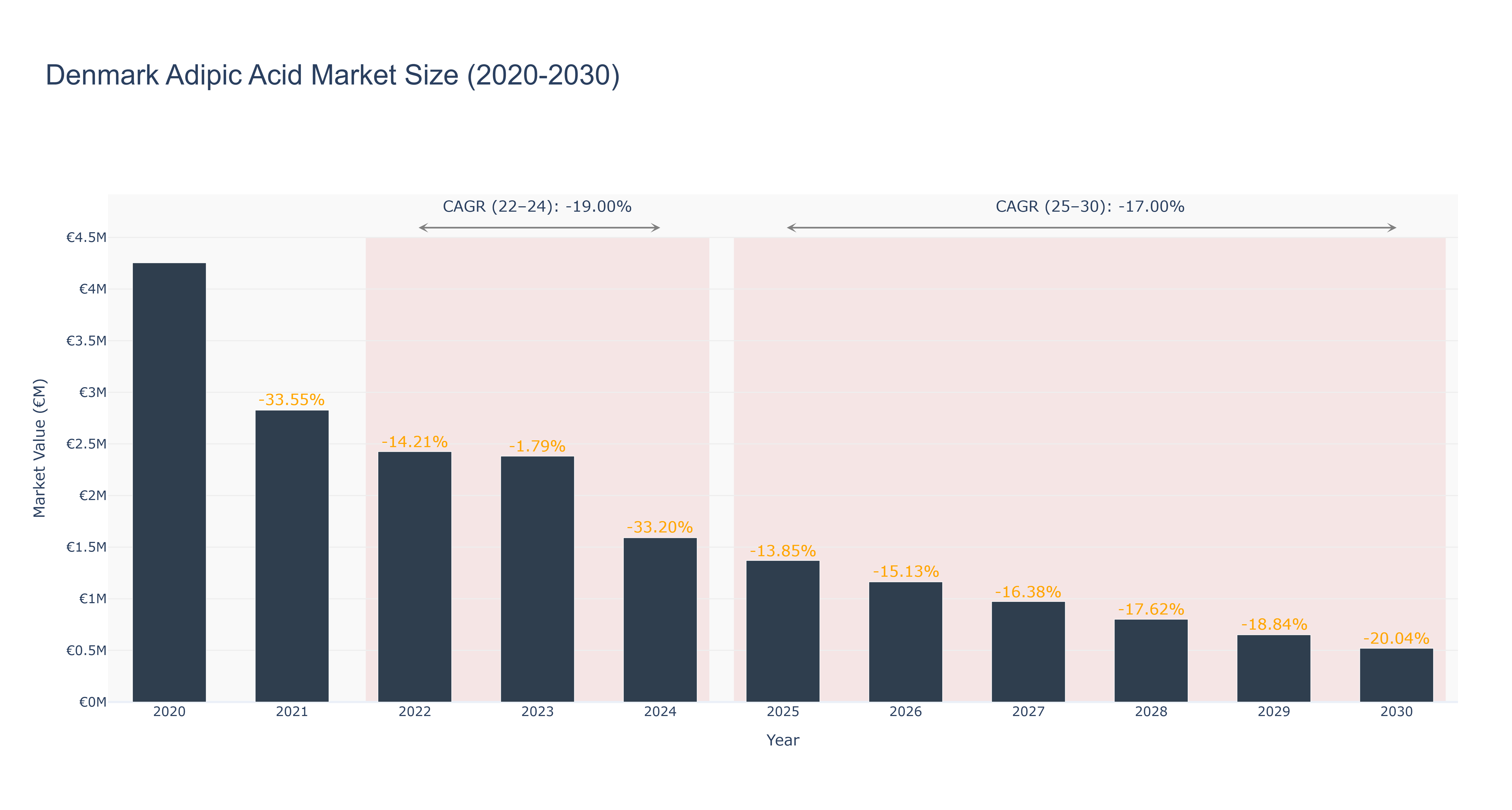
Denmark Adipic Acid Market has experienced a downward trend in market size since 2020, reaching its peak at €4.25 million in that year. The market size declined steadily over the years, with the actual market size dropping to €1.59 million in 2024. The forecasted market size is expected to continue decreasing from €1.37 million in 2025 to €0.52 million in 2030, with a CAGR of -17.00% from 2025 to 2030. The market's decline can be attributed to factors such as changing consumer preferences, increased competition, and regulatory challenges. Looking ahead, Denmark is focusing on sustainability initiatives in the chemical industry, with plans to invest in green technologies and circular economy practices to revitalize the adipic acid market. Industry drivers for the Denmark Adipic Acid Market include the growing demand for eco-friendly products, stringent environmental regulations, and the shift towards sustainable manufacturing processes. These factors are expected to drive innovation and investment in green chemistry solutions, positioning Denmark as a leader in sustainable chemical production.
Denmark Adipic Acid Market: Production & Trade Performance (2019-2025)
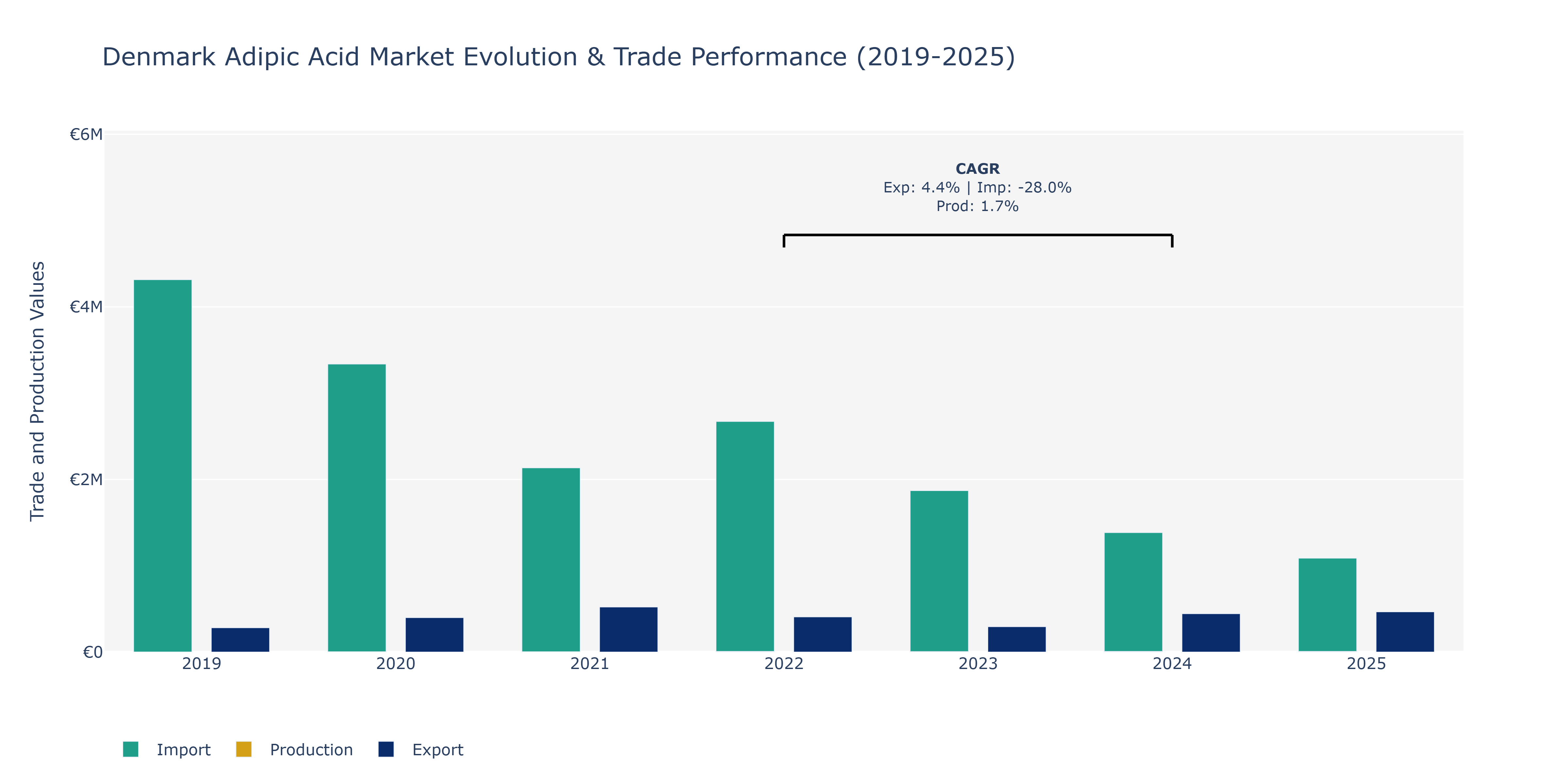
In the Denmark Adipic Acid Market, from 2019 to 2025, we observe varying trends in Exports, Imports, and Production. Exports saw a notable rise from €280.71 thousand in 2019 to €521.68 thousand in 2021, indicating a strong upward trajectory, followed by a slight decline in 2022 and 2023, before picking up again in 2024 and 2025. Imports, on the other hand, started at a high of €4.32 million in 2019, gradually decreasing annually to €1.39 million in 2024, showcasing a steady decline. In contrast, Production exhibited consistent growth from €670 thousand in 2019 to €7.59 million in 2025, with a significant peak in 2024. The market's export fluctuations could be influenced by global demand patterns, while the decline in imports might be attributed to local production capacity enhancements leading to reduced reliance on imports, thus impacting market dynamics.
Key Highlights of the Report:
- Denmark Adipic acid Market Outlook
- Market Size of Denmark Adipic acid Market, 2025
- Forecast of Denmark Adipic acid Market, 2032
- Historical Data and Forecast of Denmark Adipic acid Revenues & Volume for the Period 2022 - 2032F
- Denmark Adipic acid Market Trend Evolution
- Denmark Adipic acid Market Drivers and Challenges
- Denmark Adipic acid Price Trends
- Denmark Adipic acid Porter`s Five Forces
- Denmark Adipic acid Industry Life Cycle
- Historical Data and Forecast of Denmark Adipic acid Market Revenues & Volume By Application for the Period 2022 - 2032F
- Historical Data and Forecast of Denmark Adipic acid Market Revenues & Volume By Nylon 6,6 Fiber for the Period 2022 - 2032F
- Historical Data and Forecast of Denmark Adipic acid Market Revenues & Volume By Nylon 6,6 Resin for the Period 2022 - 2032F
- Historical Data and Forecast of Denmark Adipic acid Market Revenues & Volume By Polyurethane for the Period 2022 - 2032F
- Historical Data and Forecast of Denmark Adipic acid Market Revenues & Volume By Adipate Esters for the Period 2022 - 2032F
- Historical Data and Forecast of Denmark Adipic acid Market Revenues & Volume By Others for the Period 2022 - 2032F
- Historical Data and Forecast of Denmark Adipic acid Market Revenues & Volume By Raw Material for the Period 2022 - 2032F
- Historical Data and Forecast of Denmark Adipic acid Market Revenues & Volume By Cyclohexanol for the Period 2022 - 2032F
- Historical Data and Forecast of Denmark Adipic acid Market Revenues & Volume By Cyclohexanone for the Period 2022 - 2032F
- Denmark Adipic acid Import Export Trade Statistics
- Market Opportunity Assessment By Application
- Market Opportunity Assessment By Raw Material
- Denmark Adipic acid Top Companies Market Share
- Denmark Adipic acid Competitive Benchmarking By Technical and Operational Parameters
- Denmark Adipic acid Company Profiles
- Denmark Adipic acid Key Strategic Recommendations






































